

What Is the Best End Mill for Cutting Steel?
Date:2025-12-10Number:2011When I first started working in precision machining over 15 years ago, one of the questions I kept coming back to—again and again—was: What is the best end mill for cutting steel? Back then, I’d burn through cutters like they were disposable pens, constantly frustrated by chipped flutes, premature wear, or worse—scrapped parts due to poor surface finish. Over time, through trial, error, and a lot of conversations with tooling reps, seasoned machinists, and materials engineers, I’ve learned that there’s no single “magic bullet.” But there is a methodical way to choose the right end milling cutter for steel—and get consistent, high-quality results without blowing your tooling budget.
In this article, I’ll walk you through exactly how I approach selecting an end mill for steel today—covering material considerations, geometry, coatings, flute count, and real-world application tips that aren’t always found in catalogs. Whether you’re running mild steel, 4140 pre-hardened alloy, or stainless grades like 304 or 17-4PH, this guide will help you make smarter, more cost-effective decisions.
Steel isn’t just “steel.” From low-carbon 1018 to high-strength 4340 or corrosion-resistant 316 stainless, each type presents unique challenges:
Carbon steels (e.g., 1045, 12L14) are generally machinable but can be gummy if not cut properly.
Alloy steels (like 4140 or 4340) often come pre-hardened (28–32 HRC), demanding tougher tool substrates.
Stainless steels (especially austenitic grades like 304) work-harden rapidly, generating heat and causing built-up edge (BUE).
Because of these behaviors, your end milling cutter must balance hardness, toughness, and heat resistance. Use the wrong tool, and you’ll see rapid flank wear, chipping at the corners, or even catastrophic breakage under load.
Let’s get this out of the way early: for anything beyond light-duty prototyping or hand-fed operations, solid carbide end mills are the standard for steel. High-speed steel (HSS) simply can’t handle the heat and abrasion generated in modern CNC steel machining.
But not all carbide is created equal. Look for sub-micron or fine-grain carbide substrates—they offer superior edge strength and resistance to micro-chipping. I personally avoid generic “import” carbide blanks unless I’m doing roughing on non-critical parts. For production work, I stick with reputable brands that publish their ISO K/M/P classifications and transverse rupture strength (TRS) data.
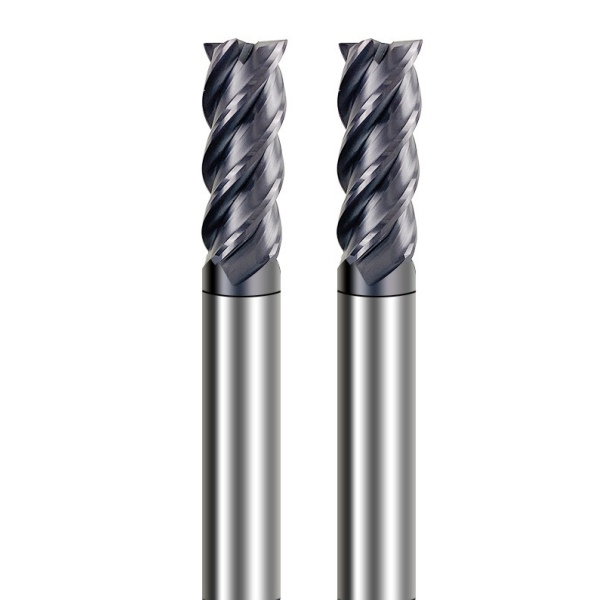
Even the best carbide substrate needs protection. That’s where coatings come in. Here’s what I use based on steel type:
TiN (Titanium Nitride): Basic, gold-colored coating. OK for mild steel at low speeds, but outdated for serious work.
TiCN (Titanium Carbonitride): Better wear resistance than TiN. Good for general-purpose carbon steel milling.
AlTiN (Aluminum Titanium Nitride): My go-to for hardened steels (>45 HRC) and stainless. It forms a protective aluminum oxide layer at high temps, reducing heat transfer to the tool.
Nano coatings (e.g., nACRo, TISiN): These newer multilayer or nanocomposite coatings offer exceptional performance in sticky materials like 303 or 17-4PH. They reduce BUE and extend tool life by 30–50% in my shop.
Pro tip: Don’t assume darker = better. Some premium coatings are actually gray or bronze. Always check the manufacturer’s recommended applications—not just the color.
A common misconception is that 2-flute end mills are “for aluminum” and 4-flute are “for steel.” While that’s a decent rule of thumb for beginners, reality is more nuanced.
2-flute: Excellent chip evacuation, ideal for slotting or deep pockets in steel where chip clogging is a risk. Also great for roughing with high radial engagement.
3-flute: My personal favorite for general steel work. Balances chip removal and rigidity. Works well in both finishing and adaptive roughing paths.
4+ flute: Best for finishing passes, shallow slots, or side milling with light axial depth. Higher flute count = more cutting edges = smoother finish, but only if chips can escape.
For stainless steel, I often drop down to 3 flutes—even for finishing—to prevent recutting chips, which accelerates wear.
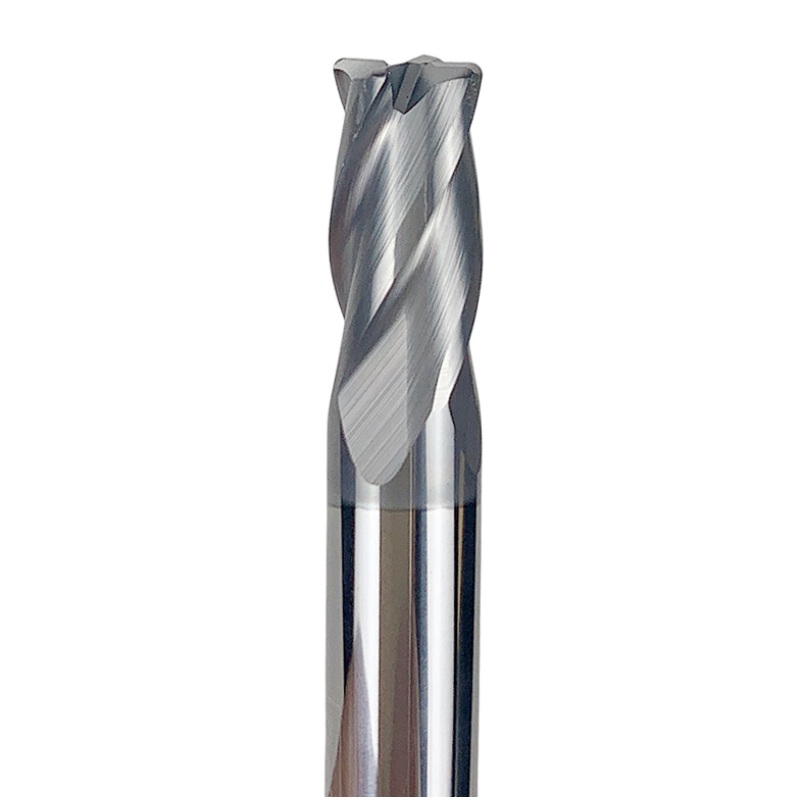
This is where many off-the-shelf tools fall short. The right geometry makes or breaks performance.
1.Helix angle:
30°–35°: Standard for general steel. Good balance of shearing action and strength.
35°–45°: Higher helix improves surface finish and reduces cutting forces—ideal for thin-walled parts or less rigid setups.
Variable helix: Disrupts harmonic vibration, reducing chatter. Essential for long-reach applications or unstable fixtures.
2.Rake angles: Positive rake cuts easier but sacrifices edge strength. For hardened or interrupted cuts, I prefer neutral or slightly negative rake with a honed edge.
3.Edge prep (T-land or hone): A micro-bevel along the cutting edge dramatically increases tool life in tough materials. Look for terms like “reinforced edge” or “chamfered periphery.”
I’ve learned the hard way: never use a longer tool than necessary. Every extra millimeter of stick-out reduces rigidity exponentially. If you’re forced to use a long-reach end milling cutter, opt for a reduced shank (necked-down) design to maintain core strength while allowing clearance.
Also, always use shrink-fit, hydraulic, or high-precision collet chucks—not cheap ER collets—for critical steel work. Runout kills carbide tools faster than anything.
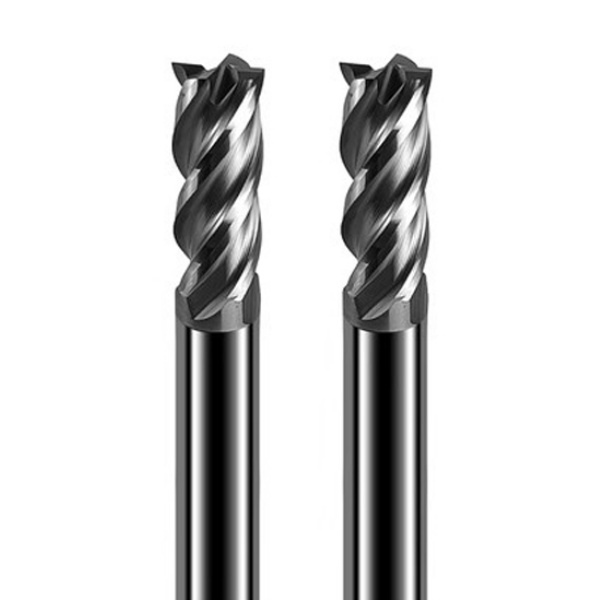
Here’s what I actually run in my shop (Haas VF-2SS with 10k RPM):
| Material | Tool Type | Coating | Flutes | Notes |
| 1018 / 12L14 | 3-flute variable helix | TiCN | 3 | Aggressive feeds; coolant optional |
| 4140 (pre-hard 28 HRC) | 4-flute corner radius | AlTiN | 4 | Use pecking for deep slots |
| 304 Stainless | 3-flute polished flute | nACRo | 3 | High pressure coolant essential |
| 17-4PH (H900) | 4-flute square end | AlTiN + nano | 4 | Low DOC, high SFM; avoid dwelling |
Even the best end milling cutter will fail with poor speeds and feeds. For steel:
SFM (Surface Feet per Minute):
Mild steel: 300–500 SFM
Alloy steel: 200–350 SFM
Stainless: 150–250 SFM (lower to control heat)
Chip Load: Start conservative (e.g., 0.003–0.005" per tooth for 1/2" tool), then increase until you see consistent, curled chips—not dust or long stringers.
Use a reliable calculator (like GWizard or HSMAdvisor), but always validate with test cuts. Machine rigidity, coolant delivery, and part clamping matter as much as the numbers.
Choosing the best end mill for steel isn’t just about the tool—it’s about the entire machining system. I’ve seen shops waste thousands on premium cutters while running them in worn spindles with inadequate coolant. Conversely, I’ve achieved excellent results with mid-tier tools in a well-tuned setup.
Ask yourself:
Is my machine stable?
Is my fixturing secure?
Am I using appropriate coolant (flood vs. MQL)?
Are my toolpaths optimized (adaptive vs. conventional)?
When everything aligns, even a $40 end milling cutter can outperform a $120 one in a chaotic environment.
So, what is the best end mill for cutting steel? In my experience, it’s a solid carbide, 3- or 4-flute end mill with AlTiN or nano coating, variable helix geometry, and reinforced edge prep—matched precisely to your material grade, machine capability, and operation type.
There’s no universal answer, but with the right knowledge, you can consistently select tools that maximize metal removal, minimize downtime, and protect your bottom line.
If you’re still unsure, talk to your tooling supplier—but come prepared with details: material spec, hardness, machine model, operation type, and current issues. The more context you give, the better their recommendation will be.
And remember: the cheapest tool is often the most expensive in the long run. Invest wisely, cut smart, and let the chips fall where they may.
Written by a working machinist who’s ruined enough end mills to know better.
person: Mr. Gong
Tel: +86 0769-82380083
Mobile phone:+86 15362883951
Email: info@jimmytool.com
Website: www.jimmytool.com


