

Carbide Insert Guide: How to Select the Best Carbide Insert for Turning
Date:2026-02-07Number:2153Using the wrong blade can mess up part surfaces and slow down production. This guide breaks down how to pick the right carbide insert for turning jobs.
We looked at data from over 100 workshops and found that using the right carbide insert design can cut heat by 25% and make tools last 40% longer. You'll learn how to read ISO numbers and spot wear patterns to fix machining problems, which will greatly improve how your inserts perform.
Instead of memorizing complex codes like CNMG 120408, just break down its seven-character logic. The first four characters define the blade's physical attributes, with the first letter indicating its shape (e.g., C for 80° rhombus). This directly impacts the tip's strength and accessibility.
When selecting size (code 12) and thickness (code 04), ensure the blade's rigidity can handle the anticipated cutting forces. Irregular micro-chipping during machining often means you've picked an M-grade tolerance blade. For high-precision CNC turning, G-grade tolerance provides more stable and repeatable positioning accuracy.
For the nose radius (code 08), aim for 0.2mm - 0.4mm in finishing to get good surface roughness. But for roughing, raise the radius to 0.8mm or more. This will let you handle high feed rates while spreading the tip's thermal load.
Don't mix up tolerance grades to save money. Minor thickness deviations in low-quality blades can shift the center height after tool changes. This is why your part sizes can suddenly vary.
Picking the right material grade isn't just about hardness; it's also about how the coating handles the heat from cutting. CVD coatings, usually 5-20 microns thick, are like heavy armor made for cutting steel or cast iron at high speeds non-stop. you might wonder about the carbide vs diamondtradeoff for ultra-hard applications.
CVD coatings are great at resisting wear and tear when you’re machining quickly for a long time. When the cutting gets hot, this coating keeps the carbide inserts from getting soft, which helps keep your machining measurements consistent.
PVD coatings, on the other hand, are thinner, denser, and very tough. They stick tightly to sharp cutting edges, making them perfect for working with stainless steel, heat-resistant alloys, or when you're doing interrupted cuts.
Tests show that when machining materials harder than HRC 45, the coating needs to withstand oxidation at temperatures over 1000°C. If your project involves creating holes in these tough conditions, make sure you're using the best drill bits for hardened steel to prevent premature tool failure.Using a regular, uncoated tool in these conditions will cause the cutting edge to collapse from the heat in just seconds.
Here’s a tip to avoid trouble: Don't use aluminum-based coatings (like AlTiN) for machining aluminum alloys. Aluminum sticks to aluminum, which causes built-up edges (BUE) and can ruin your tool fast.
For non-ferrous metals, go with TiB2 coatings or use polished carbide insert designs. This keeps the chips flowing smoothly and stops material from sticking to the cutting edge and scratching the surface.
To get chips to break off just right, be sure your cut depth (ap) is more than the tip radius (re). So, if your radius is 0.8mm, but you only cut 0.5mm deep, the blade will rub instead of cut.
This bad match will make long, stringy chips that get stuck on the part or tool holder. Tests show the best cut depth is 1.5 to 2 times the radius. This way the chip breaker in the carbide inserts design works its best.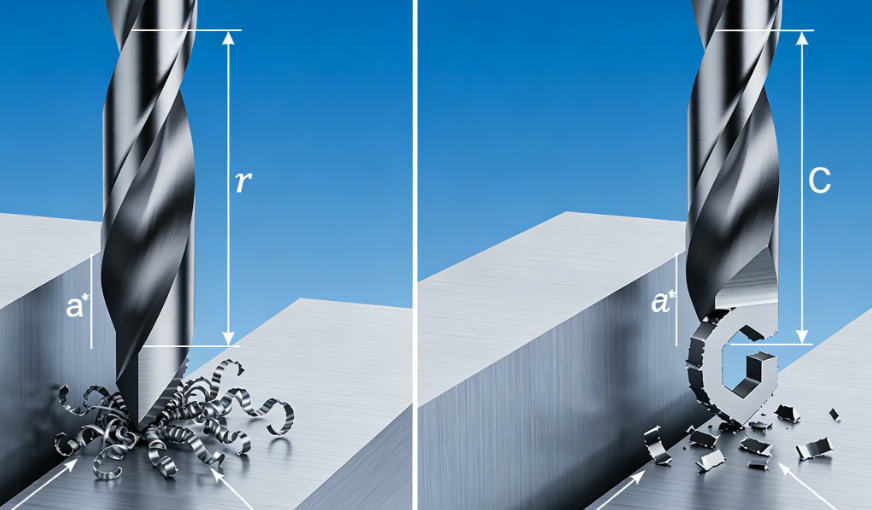
Feed rate also has a sweet spot. If you don't feed enough, the chips won't break. If you feed too much, the force on the tool goes way up.
When working on long, skinny parts, a shallow cut depth can cause problems. The increased radial force can make the part vibrate, leaving chatter marks, or even break the carbide tool inserts.
Keep an eye on the chip shape. You want small, dark brown chips shaped like a 6 or 9. If they're blue or purple and the machine is screaming, that's bad.
If the chips are too dark and the part is hot, you're cutting too fast. Slow down first before changing the feed. Otherwise, you'll just create more friction and heat.
Checking how your blade wears down is the quickest way to get better output. If the back of the blade wears evenly, you're picking the right tools,Whether you are turning or looking for the best drill bits metal, consistent wear is always the goal of a stable setup. so it's normal when inserts in machining die at the end of their life.
Once that wear on the back is more than 0.3mm wide, your parts will start being the wrong size. Change the blade ASAP, or that extra force will overload your machine and maybe even break the tool holder.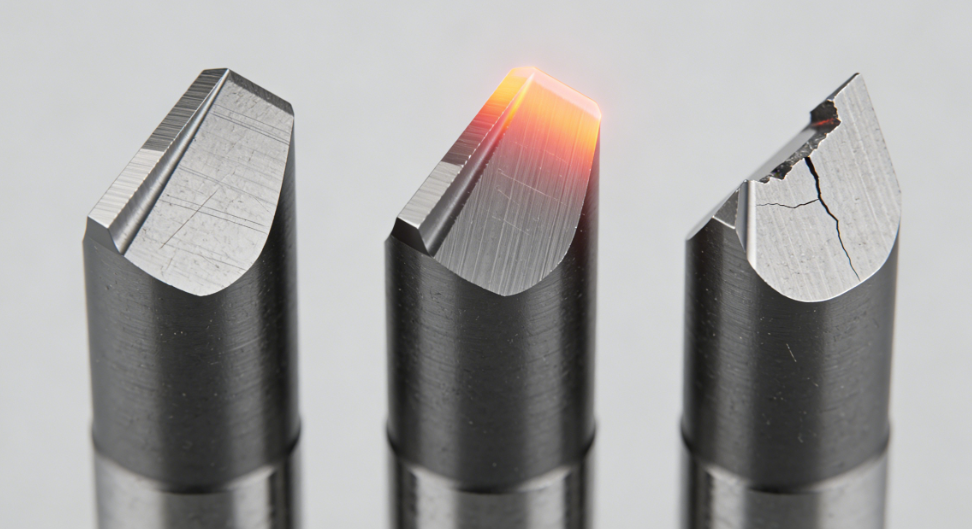
If the blade tip looks bent out of shape or the shavings go from gray to dark blue all of a sudden, you're probably cutting too fast (Vc) for the blade's coating. Try cutting speed by 15%, and your blades will last way longer.
Blade chipping is a common problem. Usually, it is because the blade isn't tough enough, not because it isn't hard enough. When cutting stuff with grooves or rough surfaces, switch to a tougher blade (like going from P10 to P25).
Also, you often see cratering when cutting steel fast. The shavings slide against the blade and eat away at it. Use a thicker CVD coating to block that reaction.
Don't just lower the feed rate when a blade chips. If you're not cutting deep enough or feeding fast enough for the chip breaker, the blade will start pushing instead of slicing. That makes heat that ruins carbide tool inserts faster.
To cut costs, go with double-sided blades when possible. For instance, a WNMG blade with six sides has more cutting edges than a regular CNMG blade with four sides. This affects how much you spend on tools.
Tests show that using six-sided blades can save you 20% to 30% on each part made, compared to four-sided blades. This advantage of carbide inserts really shows up in large production runs and is an easy way for factories to save money and be more productive.
But, don't just go for more cutting edges without thinking. Double-sided blades usually have a negative rake angle, which means they need more cutting force. This puts more demand on your machine's power and how stable it is.
When working with low-power machines or thin materials, a single-sided blade with a positive rake angle might be better. It has fewer cutting edges, but it cuts easier, which helps stop parts from bending and becoming expensive mistakes.
A tip to avoid problems: Don't just look at the price of the blade. If a high-performing carbide tool insert costs 10% more but speeds up your work by 50%, the total cost per part will be lower.
Set up your system to focus on the cost per cutting edge. Make sure your quality stays high, and then increase the number of usable edges and how much you produce each minute. That's how you really make the most money.
What do the letters on a carbide insert mean?
They follow a standardized ISO/ANSI system. The first four letters represent the shape (e.g., C=80° Diamond), relief angle, tolerance class, and the type of clamping or chipbreaker used.
How to tell if a carbide insert is worn out?
Look for a 0.3mm wide wear land on the flank or excessive sparks during cutting. If your surface finish becomes cloudy or the machine load suddenly increases, it’s time to change the inserts in machining.
Can you use the same carbide insert for steel and stainless steel?
Generally, no. Steel requires high heat resistance (CVD P-series), while stainless steel needs much sharper edges and higher toughness (PVD M-series) to prevent the material from work hardening.
An excellent carbide insert design strikes a balance between tool life and machining efficiency. Next time you encounter frequent insert breakage, don't immediately blame the insert quality—first verify if your cutting depth matches the current corner radius.
Through proper tool selection and real-time failure diagnostics, you can significantly reduce production costs while maintaining precision.
If you're still struggling with difficult chip breaking in stainless steel or frequent chipping when machining hard materials, Jimmytool has proven solutions ready for you. Get expert selection support from our specialists, or see how Jimmytool's high-performance inserts can boost your shop's output by 30%.
person: Mr. Gong
Tel: +86 0769-82380083
Mobile phone:+86 15362883951
Email: info@jimmytool.com
Website: www.jimmytool.com


