

Bull Nose vs Flat End Mill: Differences, Applications, and How to Choose the Right Tool
Date:2026-03-02Number:1875
So what is the difference between a bull nose and a flat end mill?
A bull nose end mill features a corner radius that strengthens the cutting edge and improves surface transitions, while a flat end mill (also known as a square end mill) has a sharp 90° edge designed for precise flat surfaces and sharp internal corners. The choice depends on material hardness, geometry requirements, and desired surface finish.
This guide explains the differences, advantages, limitations, CNC performance factors, and selection strategies — helping you choose the right tool for your machining project.
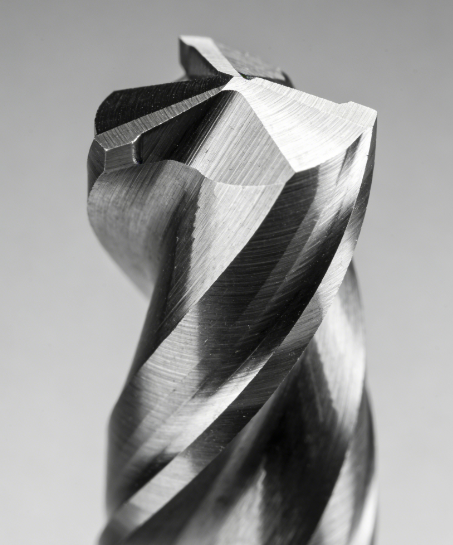
A bull nose end mill (also called a corner radius end mill) is a milling cutter with a rounded corner between the side cutting edge and the bottom cutting edge.
 Geometry and Design Characteristics
90° overall profile
Rounded corner radius (e.g., R0.5, R1, R2 mm)
Distributes cutting load across the radius
Reduces stress concentration at tool edge
Unlike a ball nose end mill, it does not have a full hemispherical tip. The radius only reinforces the corner.
Improved edge strength – The radius prevents micro-chipping.
Longer tool life – Especially in hardened steels (HRC 45+).
Smoother surface transitions – Ideal for blended surfaces.
Better load distribution – Lower peak cutting forces.
Mold and die machining
3D contour machining
Fillet creation
Aerospace structural components
Hardened tool steel finishing
A flat end mill (also called a square end mill) features a sharp 90-degree cutting edge and a completely flat bottom.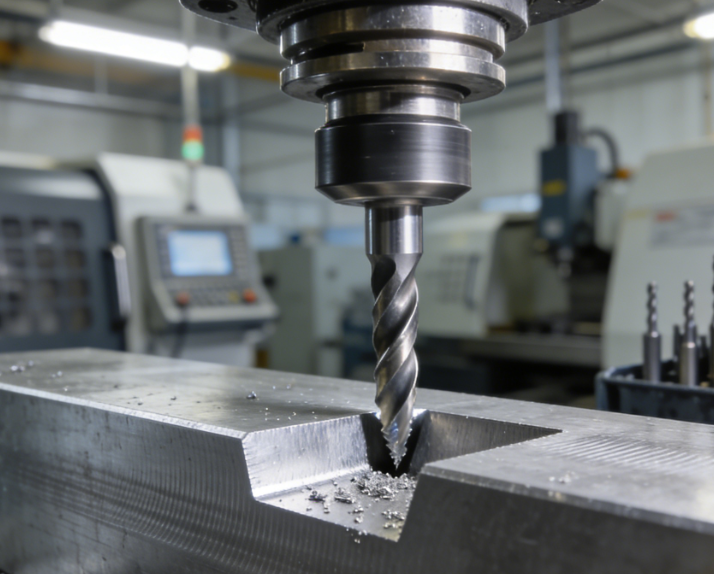
Sharp corner intersection
Flat bottom cutting edge
Designed for precise internal geometry
Sharp internal corners
Flat-bottom pockets
Efficient slotting
Higher material removal rate (MRR) in many operations
Slot milling
Pocket milling
Step milling
Facing operations
General-purpose CNC machining
| Feature | Bull Nose End Mill | Flat End Mill |
|---|---|---|
| Edge Shape | Rounded corner radius | Sharp 90° edge |
| Corner Strength | High | Moderate |
| Surface Transition | Smooth blending | Sharp transitions |
| Sharp Internal Corners | No | Yes |
| Tool Life in Hard Steel | Longer | Shorter |
| Best For | Contours & molds | Slots & flat pockets |
| Stress Distribution | Even | Concentrated at corner |
Core Difference:
Bull nose tools prioritize edge durability and smooth geometry transitions. Flat end mills prioritize precision and sharp geometry.
Choosing the right cutter depends on geometry, material, and production goals.
Machining hardened materials
Producing curved or blended surfaces
Improving tool life
Reducing edge chipping
Finishing mold cavities
Machining sharp internal corners
Creating flat-bottom pockets
Slotting operations
Roughing soft-to-medium materials
Requiring dimensional accuracy at corners
Bull nose cutters distribute forces along the radius, lowering stress concentration. Flat end mills concentrate force at the corner, increasing edge wear risk.
Flat End Mill:
Corner chipping
Edge breakdown
Higher wear in hardened steel
Bull Nose End Mill:
Even flank wear
Reduced micro-fracture
More predictable tool life
Bull nose tools reduce cusp height in contour machining, producing smoother blends.
Flat end mills produce crisp edges but may leave visible tool marks in 3D contours.
Flat end mills often allow higher feed rates in slotting.
Bull nose tools may require moderate feed adjustments depending on radius size.
A square end mill is simply another name for a flat end mill.
There is no structural difference — both refer to a cutter with a sharp 90-degree corner.
This clarification is important for SEO because users often search:
bull nose vs square end mill
square end mill vs flat end mill
Covering both terms increases keyword reach.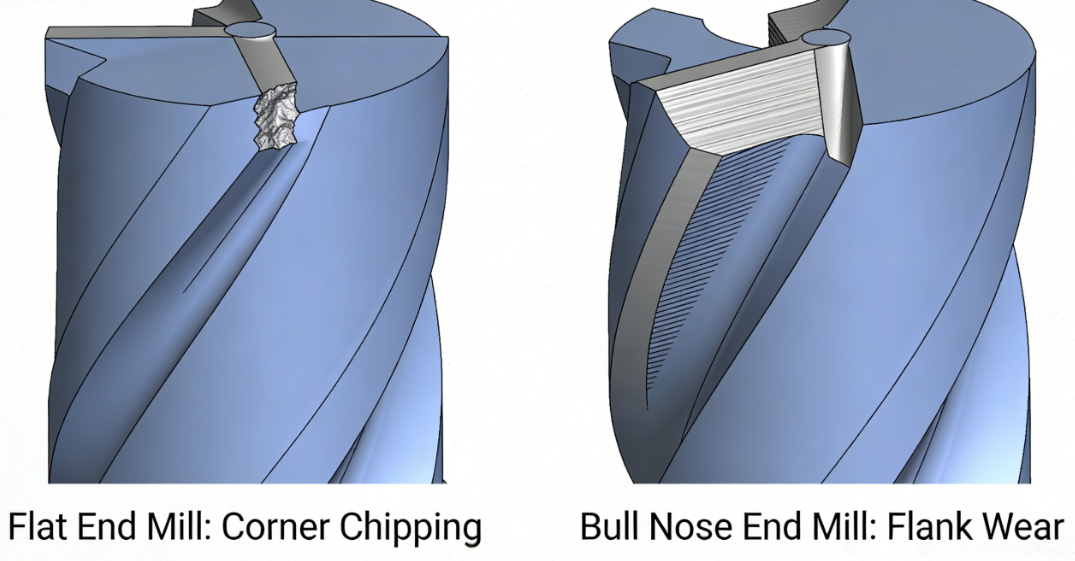
Pros
Stronger edge
Longer tool life
Better for hardened steel
Smooth contour finish
Cons
Cannot create sharp internal corners
Slightly higher tool cost
Pros
Sharp geometry
Excellent slotting
Versatile general use
Cons
Prone to corner wear
Shorter life in hard materials
The bull nose has a rounded corner radius for strength and smooth transitions, while the flat end mill has a sharp corner for precise edges and flat bottoms.
No. The radius prevents sharp internal corner creation.
In hardened materials, bull nose end mills generally last longer due to reduced stress concentration.
Yes, especially in tool steel and mold applications.
You can, but it may leave visible step marks compared to a bull nose or ball nose cutter.
There is no universal “better” tool. The correct choice depends on application:
For precision slotting and sharp geometry → Flat End Mill
For molds, hardened steel, and contour work → Bull Nose End Mill
For improved durability → Bull Nose
For cost-effective general machining → Flat End Mill
Understanding geometry-driven performance differences ensures better machining efficiency, surface finish, and tool longevity.
person: Mr. Gong
Tel: +86 0769-82380083
Mobile phone:+86 15362883951
Email: info@jimmytool.com
Website: www.jimmytool.com


