

Carbide Taps for Hardened Steel — Which One Won't Break on the First Hole?
Date:2026-03-25Number:1794
Carbide taps for hardened steel snap for one reason: wrong tool, wrong geometry, wrong material. This guide shows you exactly which tap type survives 45 HRC and above, which coatings actually extend tool life, and how to match your flute design to your specific job. Shops that get this decision right cut tap breakage by 40% and eliminate the nightmare of extracting a broken tool from a finished workpiece.
By the end, you'll know precisely which carbide tap to run — and which combinations to avoid before they cost you a part.
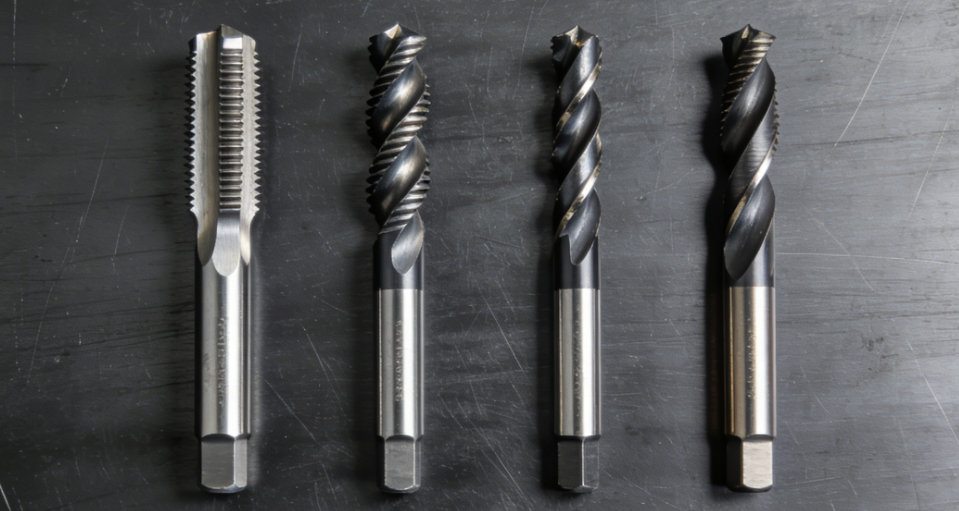
Not all carbide taps are built for the same hardness range. Picking the wrong one doesn't just shorten tool life — it breaks the tap inside your hole.
| Tap Type | Max HRC | Best Application | Breakage Risk |
|---|---|---|---|
| Solid Carbide Spiral Flute | 65 HRC | Blind holes, interrupted cuts | Low (with correct RPM) |
| Solid Carbide Straight Flute | 58 HRC | Through-holes, light chip loads | Low-Medium |
| Carbide Form Tap | 60 HRC | Ductile hard alloys, blind holes | Medium |
| TiAlN-Coated HSS | 45 HRC | Lower hardness, budget production | High above 45 HRC |
| Carbide-Tipped HSS | 50 HRC | Through-holes, mid-range hardness | Medium |
High-speed steel loses its edge rapidly once material hardness crosses 45 HRC. The thermal load from tapping hardened steel exceeds what HSS substrates can handle, even with premium coatings.
Solid carbide maintains its hardness up to 900°C, which is why it survives the cutting temperatures generated in tool steel, die steel, and hardened stainless. The material cost is higher upfront, but the per-hole cost drops significantly once you stop replacing broken taps every shift.
Not sure whether solid carbide is the right call for your specific material? Browse our carbide tap product range → and get matched to the right spec for your HRC range.
35–45 HRC: TiAlN-coated HSS or carbide-tipped taps work reliably here. Keep speeds conservative — 15–25 SFM for hand-feed operations.
45–55 HRC: Solid carbide spiral flute with AlCrN or TiAlN coating. This is the crossover zone where HSS starts failing unpredictably. Don't push it.
55–65 HRC: Solid carbide only, with AlCrN coating and flood coolant or paste lubricant. Thread milling becomes a serious alternative at this range — especially for blind holes in production environments.
Geometry isn't a preference at this hardness level. It's an engineering decision with measurable consequences.
Spiral flute taps (40–45° helix) pull chips up and out of the hole as they cut. In blind holes — which are most hardened steel applications — chip packing is the primary cause of tap fracture, not the cutting load itself.
Straight flute taps work in through-holes where chips can fall clear. Run them 20–30% slower than spiral equivalents to reduce chip buildup pressure at the tip.
Form taps don't produce chips at all — they displace material rather than cut it. In hardened steels above 50 HRC with some residual ductility (certain H13 and P20 grades), form taps outlast cut taps significantly because they eliminate the chip evacuation problem entirely.
In fully hardened, brittle tool steels, form taps can fracture the thread wall. When in doubt, check material elongation spec alongside hardness. For a detailed breakdown of this decision, see our Cutting Tap vs. Forming Tap guide.
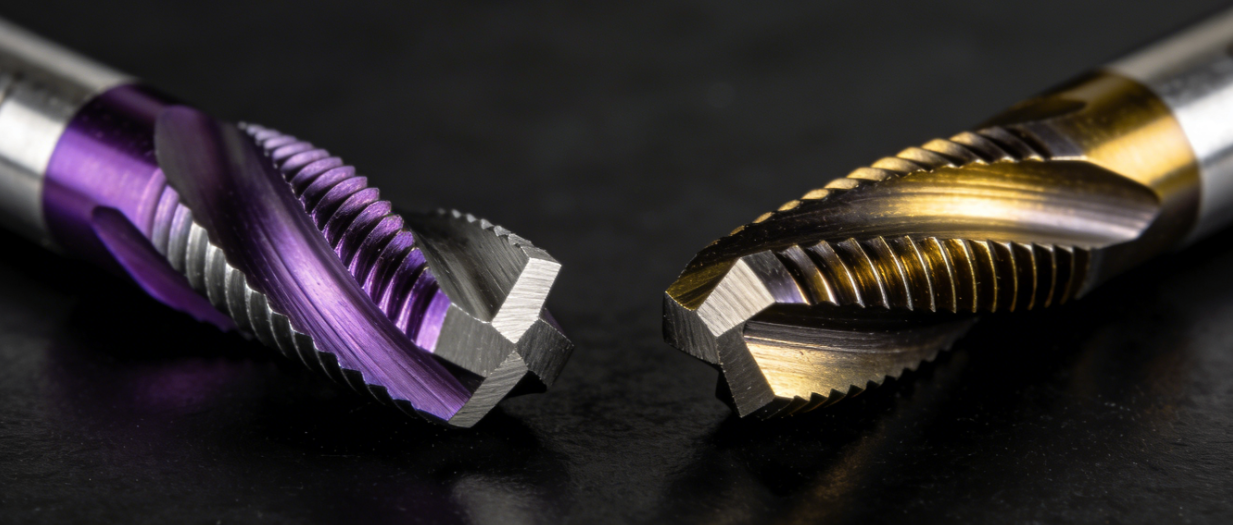
The coating determines how much heat the tap can shed before micro-chipping begins at the cutting edge.
TiAlN (Titanium Aluminum Nitride): Oxidation resistance up to 800°C. The go-to coating for dry tapping and hardened steel up to 55 HRC. It forms an aluminum oxide layer at high temperatures that acts as a thermal barrier.
AlCrN (Aluminum Chromium Nitride): Better than TiAlN above 55 HRC. Handles higher thermal load and performs well in interrupted cuts — a common scenario in die steel tapping. If you're running hardened D2 or H13, AlCrN is the specification to request.
TiCN (Titanium Carbonitride): Higher surface hardness than TiAlN but lower heat resistance. Best for harder, abrasive materials at moderate temperatures — not ideal for high-speed hardened steel applications.
AlCrN and TiAlN coatings are designed for dry or near-dry cutting because they self-insulate. Adding flood coolant to a hot tap in hardened steel can cause thermal shock microcracking on the cutting edge.
Paste lubricants or cutting oils applied before entry are the better approach above 52 HRC. They reduce friction without the thermal cycling risk of flood coolant. For a deeper look at this tradeoff, our carbide coolant guide covers the decision by material type.
This is where most shops make the wrong call, usually because they're comparing unit price instead of cost per hole.
Below 45 HRC, production runs under 300 parts: TiAlN-coated HSS taps at $12–$25/unit are cost-effective. Solid carbide is overkill — the per-hole cost advantage doesn't materialize until you're running more parts or harder material.
45–55 HRC, production runs 300–1,000 parts: Solid carbide spiral flute at $40–$75/tap. Tap life typically runs 3–5x longer than coated HSS in this range. Over a production run, you're usually spending less despite the higher unit cost.
Above 55 HRC, any volume: Solid carbide with AlCrN is the only economical option. At this hardness, thread milling should also enter your cost calculation — especially for large thread diameters or blind holes with tight tolerances. Thread mills avoid tap breakage entirely and are re-sharpenable, which changes the long-term cost math.
If your material sits below 40 HRC and you're running through-holes with good chip clearance, a quality cobalt tap or TiN-coated HSS will outperform carbide on a per-hole basis because of the lower unit replacement cost. For a side-by-side comparison of substrate options, see Cobalt vs. Carbide Drill Bits — the same substrate logic applies to taps.
Carbide taps also become harder to justify when thread diameter exceeds 3/4" in hardened steel. At that point, thread milling gives you better control, eliminates catastrophic breakage risk, and allows the same tool to cut multiple thread pitches.
Ready to spec the right tap for your hardened steel job? Our team works through material hardness, thread spec, and production volume to match you to the right tool — before you break anything. Get a free tool recommendation →
Getting the tap right is half the job. Running it wrong still breaks a $60 tool.
| Material Hardness | Tap Diameter | Recommended SFM | Feed Rate (IPR) |
|---|---|---|---|
| 40–45 HRC | M6–M10 | 20–30 SFM | 1x pitch |
| 45–52 HRC | M6–M10 | 12–20 SFM | 1x pitch |
| 52–60 HRC | M6–M10 | 8–15 SFM | 1x pitch |
| 60–65 HRC | M6–M10 | 5–10 SFM | 1x pitch |
Always use rigid tapping on CNC — floating tap holders introduce axial float that causes pitch error and edge chipping in hard materials. Synchronize spindle speed and feed exactly to the thread pitch.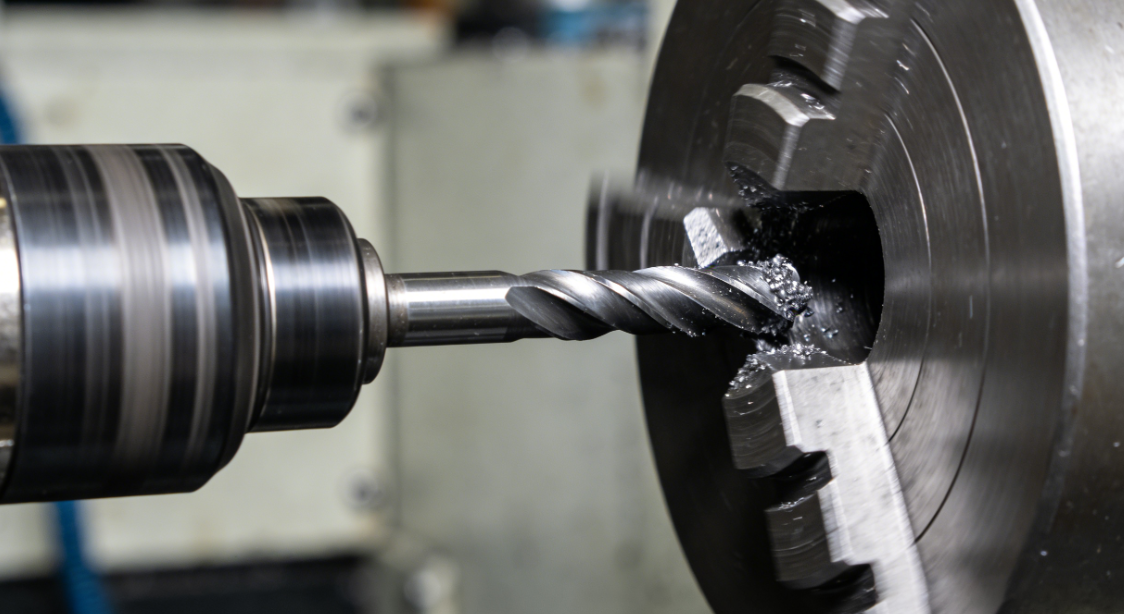
Drill the pilot hole 0.003"–0.005" larger than the standard tap drill size for hardened steel. The tighter engagement that works in soft materials generates enough torque in hard steel to snap a carbide tap at entry.
Chamfer the hole entry at 90–120° before tapping. A sharp hole edge acts as a stress concentrator on the first thread — that's where most entry fractures initiate. Deburring takes 10 seconds; extracting a broken tap takes an hour.
Tap snaps at entry: Pilot hole is undersized, or spindle isn't synchronized. Check your tap drill diameter and switch to rigid tapping mode.
Tap snaps mid-depth in blind hole: Chip packing. Switch from straight flute to spiral flute, reduce depth-per-pass, or add a chip-clearing cycle every 3–4 threads.
Thread form is oversize or torn: Feed rate is too fast — the tap is not tracking the pitch correctly. Reduce SFM and verify feed synchronization.
Edge chipping after 20–30 holes: Thermal shock from flood coolant. Switch to paste lubricant applied before entry, not during the cut.
Consistent breakage in the same material: Coating mismatch for the hardness range. If you're using TiAlN above 55 HRC, upgrade to AlCrN. If AlCrN is already specified, thread milling may be the better process entirely.
For more on selecting the right carbide tool substrate for challenging materials, the Carbide Guide covers material grades, binder content, and how those factors translate to tool performance in hard applications.
Hardened steel tapping failures are almost always a specification problem, not an operator problem. The wrong geometry, the wrong coating, or the wrong pilot size will break a premium carbide tap just as reliably as running the wrong speed.
The decision tree is straightforward: identify your HRC range, select your tap type from the comparison table, match the coating to your heat management approach, and prep the hole correctly before entry. Every failure mode in the section above maps back to one of those four variables.
If your application sits above 55 HRC, or you're dealing with interrupted cuts, blind holes, and tight thread tolerances all at once — that's where a spec conversation saves you real money before you order tools. Tell us about your job and get a tap recommendation matched to your exact material and volume →
Related Reading:
person: Mr. Gong
Tel: +86 0769-82380083
Mobile phone:+86 15362883951
Email: info@jimmytool.com
Website: www.jimmytool.com


