

Does Carbide Need Coolant? Definitive Machinist's Guide
Date:2026-03-09Number:4344Carbide tools work best with either full flood coolant or no coolant at all. The danger zone is inconsistent or light mist cooling — when a hot carbide tool receives intermittent coolant, rapid thermal cycling causes microcracks and premature edge failure. If flood coolant isn't available, go dry with an air blast instead.
Carbide (tungsten carbide, WC-Co) is one of the hardest materials on the planet — about 10 times harder than high-speed steel. But being hard means you can break easily. Carbide is different from HSS because it can absorb heat and flex slightly. However, it can't handle sudden changes in temperature well. This is the main problem with the coolant.
Thermal shock is when something goes from one very hot or very cold temperature to another very hot or very cold temperature very quickly. When a carbide tool running at 700–900°F (370–480°C) is given a small amount of 70°F coolant every now and then, the surface gets smaller faster than the inside. The resulting tension in the material is greater than its breaking point, causing small cracks to form and spreading across the edge.
The key point to remember is that it's more important to keep the temperature consistent than to keep it low. A carbide tool running dry at a constant 800°F (428°C) will last longer than a tool that is repeatedly cooled and reheated between 200°F (93°C) and 800°F (428°C).
Pro Tip: Carbide's thermal conductivity is about 80 W/m·K vs. 25 W/m·K for HSS. It dissipates heat quickly through the body — which is both an asset (heat exits fast) and a vulnerability (surface-to-body temperature gradients are steep during shock events).

When flood coolant is applied correctly — high volume, consistent flow, directed at the cutting zone — it delivers four simultaneous benefits:
•Heat dissipation: Keeps cutting edge temperatures below 500°F even at aggressive feeds
•Lubrication: Reduces friction at the chip-tool interface, improving surface finish
•Chip evacuation: Flushes swarf away, preventing re-cutting and built-up edge (BUE)
•Workpiece stability: Prevents thermal expansion and distortion in tight-tolerance parts
Flood coolant is strongly recommended for: stainless steel, titanium, Inconel and other superalloys, deep pocketing (>3× diameter), drilling beyond 4×D, and any finishing pass requiring Ra <1.6 µm.
Typical flood coolant parameters: water-soluble emulsion at 5–8% concentration, pH 8.5–9.5, flow rate ≥10 GPM for milling, ≥3 GPM for turning.
Pro Tip: Check concentration weekly with a refractometer. Diluted coolant loses lubricity; over-concentrated coolant loses cooling efficiency and foams excessively.
Many machinists assume 'no coolant' means 'worse performance.' In practice, dry machining with a proper air blast often outperforms inconsistent mist cooling for carbide tooling.
Dry machining works well when:
•Cutting aluminum, brass, or cast iron at standard speeds
•Using coated carbide inserts (TiAlN, AlCrN) — coatings provide heat resistance up to 1,600°F
•Light finishing passes where chip load is low
•Machining ceramics or graphite (coolant causes chip packing)
•Shops lacking proper coolant filtration and maintenance systems
The air blast plays a crucial role: it removes chips without thermal shock, preventing re-cutting that is a primary cause of carbide tool failure in dry operations. Minimum air pressure: 80 PSI directed at the cutting zone.
Trade-offs of dry machining:
•Tool life typically 20–40% shorter than flood cooling in demanding materials
•Metal removal rates may need to be reduced 10–15% to maintain dimensional accuracy
•Not suitable for deep drilling without through-tool or high-pressure coolant

MQL delivers 10–50 mL/hour of vegetable-based or synthetic ester oil as a fine aerosol directly to the cutting zone. It uses 95% less fluid than flood cooling while providing targeted lubrication exactly where it's needed.
MQL is ideal for:
•Aluminum and non-ferrous metals at high SFM
•TiAlN or AlCrN coated carbide tools (coatings handle heat; MQL handles lubrication)
•Environmentally sensitive shops seeking to reduce coolant waste
•Screw machining and turning of medium-hardness steels
MQL limitations:
•Insufficient heat removal for austenitic stainless steels or titanium
•Not effective for deep-hole drilling beyond 5×D
•Requires clean compressed air supply — contaminated air causes coating damage
The right cooling strategy varies significantly by workpiece material. Here's a practical reference:
Material | Recommended Cooling | Key Reason | Avoid |
Aluminum (6061, 7075) | Flood or MQL | Prevents BUE; aids chip evacuation | Heavy mist (causes sticking) |
Mild Steel (1018, A36) | Flood or Dry+Air | Manages heat; prevents work hardening | Intermittent mist |
Stainless Steel (304, 316) | Full Flood (high pressure) | Prevents work hardening & warping | Dry or MQL alone |
Hardened Steel (>45 HRC) | Dry or MQL | Coated inserts handle heat better dry | Water-based flood (shock risk) |
Titanium (Ti-6Al-4V) | High-pressure flood | Very low thermal conductivity | Dry (catastrophic tool failure risk) |
Cast Iron | Dry + Air Blast | Coolant causes chip packing | Flood (creates abrasive sludge) |
Brass / Copper | Dry or Light MQL | Soft material, low heat generation | High-concentration emulsion |
Inconel / Superalloys | High-pressure through-tool | Extreme heat generation | Dry or low-pressure flood |
Modern carbide tooling rarely ships uncoated. The coating dramatically affects how the tool interacts with coolant and heat. Understanding your coating is key to selecting the right cooling strategy.
Coating | Max Temp | Best Cooling Strategy | Typical Applications |
Uncoated WC-Co | ~400°F (200°C) | Full flood required | Non-ferrous, wood, plastics |
TiN (Titanium Nitride) | ~1,100°F (600°C) | Flood preferred; dry OK on steel | General steel, cast iron |
TiAlN | ~1,400°F (760°C) | Dry + air blast or MQL | Hardened steel, dry high-speed milling |
AlTiN | ~1,650°F (900°C) | Dry preferred; MQL acceptable | High-speed machining, aerospace alloys |
AlCrN | ~1,800°F (980°C) | Dry or MQL | Super alloys, stainless at high SFM |
Diamond (CVD/PCD) | >2,000°F (1,100°C) | Dry or air blast | Graphite, ceramics, non-ferrous only |
Pro Tip: AlTiN and AlCrN coatings form an Al₂O₃ (aluminum oxide) layer at high temperatures — this ceramic layer acts as a thermal barrier, making these tools perform better dry than with inconsistent coolant.
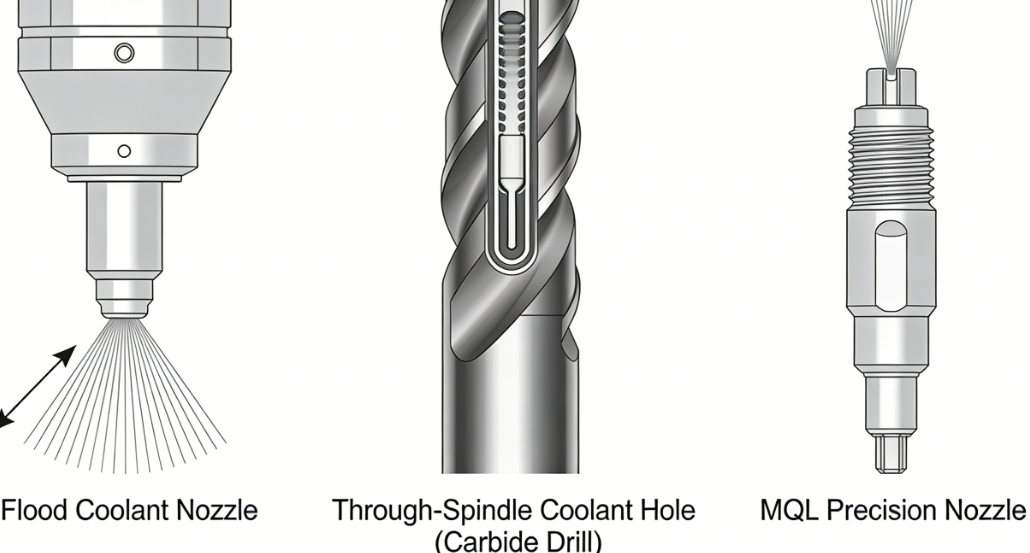
The most common system. Multiple nozzles direct coolant at the cutting zone from outside the spindle. Effective for most turning, milling, and face-mill operations. Limitations arise in deep pockets and small-diameter drilling where the coolant can't reach the cutting tip.
•System cost: $500–$3,000 for sump, pump, and nozzles
•Optimal flow: 10–20 GPM for milling; 5 GPM for turning
•Best for: general-purpose machining, large face mills, turning
Coolant is delivered through internal channels in the tool body directly to the cutting edge. This is the gold standard for deep drilling, long-reach end milling, and difficult-to-reach geometries.
•System pressure: 300–1,000 PSI (standard) up to 2,000 PSI (high-performance)
•Extends tool life up to 50% in deep-hole applications vs. external flood
•Essential for drilling beyond 6×D in stainless or titanium
•Requires TSC-capable spindle and through-coolant toolholders
Compressed air from 80–120 PSI clears chips without any thermal shock risk. The most carbide-friendly 'cooling' method for coated tools running dry. Not suitable for heat-sensitive workpieces or abrasive materials.
Emerging technology using liquid nitrogen or CO₂ delivered to the cutting zone. Cools to -300°F while evaporating completely, leaving zero residue. Particularly effective for titanium, CFRP composites, and medical-grade materials where coolant contamination is unacceptable.
•No disposal costs — CO₂/N₂ evaporate completely
•Dramatically extended tool life in titanium (3–5×)
•High infrastructure cost: $10,000–$30,000+ for system installation
A production shop running 1,000 SFM on 6061-T6 housings switched from water-based flood to MQL using a vegetable ester oil. Result: coolant costs dropped 42%, chip evacuation improved due to better lubricant penetration into spiral flutes, and tool life remained within 5% of flood performance. The key: 6061 aluminum is soft enough that heat generation at 1,000 SFM stays within TiAlN coating tolerance.
A job shop was experiencing warping of 0.003–0.005" TIR on stainless steel pump bodies when running dry. Root cause: austenitic stainless work-hardens rapidly, generating sustained heat that caused 0.004" thermal expansion. Solution: high-pressure flood at 500 PSI with 7% emulsion concentration. Warping dropped to <0.001" TIR, tool life increased 3×.
An automotive shop tested dry vs. flood coolant on gray cast iron brake components. Flood coolant created an abrasive slurry from iron particles mixing with emulsion — this slurry caused accelerated flank wear. Switching to dry machining with air blast reduced flank wear by 35% and eliminated coolant disposal costs for this operation entirely.
Recognizing early failure modes can save expensive tooling. Watch for these warning signs:
•Edge chipping (small, irregular fractures): Classic thermal shock signature — check coolant consistency
•Uniform flank wear faster than expected: Usually insufficient cooling or wrong coolant concentration
•Built-up edge (BUE): Material welding to cutting edge — increase coolant flow or switch to oil-based coolant
•Cratering on rake face: Heat concentration at the cutting zone — upgrade to flood or through-tool coolant
•Tool fracture (catastrophic failure): Severe thermal shock or excessive cutting parameters — ensure full flood or go dry
•Discoloration (blue/brown on tool): Tool running too hot — either improve cooling or reduce SFM/feed
Pro Tip: Photograph your worn tools before discarding them. The wear pattern tells a precise story about what went wrong — and helps you optimize coolant strategy for the next run.
WD-40 can serve as a light lubricant for occasional hand-held or low-speed drilling, but it is not suitable for CNC machining. It has poor heat capacity, evaporates rapidly under cutting temperatures, and leaves a film that can contaminate some workpieces. Use proper cutting oil or water-soluble emulsion for machine work.
Yes, for most drilling operations carbide drill bits benefit significantly from coolant — particularly for depths beyond 3×D. For deep drilling (5×D+), through-tool or high-pressure coolant is strongly recommended to prevent chip packing and catastrophic drill failure.
Yes — with coated end mills (TiAlN, AlCrN) in mild steel at controlled cutting parameters. Reduce SFM by 15–20% compared to flood conditions, ensure a strong air blast for chip evacuation, and monitor for BUE formation. In stainless steel or alloy steels, flood cooling is strongly preferred.
Poorly maintained coolant is often worse than no coolant — it promotes bacterial growth, loses lubricity, and can cause corrosion on machine components. Follow this weekly maintenance schedule:
•Monday: Check concentration with refractometer (target 5–8% for most emulsions)
•Wednesday: Test pH — should be 8.5–9.5; below 8.0 signals bacterial contamination
•Friday: Skim tramp oil from sump surface (excess tramp oil feeds bacteria and reduces cooling)
•Monthly: Add biocide or fungicide per manufacturer recommendation
•Every 3–6 months: Complete sump cleanout, biocide wash, fresh coolant charge
•Ongoing: Filter coolant at 25–50 microns to remove metal fines that cause accelerated tool wear
Get the Right Carbide Tool for Your Application
Now that you know exactly how to cool your carbide tooling, make sure you're running the right tool for the job.
JimmyTool manufactures precision solid carbide end mills, drill bits, and thread mills engineered for demanding CNC operations — whether you run flood coolant, dry, or MQL. Every tool ships with coating and application data to match your exact cooling setup.
person: Mr. Gong
Tel: +86 0769-82380083
Mobile phone:+86 15362883951
Email: info@jimmytool.com
Website: www.jimmytool.com


