

Chamfer Mill Speeds and Feeds: The Complete Parameter Guide
Date:2026-03-10Number:6532Most chamfer tool failures are caused by one thing: the speeds and feeds are too high, but the tools are not dull and the workholding is not bad. This guide gives you exact values for SFM, RPM, and chip load for steel, aluminum, titanium, cast iron, stainless, and high-temp alloys. It also has one surprising tip that will triple the life of your tools.
Chamfer milling looks simple — you're just knocking off an edge. The tool's cutting geometry, with its angle, puts on forces that standard end mills don't experience. What works perfectly on a square end mill will cause a chamfer mill to break in the same material. If you do this correctly, you'll get clean, burr-free bevels that will last for thousands of parts. If you make a mistake, you'll need to buy new tools every time you use them.
Before you change a setting, make sure you've locked in two numbers. SFM (Surface Feet per Minute) is how fast the cutting edge moves against the material. IPT, or Inches Per Tooth, is the amount of material that each flute removes per revolution. Everything else in this system is based on these two.
Machinists often get confused when they copy SFM values from a square end mill chart and apply them directly to a chamfer mill. A chamfer mill's cutting edge is angled at about 45°. Because of this, the effective cutting diameter changes based on how deep the cut is. This can cause your calculated RPM to be 20–30% off from what the tool actually needs.
Formula 1 — RPM:RPM = (SFM × 12) ÷ (π × Tool Diameter) → Always use the largest active cutting diameter, not the tip diameter.
Formula 2 — Feed Rate:Feed Rate (IPM) = RPM × Number of Flutes × Chip Load (IPT)
Worked example: 1/2" chamfer mill, 6061 aluminum, 4 flutes, SFM 650 → RPM = (650 × 12) ÷ (3.14159 × 0.5) = 4,965 RPM→ Feed = 4,965 × 4 × 0.004 = 79.4 IPM
One thing most guides skip: start at 70% of your calculated feed rate on the first test cut. This isn't being timid — it's protecting your setup. Once you see clean chips and hear a steady cutting tone, push to 100%. Shops that skip this step replace tools. Shops that don't, don't.
Quick benchmarks to know cold:
These values apply to solid carbide chamfer mills with standard TiAlN coating. Uncoated tools: reduce SFM by 20%. HSS tools: cut SFM in half. For chamfer depths over 20% of tool diameter, reduce feed rate by an additional 15%.
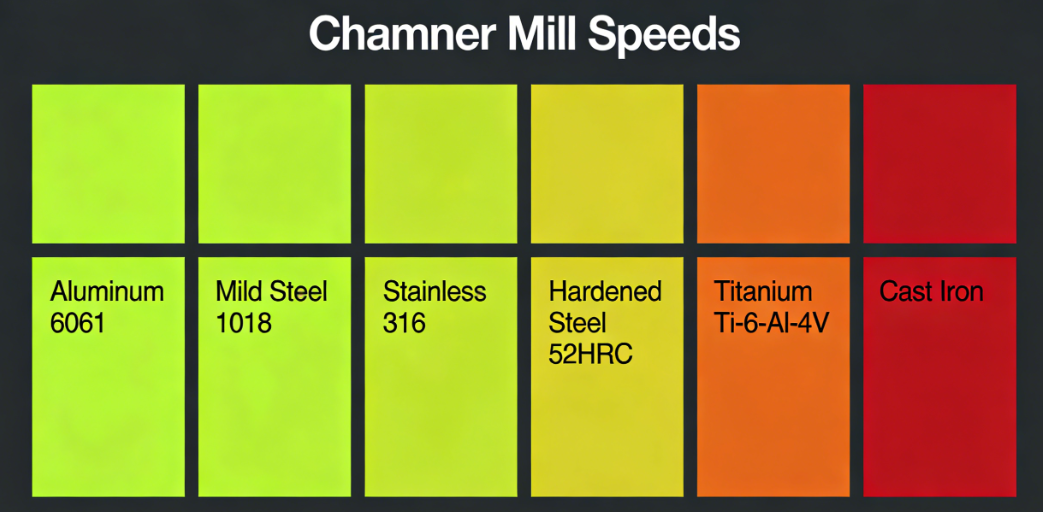
Aluminum is the best material for chamfer mills. You can use aggressive SFM without worrying about heat because aluminum quickly conducts it away. The real risk is called "built-up edge," or BUE. This is when aluminum sticks to the flute and tears the surface instead of cutting it. Polished flutes and a ZrN coating get rid of this problem completely.
For 7075-T6, reduce the SFM to 500–700. The temper makes it resistant enough to cutting that pushing above 800 SFM quickly wears out the flute without improving performance.
Parameters at a glance:
| Aluminum Grade | SFM | 1/8" IPT | 1/4" IPT | 1/2" IPT | 3/4" IPT | Coating |
|---|---|---|---|---|---|---|
| 6061-T6 | 650–1000 | 0.0015 | 0.004 | 0.007 | 0.009 | ZrN / Uncoated |
| 7075-T6 | 500–700 | 0.0012 | 0.003 | 0.006 | 0.008 | ZrN / Uncoated |
| 2024-T4 | 500–800 | 0.0012 | 0.003 | 0.005 | 0.007 | ZrN |
| Cast Aluminum | 400–600 | 0.0010 | 0.002 | 0.004 | 0.006 | TiAlN |
The most common mistake people make when they cut steel with a chamfer is using the same settings for a square end mill's depth of cut as they would for a chamfer mill's longer engagement angle. For steel with a hardness below 30 HRC, keep the feed rate between 450 and 650 SFM and focus on increasing the chip load instead of the speed. The trade-off — lower SFM, higher IPT — gets you clean edges and a long tool life at the same time.
Hardened steel (40–55 HRC) is a whole other world. Lower the flow rate to 200–300 SFM. Keep the chip load low, and don't forget to add coolant. If you run it dry above 300 SFM in hardened steel, it can turn a $40 chamfer mill into scrap in under 30 seconds.
Parameters at a glance:
| Steel Type | Hardness | SFM | 1/8" IPT | 1/4" IPT | 1/2" IPT |
|---|---|---|---|---|---|
| Low Carbon (1018, 1020) | <30 HRC | 500–650 | 0.0010 | 0.0020 | 0.0035 |
| Medium Alloy (4140) | 30–40 HRC | 350–450 | 0.0008 | 0.0016 | 0.0028 |
| High Alloy (D2, H13) | 40–55 HRC | 200–300 | 0.0005 | 0.0010 | 0.0020 |
| Hardened Tool Steel | >55 HRC | 150–200 | 0.0003 | 0.0007 | 0.0012 |
Stainless steel gets harder if you slow down or let the tool rub without cutting. There are two rules to remember:
- Keep the chip load the same throughout the cut.
- Never stop the feed while the spindle is running. If you let a tool sit in stainless steel for even a little bit, a hardened surface layer will form on the cutting edge. This will ruin the edge of the tool every time you use it.
A TiAlN coating is essential for stainless steel. It can handle the heat from stainless steel's poor ability to conduct heat and prevent microchipping at the edge. Uncoated carbide in stainless will work, but only for a short time.
Parameters at a glance:
| Stainless Grade | SFM | 1/4" IPT | 1/2" IPT | Coating |
|---|---|---|---|---|
| 304 | 300–400 | 0.0014 | 0.0025 | TiAlN |
| 316 | 280–380 | 0.0013 | 0.0022 | TiAlN |
| 17-4 PH | 200–300 | 0.0010 | 0.0018 | AlTiSiN |
Titanium conducts heat about one-sixth as well as aluminum. Most of the heat from the cut stays in the tool tip instead of escaping through the cutout. "Run slower" is the right advice, but it's not enough. It's also important to keep the chip's electrical resistance high enough so that heat is transferred out of the chip and away from the cutting edge.
It's essential to use through-tool coolant at 300+ PSI when working with titanium. One aerospace shop found that they could triple the life of a tool just by switching from one way of delivering the tool to another way. They did this without making any changes to the tool. That's the difference between guessing and knowing.
Parameters at a glance:
| Titanium Grade | SFM | 1/8" IPT | 1/4" IPT | 1/2" IPT | Best Coating |
|---|---|---|---|---|---|
| Grade 2 (Pure Ti) | 150–200 | 0.0006 | 0.0012 | 0.0020 | AlTiN |
| Ti-6Al-4V (Grade 5) | 100–150 | 0.0005 | 0.0010 | 0.0016 | AlTiN |
| Ti-6Al-6V-2Sn | 75–120 | 0.0004 | 0.0008 | 0.0014 | AlTiSiN |
This might surprise machinists, but it's true: cast iron often works better when it's dry and you use an air blast to cool it, rather than using flood coolant. When cold coolant hits hot cast iron, it can cause small cracks to form at the tool's edge. Use air to keep chips clear, and use a tough carbide substrate. This makes the abrasive graphite structure easier to manage.
High-temperature alloys like Inconel and Hastelloy are in a category of their own. SFM drops to 50–100, chip loads stay minimal, and through-tool coolant at maximum available pressure is required. These materials are unforgiving. Start with a cautious approach and only adjust the settings after successful trials.
| Material | SFM | 1/4" IPT | 1/2" IPT | Coolant Strategy |
|---|---|---|---|---|
| Gray Cast Iron | 300–400 | 0.0020 | 0.0032 | Air blast |
| Ductile Iron | 250–350 | 0.0016 | 0.0028 | Air blast or dry |
| Inconel 718 | 50–100 | 0.0006 | 0.0010 | Through-tool |
| Hastelloy C | 60–90 | 0.0005 | 0.0009 | Through-tool |
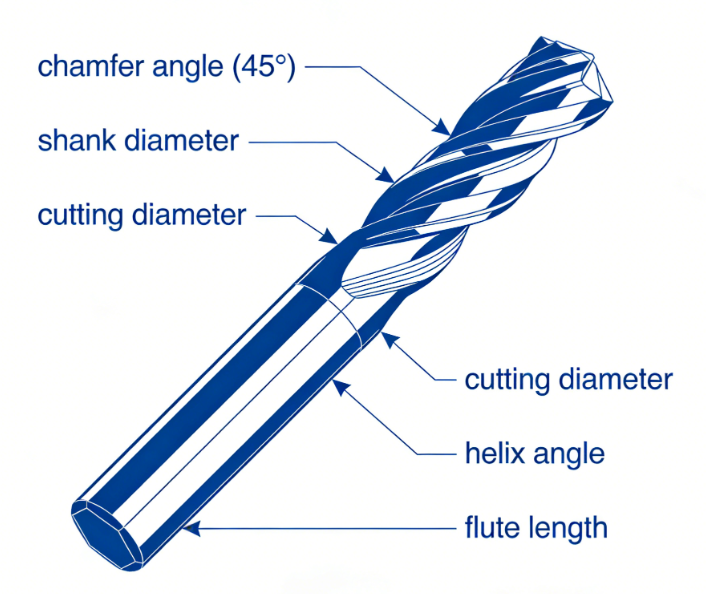
The angle defines the cut geometry — and the material removal ratio. A 45° chamfer removes at a 1:1 ratio: 0.010" axial depth creates a 0.010" chamfer face width. Other angles shift that ratio, so match the angle to the print callout, not just to what's in the toolcrib.
45° — Best all-round choice. Deburring, general chamfering, edge breaks. The most forgiving geometry for varying chip loads. Works across all materials without special technique adjustments.
60° — Countersinking and pre-thread chamfers. Perfect for flathead screw countersinks. The steeper angle reduces radial cutting force, which is why 60° tools tend to last longer in high-volume countersinking applications.
90° — Spot drilling and heavy deburring only. Very aggressive cutting geometry. High chatter risk on any setup that isn't exceptionally rigid. Don't use a 90° chamfer mill where a 45° will do the job.
Double-angle — Two edges simultaneously. Machines both sides of a feature in one pass. A 23% cycle time reduction is achievable in valve body work — but only with excellent workholding rigidity. Any movement in the setup and the geometry goes wrong on both faces at once.
More flutes don't always produce better results. A 4-flute chamfer mill in aluminum clogs with chips faster than a 2-flute, killing surface finish and forcing the tool to recut chips instead of cutting clean metal. Match flute count to material and the finish takes care of itself.
| Flute Count | Best For | Feed Rate Impact |
|---|---|---|
| 2 Flute | Aluminum, non-ferrous, plastics | Highest chip load per tooth — push feed aggressively |
| 3 Flute | Steel, stainless — best balance | Moderate chip load, smooth cutting force distribution |
| 4 Flute | Hardened steel, cast iron, finish passes | Lower chip load per tooth — reduce IPT ~25% vs 2-flute |
| Coating | Color | Max Temp | Best Material |
|---|---|---|---|
| TiN | Gold | 600°C | General purpose, low-alloy steel |
| TiAlN / AlTiN | Violet-gray | 900°C | Steel, titanium, high-temp alloys |
| TiCN | Gray-blue | 400°C | Abrasive materials, cast iron |
| ZrN | Pale gold | 550°C | Aluminum, copper, non-ferrous |
| Uncoated | Bright silver | — | Aluminum with polished flutes (no BUE risk) |
Real scenario: 3/8" 3-flute AlTiN chamfer mill, 4140 steel at 35 HRC, flood coolant.
Step 1 — Find your SFM range.4140 at 35 HRC = medium alloy steel. AlTiN-coated carbide = 350–450 SFM. Start at 350. If machine rigidity is questionable, start at 300.
Step 2 — Calculate RPM.RPM = (350 × 12) ÷ (3.14159 × 0.375) = 4,200 ÷ 1.178 = 3,565 RPM. Program 3,500.
Step 3 — Find chip load.3/8" tool in medium alloy steel from the chart above = 0.0012–0.0016". Use 0.0013" as the starting chip load — middle-conservative for a first cut.
Step 4 — Calculate feed rate.IPM = 3,500 × 3 × 0.0013 = 13.65 IPM. Program 13.5 IPM. After confirming clean chips and no chatter, step to 15 IPM.
Step 5 — Check chamfer depth.If chamfer depth exceeds 20% of tool diameter (that's 0.075" for a 3/8" tool), reduce feed by 15%. Deep chamfers increase radial engagement and heat generation significantly — the chart values assume a standard edge break, not a deep chamfer.
Chatter in chamfer milling has a counter-intuitive fix: increasing feed rate often kills chatter faster than reducing speed. A higher chip load forces the cutting edge to engage material more aggressively, which stabilizes the tool by reducing the tendency to bounce off the surface.
The instinct to "slow everything down" when chatter starts usually makes it worse in chamfer milling, not better. Try this sequence instead: increase feed 10–15% first. If chatter persists, then reduce RPM by 10–20%.
The four-point rigidity stack — get all four right:
For unavoidable long-overhang situations: reduce SFM by 25% from standard recommendations. Don't reduce chip load — maintaining chip thickness is how the tool stays stable through the cut.
Trap 1 — Using tip diameter for RPM calculation.On a chamfer mill, the effective cutting diameter changes with depth of cut. Always use the largest diameter that's actively cutting to calculate RPM. Under-calculating means you're actually running too fast — and burning the edge without knowing why.
Trap 2 — Flood coolant on cast iron.Thermal shock from cold coolant hitting hot cast iron micro-cracks the cutting edge. Switch to air blast. Dry with good chip evacuation is often better than flood in gray iron — the opposite of most other materials.
Trap 3 — Pausing feed in stainless steel.Any dwell while the spindle is running work-hardens the surface beneath the tool. Once that layer forms, it's harder than the tool. Stop the spindle before pausing the program in stainless, no exceptions.
Trap 4 — Applying end mill chip loads directly to chamfer mills.The angled cutting edge creates a longer contact zone per revolution than a square end mill of the same diameter. The same IPT value feels heavier. Start at 80% of what you'd use on a square end mill, then adjust upward from there.
Trap 5 — Skipping the test cut in a new material.Run the first pass at 70% feed on scrap and listen. Steady medium-pitched tone + clean C-shaped chips = correct parameters. High-pitched squealing = too fast or rubbing. Low-frequency chatter = increase feed rate or reduce RPM slightly. Three sounds, three fixes — learn them and you'll diagnose problems in seconds.
Quick diagnostic reference:
Knowing the parameters is half the battle. Having the right tool geometry, coating, and substrate for your specific material is the other half — and that's where most shops leave performance on the table.
JimmyTool carries precision carbide chamfer mills across every angle, diameter, coating, and flute count covered in this guide. Every tool is engineered for the parameters above, not just priced for the shelf.
person: Mr. Gong
Tel: +86 0769-82380083
Mobile phone:+86 15362883951
Email: info@jimmytool.com
Website: www.jimmytool.com


