

Best Insert Radius for Finishing Milling Steel: 5 Rules for Mirror Finish
Date:2026-04-16Number:1622Finding the best insert radius for finishing milling steel is the difference between a mirror-like surface and a rejected part. Many machinists focus entirely on insert grades, but the nose radius is the primary geometric "switch" that controls surface roughness (Ra).
During a recent test on 4140 alloy steel, we increased the radius from 0.4mm to 0.8mm while using a wiper insert, which successfully dropped the Ra from 1.6 to 0.4 and boosted tool life by 35 percent.
This guide explores the physics of theoretical roughness, the 4:1 golden rule for feed rates, and how to manage heat when finishing high-hardness alloys.
The surface finish in milling is not a mystery; it is a mathematical outcome of the interaction between the insert's nose radius and the feed per tooth. The theoretical surface roughness (Ra) can be estimated using the formula:
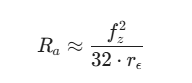
Where fz is the feed per tooth and T is the corner radius.
Increasing the radius directly reduces the scallop height left by the tool path. However, a larger radius also increases the contact area between the tool and the workpiece, which can lead to vibration if the machine setup lacks rigidity. For precision finishing in
A common error in finishing steel is choosing a feed rate that ignores the geometric limits of the insert. To maintain a stable cutting action and prevent the tool from simply "rubbing" the metal, the feed per tooth (fz) should generally not exceed 25 percent of the nose radius.
If you are using a 0.8mm radius, your feed per tooth should be around 0.2mm or less. Going beyond this 4:1 ratio causes the radial cutting forces to spike, leading to poor dimensional accuracy and premature edge wear. This rule ensures the cutting edge actually shears the material rather than pushing it, which is essential when working with a
While a large radius improves surface finish, it generates significant radial cutting forces. On long, slender workpieces or thin-walled steel parts, these forces trigger chatter that ruins the finish instantly.
In these scenarios, the best insert radius for finishing milling steel is often a smaller one, such as 0.2mm or 0.4mm. A smaller radius directs more of the cutting force axially up the spindle rather than radially into the part. This reduction in side-pressure is the only way to maintain precision on unstable setups, similar to how
Stop Struggling with Inconsistent Finishing
Is your shop losing time on secondary polishing? Browse our precision
products to find the exact milling inserts designed for mirror-finishing steel.
Wiper inserts represent a massive leap in finishing efficiency. Unlike a standard radius that is perfectly circular, a wiper insert has a flattened section on the cutting edge that acts like a smoothing plane.
A wiper allows you to double your feed rate while maintaining the surface finish of a tool with a much larger radius. For example, a 0.4mm wiper insert can produce the same surface quality as a standard 0.8mm or 1.2mm radius but with much lower radial force. This technology is a mandatory consideration for
Finishing steel that exceeds 50 HRC requires a specific approach to radius selection to prevent the cutting tip from softening. A radius that is too small has very little mass to soak up the intense heat generated at the shear zone, leading to rapid "nose wear."
For hardened steel, a larger radius like 0.8mm or 1.2mm is preferred. The increased volume of carbide at the tip acts as a heat sink, distributing the thermal load across a wider area. This protects the
Choosing the best insert radius for finishing milling steel isn't just about the finish; it is about eliminating the need for expensive grinding or manual polishing. By locking in an Ra 0.4 or Ra 0.8 directly from the milling machine, you remove an entire stage of production.
A larger, stable radius reduces the frequency of tool changes and ensures that the first part and the 100th part are identical. This consistency is what separates profitable shops from those plagued by scrap. Whether you are using an
What is the best nose radius for surface finish in steel milling?
Standard choices are 0.4mm to 0.8mm. For a high-gloss finish, 0.8mm combined with a wiper geometry is the industry standard for most steel alloys.
How does insert radius affect cutting forces?
A larger radius increases radial forces because more of the tool is in contact with the workpiece. This can cause vibration on thin-walled parts or long tool extensions.
Can I use a large radius for finishing small features?
No, the insert radius must always be smaller than the smallest internal corner radius required by the part drawing to avoid over-cutting and dimensional errors.
Stop guessing which insert will give you the best finish. By applying the 4:1 rule and matching your radius to your part rigidity, you can transform your surface quality and drastically reduce your cycle times.
Ready for a Technical Tooling Review?
Don't let poor surface finishes kill your margins.
person: Mr. Gong
Tel: +86 0769-82380083
Mobile phone:+86 15362883951
Email: info@jimmytool.com
Website: www.jimmytool.com


