

Carbide Taps vs HSS: Which Wins for Your Material?
Date:2026-03-27Number:2132Carbide taps vs HSS is the debate every machinist hits eventually — and getting it wrong costs more than just a broken tap. Pick the wrong tool for a titanium or hardened steel job, and you're looking at scrapped parts, downtime, and a threading operation that chews through tooling budget fast.
Shops running high-volume CNC threading in hard materials routinely report 3–10× longer tool life after switching from HSS to carbide. That's a real number with a real impact on cost per hole — but it only holds when the material, setup, and hole geometry actually support carbide's requirements.
This guide breaks down carbide taps vs HSS across tool life, material hardness limits, breakage risk, and cost per hole — so you can make the right call for your exact job, not just the popular one.
Before diving into specifics, here's the full head-to-head at a glance. This table covers the decision factors that matter most in a real production environment.
|
Factor |
Carbide Taps |
HSS Taps |
|
Tool Life |
3–10× longer than HSS |
Baseline reference |
|
Cost Per Tap |
$15–$60+ |
$2–$15 |
|
Best Materials |
Hardened steel, titanium, composites, graphite (≥35 HRC) |
Aluminum, mild steel, plastics, brass (<35 HRC) |
|
Breakage Risk |
High — brittle under side-load |
Low — flexible, forgiving |
|
CNC Suitability |
Excellent — rigid setups required |
Moderate — works on CNC and manual |
|
Manual Use |
Not recommended |
Yes — standard choice |
|
Cutting Speed |
2–3× faster SFM possible |
Standard SFM range |
|
Cost Per Hole (volume) |
Lower at 500+ holes/shift |
Lower for small runs |
Need help reading this table for your specific material or machine setup? Browse our full cutting tool range to match tap specs to your job.
Carbide taps win on tool life — but only when the setup keeps them rigid. In CNC tapping of stainless steel or hardened alloys above 35 HRC, carbide consistently outlasts HSS by 3–10×, which crushes the cost-per-hole calculation over a full production run.
The math flips fast on short runs and softer materials. At volumes under 200–300 holes per shift, HSS taps recover their upfront cost advantage before carbide's tool life ever pays off.
HSS taps run $2–$15 per tap versus $15–$60+ for carbide. For prototype work, job shops doing mixed-material runs, or any manual tapping operation — HSS is the logical default.
HSS also holds an edge in threading aluminum, where material ductility means tap breakage is rare and tool life differences are minimal. Cobalt-grade HSS closes the gap further in moderate-hardness applications — see our cobalt vs carbide drill bit breakdown for more context on that middle-ground.
Above 500 holes per shift on CNC, carbide's cost per hole drops well below HSS even accounting for the higher tap price. Add in reduced machine downtime from fewer tap changes, and the ROI accelerates.
For hardened steel applications specifically, see our guide on carbide taps for hardened steel — it covers coating selection and geometry for materials above 45 HRC.
Material hardness is the sharpest dividing line between these two tools. HSS taps handle materials up to roughly 35 HRC with reliable results — think mild steel, aluminum, brass, and most plastics.
Carbide takes over above that threshold. In titanium alloys, hardened tool steel, graphite, and carbon fiber composites, HSS dulls quickly and tap breakage risk spikes. Carbide's hardness (typically 89–93 HRA) maintains a clean cutting edge where HSS fails within the first dozen holes.
Blind hole tapping in hard materials is where the carbide vs HSS decision gets most consequential. Chip evacuation is restricted, heat builds faster, and any flex in the tap shank causes immediate breakage — carbide's rigidity is a direct advantage here.
Through holes in the same hard materials give HSS slightly more forgiveness, but carbide still dominates on thread quality and tool life. If you're also evaluating drill bit choices for the pre-tap hole, our best drill bits for hardened steel guide covers compatible tooling from the same cutting system perspective.
Breakage risk is carbide's biggest liability. It's a brittle material — any side-load, misalignment, or interrupted cut can snap a carbide tap instantly. HSS bends before it breaks, which is why it remains the default for any setup that isn't perfectly rigid.
Carbide tapping on CNC with a rigid tap holder and controlled feed rate is a controlled environment. Carbide tapping on a manual drill press or with a floating tap holder is a parts-scrappage exercise.
Rigid tap holder — no floating chuck
Synchronized spindle speed and feed rate (CNC G84 cycle or equivalent)
Accurate pilot hole size — undersized holes dramatically increase breakage risk
Adequate coolant — carbide tolerates higher speeds but generates more heat per stroke
Confirmed workpiece clamping — any movement under cut load causes side-loading
For more on coolant strategy in carbide tooling, does carbide need coolant walks through when it's required versus when it's optional — material and speed-dependent.
CNC tapping environments are where carbide delivers its full advantage. Controlled feed rates, rigid holders, and consistent cutting conditions eliminate the variables that make carbide dangerous. Cutting speeds 2–3× higher than HSS are achievable, which directly reduces cycle time on high-volume jobs.
Manual tapping is an HSS domain. Tap wrenches, hand-held drills, and any non-synchronized threading operation introduce exactly the lateral forces that snap carbide. Even experienced machinists running carbide by hand see elevated breakage rates.
Material type also determines whether a cutting tap or forming tap makes sense before you even pick carbide or HSS. Forming taps eliminate chip problems entirely in ductile materials — our cutting tap vs forming tap guide covers that decision in detail.
Here's the rule that resolves most carbide vs HSS decisions in under 30 seconds. Run through it in order:
Material under 35 HRC + manual setup → HSS. Lower cost, lower breakage risk, no downside.
Material under 35 HRC + CNC + high volume (500+ holes/shift) → HSS still, unless cycle time is the constraint.
Material 35–45 HRC + CNC + rigid setup → Carbide with TiCN or AlTiN coating.
Material above 45 HRC → Carbide only. HSS will not hold thread quality across the run.
The one variable this tree doesn't resolve for you is coating and geometry for your specific combination of material, hole depth, and machine feed rate. That's where shops leave the most performance on the table — picking the right tap type but the wrong coating for the actual material chemistry.
Not sure which tap spec fits your material and setup? Browse our full tapping tool range →
Choosing carbide over HSS is only the first decision. Coating type changes tool life dramatically in specific materials — and most tap purchases get made without this variable considered.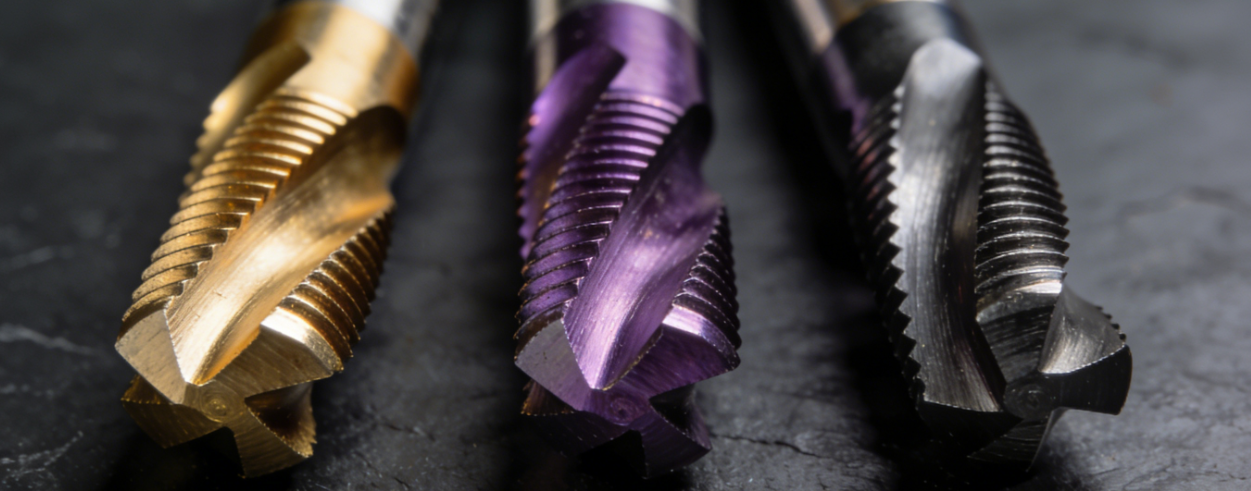
TiN (titanium nitride) is the entry-level coating — it works on mild steel and general applications but underperforms in stainless and titanium. TiCN handles stainless well. AlTiN is the choice for dry-machining hard alloys above 45 HRC, where its heat resistance at the cutting zone prevents the premature edge rounding that kills uncoated carbide.
Spiral flute carbide taps are the standard for blind holes — the flute geometry pulls chips up and out. Straight flute taps push chips ahead and suit through holes only. Spiral point (gun taps) are the fastest-cycling choice for through holes in production CNC. Our deeper carbide guide covers geometry selection across cutting conditions.
Tap selection rarely happens in isolation. The drill bit making the pilot hole, the end mill used for face preparation, and the boring tools establishing feature position all affect threading success.
If your operation involves hard materials end-to-end, pairing carbide taps with the right drill bits matters. See tungsten carbide drill bits for metal for drill bit specs that match carbide tap requirements. For shops also choosing between carbide and diamond tooling across the same material, our carbide vs diamond comparison covers the hardness limits where that decision diverges.
For aluminum-heavy work where you're tapping after milling, carbide burr for aluminum and best drill bits for aluminum complete the tooling picture for that material class.
Carbide taps win on hard materials, high-volume CNC runs, and applications where thread quality cannot degrade over the production cycle. HSS wins everywhere else — especially when the setup isn't rigid, the material is below 35 HRC, or the run volume doesn't justify the price premium.
The material hardness threshold (35 HRC), the 500+ holes/shift volume mark, and your machine's ability to run rigid tapping are the three numbers that determine which tool earns its place in your operation.
Have specs but still unsure which tap — and which coating — fits your job? Send us your requirements → We'll recommend the right tool geometry and coating for your exact material and machine setup.
person: Mr. Gong
Tel: +86 0769-82380083
Mobile phone:+86 15362883951
Email: info@jimmytool.com
Website: www.jimmytool.com


