

Face Mill vs End Mill: Understanding the Key Differences
Date:2026-03-26Number:1725
Face mill vs end mill — pick the wrong one and you're looking at poor surface finish, blown tolerances, and wasted tooling budget before the job is half done.
This guide breaks down exactly how each cutter performs, where each one falls short, and which one fits your specific operation. By the end, you'll know the answer without second-guessing it.
Here's the side-by-side breakdown most guides skip over.
| Factor | Face Mill | End Mill |
|---|---|---|
| Primary cut direction | Axial (face of workpiece) | Axial + Radial |
| Ideal for | Large flat surface stock removal | Profiles, pockets, slots, 3D contours |
| Surface finish Ra | 0.8–3.2 µm (with wiper inserts) | 0.4–1.6 µm (depending on stepover) |
| Typical diameter range | 50mm–250mm+ | 1mm–50mm |
| Cutting edges | Indexable inserts (4–12+) | 2–6 flutes, solid or indexable |
| Material removal rate | High | Low–Medium |
| Setup complexity | Low | Medium–High |
| Tooling cost per edge | $4–$12 (replaceable insert) | $15–$80+ (solid carbide regrind or replace) |
| Best material match | Steel, cast iron, aluminum (large stock) | Aluminum, steel, titanium (complex geometry) |
Face mills win on speed and cost-per-edge for flat stock. End mills win on flexibility and geometric capability.
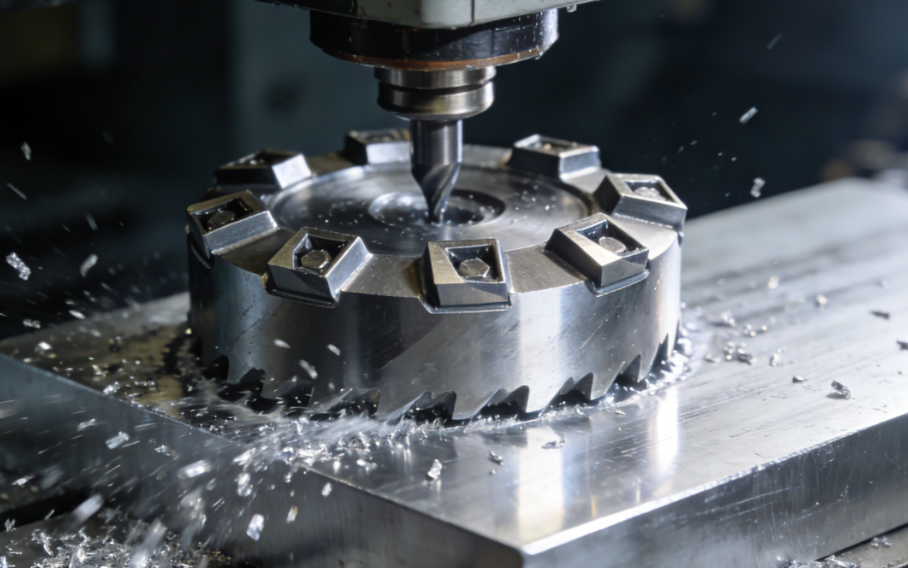
A face mill mounts perpendicular to the spindle axis and cuts primarily on its bottom face. It removes large amounts of material in a single pass using multiple indexable inserts, each taking a small chip load. The cutter spans a wide diameter — often 80mm to 200mm — which means more cutting edges engaged at once, more material out per revolution.
That translates directly to cycle time. A 125mm face mill running at 200m/min surface speed on mild steel can remove 8–12 cm³/min with a 2mm depth of cut and 80% radial engagement. You're not replicating that with a 20mm end mill.
With a standard carbide insert, face milling delivers Ra 1.6–3.2 µm. Add a wiper insert — a geometry designed to burnish the surface on the back sweep — and you're hitting Ra 0.8–1.2 µm without a secondary finishing pass.
That matters on parts where flatness and surface finish are critical but tight contours aren't. Think mold bases, fixture plates, machine frames, and raw billet prep.
A quality indexable carbide insert runs $4–$12 per edge depending on grade and coating. Most face mill bodies hold 4–8 inserts with 2–4 cutting edges per insert. You're looking at $0.50–$3.00 per edge-pass — far cheaper than grinding or replacing a solid carbide end mill.
Face mill bodies themselves cost $150–$600, but that's a one-time investment. The per-edge cost over the tool's life is what makes face milling the economical choice for flat surfacing at volume. For more on carbide tooling grades and when each makes sense, see our Carbide Guide.
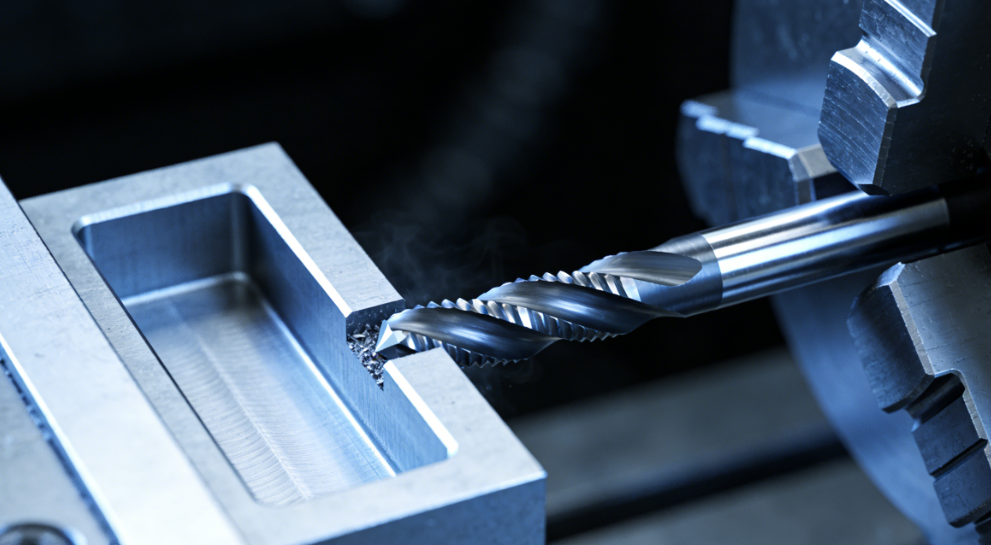
An end mill cuts on both its periphery and its end face, which means it can go sideways, plunge, profile, and follow a contour. It's the tool that makes pockets, T-slots, ramps, helical interpolations, and 3D surface paths possible. A face mill can't do any of that.
End mills come in flat (square-end), ball nose, corner radius, and specialty geometries. Each is purpose-built for a specific operation — which also means selecting the wrong one costs you either tool life or surface quality.
For a 12mm solid carbide end mill in 6061 aluminum, a typical starting point is: spindle speed 10,000–12,000 RPM, feed rate 1,500–2,000 mm/min, axial depth of cut 1×D (12mm), radial engagement 10–15% of diameter for finishing. These numbers shift based on flute count, coating, and machine rigidity.
Getting chip load right is what separates a tool that lasts 100 parts from one that snaps on part 12. Too light and you're rubbing instead of cutting, generating heat without chip evacuation. Too heavy and you're overloading the flute. For operations in challenging materials, understanding whether carbide needs coolant in your application makes a real difference in tool life.
Flat end mills are your default for pockets, shoulders, and slots. Ball end mills handle curved surfaces and 3D contours. Corner radius end mills — the most underused of the three — add strength to the cutting edge and dramatically reduce chipping on hard materials.
If you're milling hardened steel or titanium, a corner radius end mill at the same diameter will outlast a sharp-corner flat end mill by a factor of 3–5x in edge life. The geometry change alone changes the economics of the job. For related comparisons in profile geometry, see Bull Nose vs Flat End Mill.
This is where most buyers make the wrong call. Here's the decision framework, broken down by job type.
If your job is flat surface preparation on a large workpiece → Face mill.You'll remove more material, faster, at a lower cost-per-edge. An end mill here is the expensive, slow choice.
If your job involves pockets, slots, contours, or internal geometry → End mill.A face mill physically cannot do this work. There is no workaround.
If your job requires both flat surfacing AND contours → Start with a face mill to bring the part to near-net, then switch to an end mill.Using an end mill for bulk stock removal when a face mill is available adds cycle time and burns through expensive solid carbide unnecessarily.
Total cost to consider:
The break-even point is clear: for any job with significant flat stock removal, face milling pays for itself within the first few parts. For complex geometry, end mills have no substitute.
Not sure which tooling setup fits your specific part or production run?Talk to our engineering team — we review part requirements and recommend the right tooling approach at no cost.
Aluminum is forgiving for both tools, but the approach differs. Face milling aluminum at high surface speeds (300–600 m/min with uncoated or PVD-coated carbide inserts) delivers excellent surface finish and fast cycle times. End milling aluminum benefits from high-helix, polished-flute geometries specifically designed for non-ferrous materials — chip evacuation is the critical variable here.
For drilling and boring operations that pair with milling in aluminum work, our guide on carbide drill bits for aluminum covers the companion tooling side.
Cast iron is one of the strongest use cases for face milling — it machines cleanly with ceramic or CBN inserts at high speeds, and the wide-diameter face mill distributes cutting forces efficiently. For context on insert material selection, carbide vs ceramic cutting breaks down when each insert type gives you better results.
End milling steel requires attention to coating (TiAlN or AlTiN for dry cutting above 800°C) and chip load discipline. Undercutting on chip load is the most common reason solid carbide end mills fail prematurely in steel.
Titanium is where end mill selection becomes critical. Low thermal conductivity means heat stays in the cutting zone — aggressive coatings, sharp cutting edges, and consistent chip load are non-negotiable. Face milling titanium works for flat stock removal but requires conservative cutting data; titanium's spring-back and work-hardening punish any tool running too slow or rubbing rather than cutting.
Using an end mill for bulk flat removal. This is the most expensive habit in CNC shops. An end mill doing a face mill's job costs 3–5× more in cycle time and tooling spend per part.
Ignoring insert orientation on face mills. Most face mill bodies have a lead angle built in. Running the wrong lead angle for your material — especially on thin-wall parts — causes chatter and edge chipping that looks like a machine problem but is actually a setup problem.
Running the same end mill for roughing and finishing. Dedicated roughing end mills (corn cob/chipbreaker geometry) and finishing end mills have fundamentally different geometries. Running a finishing end mill at roughing chip loads destroys the edge; running a roughing end mill for finish passes leaves marks on the surface.
Skipping corner radius on hard materials. As covered above — if you're end milling anything above 40 HRC, a corner radius geometry is not optional. It's the difference between a tool that runs the job and a tool that breaks mid-program.
For related tooling decisions around specialty cutters used alongside end mills, see our guides on dovetail cutters for metal and chamfer mill speeds and feeds.
The cutter choice comes down to geometry, volume, and what the part actually demands. Face mills own flat surfacing at scale. End mills own everything that requires contour, profile, and precision geometry.
Running the wrong tool doesn't just slow you down — it inflates tooling cost, extends cycle time, and risks part quality on every run. Get the choice right before the program runs, not after the scrap pile builds.
Ready to source the right milling tooling for your application?Browse our full product catalog or contact our team directly — we'll match you to the right cutter geometry, grade, and coating for your specific material and operation.
person: Mr. Gong
Tel: +86 0769-82380083
Mobile phone:+86 15362883951
Email: info@jimmytool.com
Website: www.jimmytool.com


