

Carbide vs Ceramic Inserts: Differences, Applications & How to Choose
Date:2026-03-04Number:2632Choosing the wrong cutting insert doesn't just waste tool budget — it can destroy a workpiece, damage your spindle, and cost hours of unplanned downtime. Yet the choice between carbide and ceramic inserts (and when to consider CBN) still trips up experienced machinists every day.
This guide cuts through the noise. We compare every performance dimension that actually matters in the shop — hardness, thermal stability, toughness, cutting speed, cost-per-part, and real-world application fit — so you can make the right call the first time.
Carbide inserts are composed of tungsten carbide (WC) particles bonded with a cobalt (Co) binder, produced through powder metallurgy. The cobalt content typically ranges from 6–12% and acts as the decisive lever between toughness and hardness: more cobalt means a tougher but slightly softer insert; less cobalt yields a harder, more wear-resistant — but more brittle — edge.
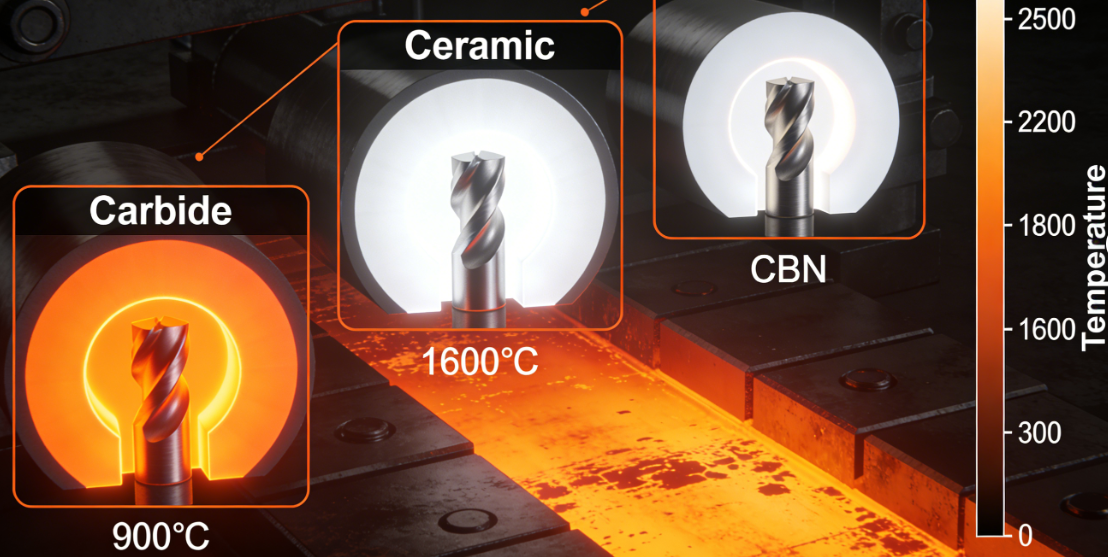
Most production carbide inserts are further enhanced with PVD or CVD coatings (TiN, TiAlN, Al₂O₃), which dramatically extend tool life by reducing friction and oxidation at the cutting interface. Carbide inserts register a hardness of roughly 90–92 HRA (≈1600 HV) and can sustain cutting temperatures up to approximately 900 °C before the cobalt binder begins to soften.
Ceramic inserts contain no metallic binder. They are sintered from one of three material families:
With a hardness of 93–95 HRA (2200+ HV)and the ability to sustain cutting temperatures up to 1600–2000 °C without losing their edge, ceramics operate in a performance envelope carbide simply cannot reach.
CBN (Cubic Boron Nitride) is the third tier — harder than ceramics, capable of machining materials above 60 HRC, and priced accordingly (3–5× ceramic). We include it in the comparison tables below for complete coverage.
| Property | Carbide | Ceramic | CBN |
|---|---|---|---|
| Hardness | 90–92 HRA (~1600 HV) | 93–95 HRA (2200+ HV) | 96–98 HRA (4000+ HV) |
| Max Operating Temp | 800–900 °C | 1600–2000 °C | 1400–1600 °C |
| Toughness (Impact) | High | Low | Medium |
| Wear Resistance | Good | Excellent | Superior |
| Cutting Speed Range | 100–600 SFM | 500–3000 SFM | 600–4000 SFM |
| Interrupted Cuts | Excellent | Poor | Fair |
| Coolant Compatibility | Yes (recommended) | No (thermal shock risk) | Dry preferred |
| Relative Cost (per insert) | $ Low | $$ Medium | $$$$ High |
| Tool Life vs Carbide | Baseline (1×) | Up to 5× (hard materials) | Up to 20× (>60 HRC) |
| Best Material Range | Steel, S.Steel, Cast Iron, Al | Superalloys, Hardened Steel, Cast Iron (50–60 HRC) | Hardened steel >60 HRC, Sintered metals |
Typical Cutting Speeds at a Glance
Ceramic inserts are meaningfully harder than carbide — measuring over 2200 HV versus carbide's ~1600 HV. In practical terms, this means ceramic cutting edges retain their geometry much longer when machining hard or abrasive materials. In continuous turning of hardened steels (45–60 HRC), ceramics can outlast carbide inserts by a factor of 3–5×. However, hardness and brittleness are two sides of the same coin: the same molecular structure that resists wear also makes ceramics susceptible to microcracking under impact.
This is where ceramics truly separate themselves. Carbide inserts begin to lose hardness above ~900 °C, because the cobalt binder softens — a phenomenon called "hot hardness drop." Ceramic inserts, lacking any metallic binder, maintain full hardness past 1600 °C. This is why ceramics can run at cutting speeds 3–5× faster than carbide in the right application, generating the extreme heat needed to plasticize the chip — rather than being destroyed by it.
Flooding a hot ceramic insert with coolant creates rapid thermal cycling (thermal shock), which causes microscopic cracking and sudden insert failure. Run ceramics dry, or with carefully directed air blast only.
Carbide wins decisively here. Its cobalt binder acts as a micro-scale shock absorber, allowing the insert to absorb mechanical impacts during interrupted cuts (milling, turning parts with holes or keyways, rough surfaces). Ceramic inserts in the same situation may chip or shatter on the first pass. If your operation involves any kind of interrupted cutting, start with carbide — or use whisker-reinforced ceramic grades specifically engineered for toughness.
Ceramic inserts cost roughly 2–3× more per insert than comparable carbide grades. But total machining cost is calculated per part, not per insert. When ceramics enable cutting speeds 3–5× faster and tool life 3–5× longer on compatible materials, the math often reverses: ceramics become cheaper per part despite costing more per insert. The key variables are:
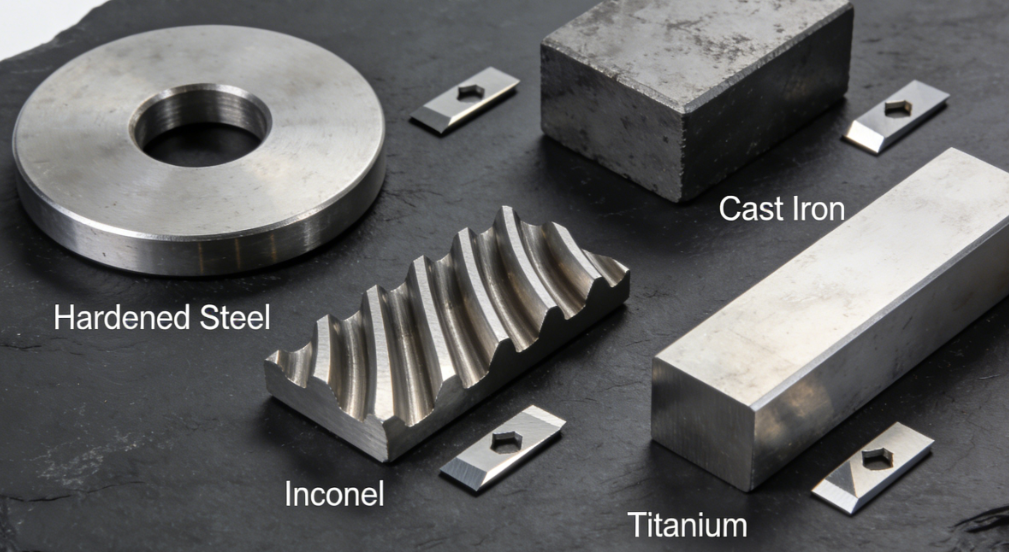
This is ceramic's strongest application. Superalloys maintain their hardness at elevated temperatures, meaning heat generated during cutting does not soften the workpiece — it accumulates at the tool. Carbide inserts in HRSA cutting degrade extremely rapidly. Ceramic inserts (particularly SiAlON grades) run at speeds 20–30× faster than carbide in this material class, converting what would be a multi-hour operation into minutes. The tradeoff: ceramic generates heat to plasticize the chip, so cutting speeds must remain high — do not slow down mid-cut.
For steels between 45–60 HRC, ceramic inserts offer an excellent cost/performance balance — 2–4× faster than carbide with significantly better tool life. Above 60 HRC, CBN becomes preferable as ceramic insert life drops steeply. Both ceramics and CBN should be run dry in hard turning applications to avoid thermal shock and maintain consistent edge temperatures.
Silicon nitride ceramics (Si₃N₄) are the preferred choice for high-volume cast iron machining, delivering cutting speeds up to 1000 m/min with excellent surface finish. The abrasive graphite inclusions in cast iron that rapidly wear carbide are less damaging to the much-harder ceramic substrate. In interrupted cast iron cuts (e.g., engine blocks with cored features), use carbide with proper edge preparation.
For the vast majority of everyday machining — carbon steels, stainless steels, aluminum alloys — carbide remains the default correct choice. Ceramics offer no meaningful advantage here and introduce brittleness risk. Coated carbide grades (TiAlN for stainless, DLC for aluminum) provide outstanding performance and versatility.
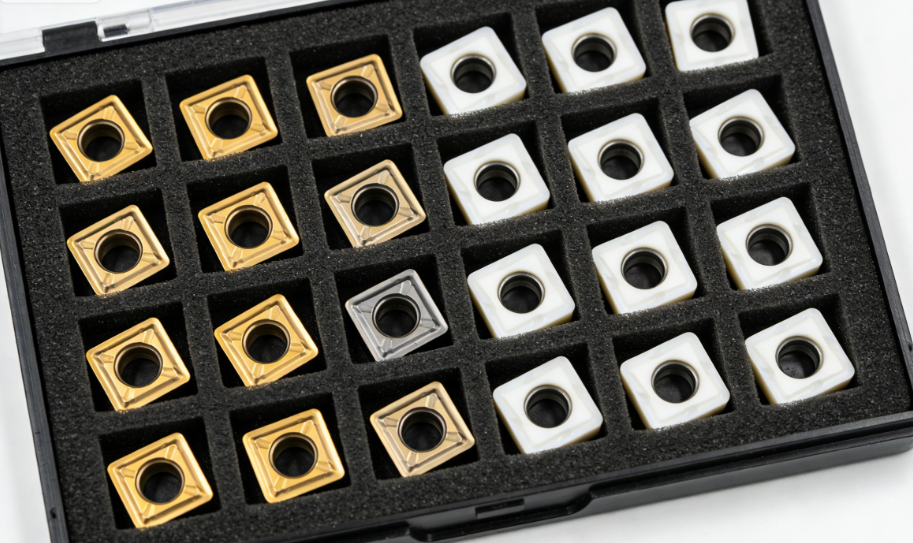
Storage: Store ceramic inserts in individual compartments — never loose in a container where they can contact each other. Micro-chips from incidental contact are invisible to the naked eye but will cause premature edge failure at cutting temperatures. Always handle with clean gloves: skin oils cause localized thermal stress when the insert heats up.
Warm-up: Begin the first pass with a light depth of cut at operating speed before ramping to full parameters. This thermal warm-up can extend insert life by 20–30%.
Coolant: Never flood-cool a hot ceramic insert.The rapid thermal gradient from ~1000 °C to ambient in milliseconds induces microcracking. Run dry or use targeted air blast to clear chips without shocking the insert.
Speed consistency: Ceramics require consistent high speed. If you slow down mid-cut (e.g., programmed dwell, feed hold), the insert cools below its operating window and may crack on re-engagement. Program smooth constant-velocity tool paths.
Coolant: Use appropriate coolant concentration (typically 5–10% emulsion) and ensure consistent, uninterrupted flow. Intermittent coolant causes thermal cycling on carbide just as it does on ceramic, accelerating edge wear.
Insert seats: Always clean the insert seat and shim with a lint-free cloth before mounting. Even 0.01 mm of debris under a carbide insert creates localized stress concentration that causes premature fracture.
Rotation: Rotate carbide inserts at the first sign of consistent flank wear — do not run to catastrophic failure. Small, controlled wear is recoverable; a broken insert can damage the workpiece and the tool holder simultaneously.
The carbide vs ceramic debate has no universal winner — it has context-specific correct answers. Carbide inserts remain the backbone of modern machining: tough, versatile, coolant-compatible, and cost-effective across the widest range of materials and operations. They are the right default choice for most workshops.
Ceramic inserts are a specialized performance tool. When the conditions align — hard or heat-resistant materials, continuous cuts, rigid machines, high-volume production — ceramics deliver productivity gains that no carbide insert can match. The key is understanding why ceramics perform the way they do, and ensuring your application meets the requirements for that performance to materialize.
CBN rounds out the toolkit for the most demanding hardened workpiece applications, where ceramics themselves begin to struggle.
Match insert material to workpiece hardness, cut continuity, and machine rigidity — not to brand preference or habit. Use carbide as your baseline, consider ceramic when hardness exceeds 45 HRC in continuous turning, and evaluate CBN only when hardness exceeds 60 HRC or ceramic tool life is economically insufficient.
JimmyTool supplies precision carbide, ceramic, and CBN inserts for demanding machining applications worldwide. Get expert insert selection support and competitive pricing.
person: Mr. Gong
Tel: +86 0769-82380083
Mobile phone:+86 15362883951
Email: info@jimmytool.com
Website: www.jimmytool.com


