

Lollipop End Mills: The Ultimate Guide to 5-Axis Undercutting and Precision Deburring
Date:2026-03-24Number:1765A lollipop end mill features a spherical ball at the end of a narrowed neck, allowing it to cut in directions that standard ball nose tools cannot reach. You can learn more about these differences in our comprehensive
This unique geometry is the "secret weapon" for machining internal radii and backside chamfers without flipping the part. By utilizing the spherical cutting edge, you can maintain a constant surface speed even on steep vertical walls.
The primary advantage of this tool is its ability to process geometries that exist beneath an overhanging feature. When programming these paths, you must balance the neck-to-ball diameter ratio to ensure the tool doesn't snap under lateral pressure.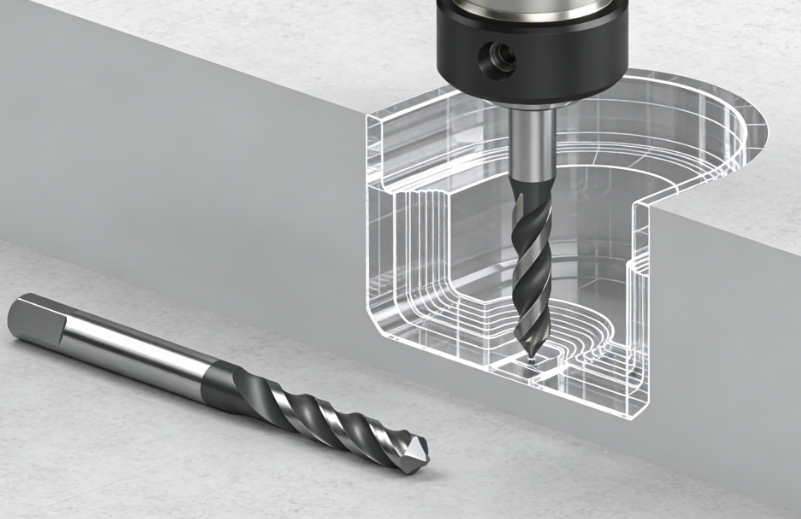
A proven rule of thumb is maintaining a 1:1.5 ratio between the neck diameter and the spherical head. For more technical insights on tool geometry, check our
Avoid "climb milling" into deep undercuts where chip evacuation is restricted, as this leads to rapid heat buildup. Instead, use a progressive step-down approach with a 10% radial engagement to keep the tool cool and stable.
Automating the deburring process is the fastest way to lower your cost per part in high-volume production. Unlike traditional methods, a lollipop cutter can follow a 5-axis tool path to clean up irregular edges with a consistent ±0.05 mm accuracy.
The 300-degree wrap angle allows the tool to wrap around an edge, removing burrs from both the top and bottom simultaneously. This process is far more efficient than using a standard
Choosing between a 220-degree and a 300-degree wrap angle depends entirely on the depth of the undercut you are targeting. A 220-degree tool offers a thicker, more rigid neck, making it ideal for aggressive material removal on shallow contours.
If you are working inside a deep, narrow cavity, the 300-degree version provides the extra "reach-around" capability needed to clear the shoulder. However, remember that the thinner neck on these high-angle tools requires a 20% reduction in your standard feed rate to prevent deflection.
Match your wrap angle to the specific CAD geometry to ensure the neck never makes contact with the part wall. Running a full-scale interference check in your simulation software is the only way to guarantee a collision-free 5-axis program.
The most common cause of tool failure with lollipop end mills is unintended neck contact with the workpiece. Setting a safety buffer of at least 0.25 mm in your CAM software prevents the narrowed neck from rubbing against the top edge of a cavity.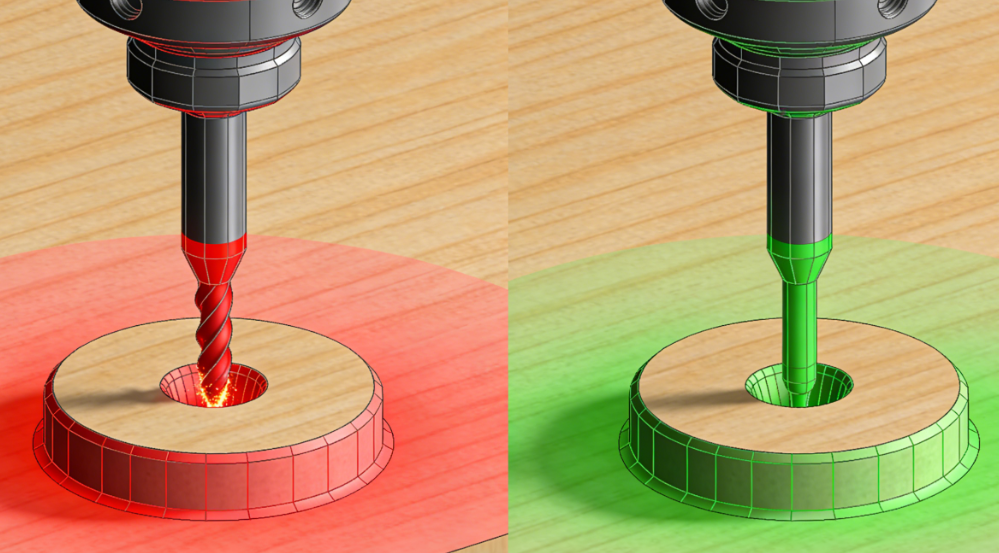
When defining the tool in your library, always model the "non-cutting" neck as a collision-sensitive element. This allows the software's interference-checking algorithm to automatically tilt or retract the tool before a crash occurs.
For 3-axis operations, ensure the "Entry" and "Exit" moves are vertical and centered within the hole or pocket. Any lateral movement during the plunge can lead to a snapped neck if the clearance is tighter than the tool’s spherical radius.
Standard ball nose tools often struggle with "chatter" when reaching into deep, narrow pockets. A long-neck
To achieve a surface roughness of Ra 0.8 μm or better, use a constant step-over strategy that limits the "scallop height" between passes. Keeping the tool engaged at a 45-degree angle to the surface prevents it from "walking" or vibrating against the cavity walls.
If you notice microscopic vibration marks, reduce your spindle speed by 10% and increase the feed rate slightly to "load" the tool. This extra pressure stabilizes the slender neck and prevents the harmonic resonance that ruins high-precision molds.
One of the greatest time-savers in CNC machining is performing backside operations in the same setup. You can use a lollipop cutter to chamfer the bottom edge of a through-hole by entering from the top and cutting upwards.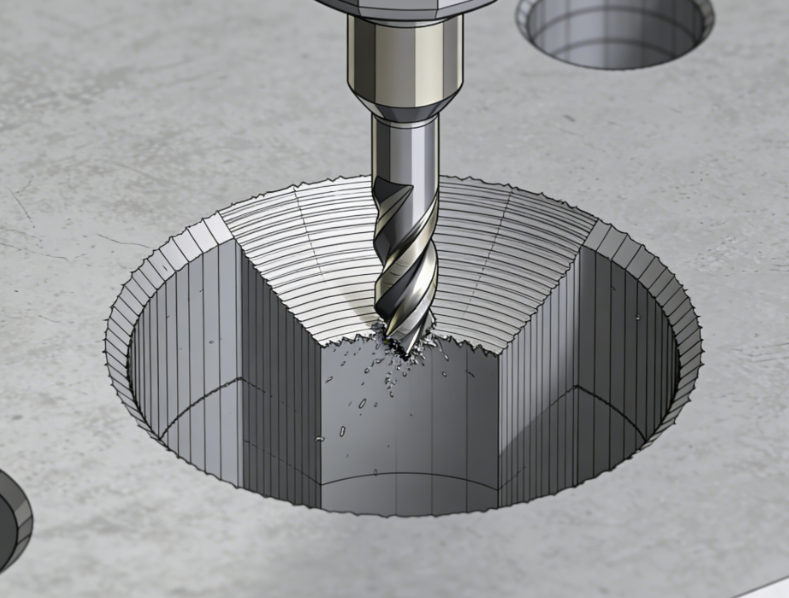
Ensure your machine’s spindle runout is less than 0.01 mm before attempting high-speed back chamfering. For optimal results, follow our established
Using an uncoated tool on hardened steel is a recipe for immediate edge wear. For carbon steels and heat-treated alloys, always choose a
If your project involves
Check the "red hardness" rating of your tool coating if you plan on running dry machining with compressed air. A high-quality coating maintains its hardness even when temperatures at the cutting tip exceed 800°C.
The "1:8 Rule" is critical: for every unit of neck length added, the tool's rigidity decreases by the cube of that length. To maintain accuracy, always select the shortest effective neck length that can clear your specific geometry.
If you must use an extra-long tool, look for a "stepped neck" design that tapers toward the spherical head. This tapered structure provides significantly more support at the base, reducing the "spring" effect during heavy side-cutting.
When using tools with a length-to-diameter ratio greater than 5:1, reduce your radial depth of cut (RDOC) to avoid tool deflection. Even a 0.02 mm deflection can cause the part to fall out of tolerance or lead to premature tool fatigue.
Most machinists make the mistake of calculating their RPM based on the tool's full spherical diameter. However, when cutting a shallow contour, the "effective" diameter at the contact point is often much smaller.
Maintaining a high surface speed is especially important when dealing with specialized geometries. Our guide on
Chips trapped in an undercut cavity will be re-cut by the tool, leading to poor surface finish and sudden tool breakage. In vertical milling, use a high-pressure air blast rather than flood coolant to blow chips out and away from the tool path.
For deep horizontal pockets, through-tool coolant is the most effective way to flush the cutting zone. If your machine isn't equipped with through-coolant, consider a "peck-milling" strategy to allow chips to escape periodically.
Ensure the air nozzle is aimed directly at the gap between the neck and the workpiece edge. This constant stream of air not only clears debris but also helps cool the slender neck, which acts as a heat sink during long cycles.
What is the best wrap angle for a lollipop end mill?
The 270-degree wrap angle is the most versatile choice, offering a balance between significant undercut reach and neck strength.
Can I use a lollipop cutter on a 3-axis CNC machine?
Yes, but you are limited to linear undercuts or backside chamfering along a single plane. 5-axis machines are required for complex 3D contouring.
How do I prevent tool chatter with long-neck lollipop tools?
Reduce your feed rate by 20% for every additional 2x diameter of neck length and use a "constant climb" milling direction to stabilize the tool.
Stop struggling with complex geometries and manual finishing. By mastering lollipop end mills, you can streamline your production and achieve superior surface quality.
Explore Jimmytool's Tooling Solutions Browse our full range of high-performance
person: Mr. Gong
Tel: +86 0769-82380083
Mobile phone:+86 15362883951
Email: info@jimmytool.com
Website: www.jimmytool.com


