

Dovetail Cutter Feeds and Speeds: Formulas & Charts
Date:2026-02-27Number:3348
Dovetail cutters are precision tools used to machine angled sidewalls, undercuts, and interlocking features. However, unlike standard end mills, dovetail cutters operate under higher radial engagement and side-load stress.
Selecting correct dovetail cutter feeds and speeds is therefore not just about efficiency — it directly affects tool life, surface finish, dimensional accuracy, and machine spindle load.
This guide provides:
Clear calculation formulas
Material-specific feeds and speeds charts
Chip load recommendations
Practical machining strategies
Troubleshooting guidance
If optimized correctly, dovetail cutting can be stable, repeatable, and highly productive.
Feeds and speeds refer to the cutting parameters that control tool rotation and linear movement during machining.
Spindle Speed (RPM) – How fast the cutter rotates
Surface Speed (SFM or m/min) – Linear speed at the tool’s outer diameter
Feed Rate (IPM or mm/min) – Linear advance of the tool
Chip Load (IPT or mm/tooth) – Material removed per tooth per revolution
Because dovetail cutters engage material with angled side flanks, improper feeds and speeds can lead to:
Chatter and vibration
Premature tool wear
Tool breakage at the neck
Poor corner definition
Therefore, parameter selection must account for geometry and engagement depth.
Dovetail cutters differ from end mills in three important ways:
Angular Cutting Edge (30°, 45°, 60° common)
Reduced Neck Diameter
Side-cutting Dominant Engagement
The most common industrial standard angle is defined by Dovetail cutter geometry, often used for fixtures, T-slot alternatives, and modular clamping systems.
Because the cutting occurs primarily along angled flanks:
Radial chip thinning occurs at shallow depths
Tool rigidity is lower than equal-diameter end mills
Heat concentrates near the cutting edge root
This means conservative chip load selection is critical.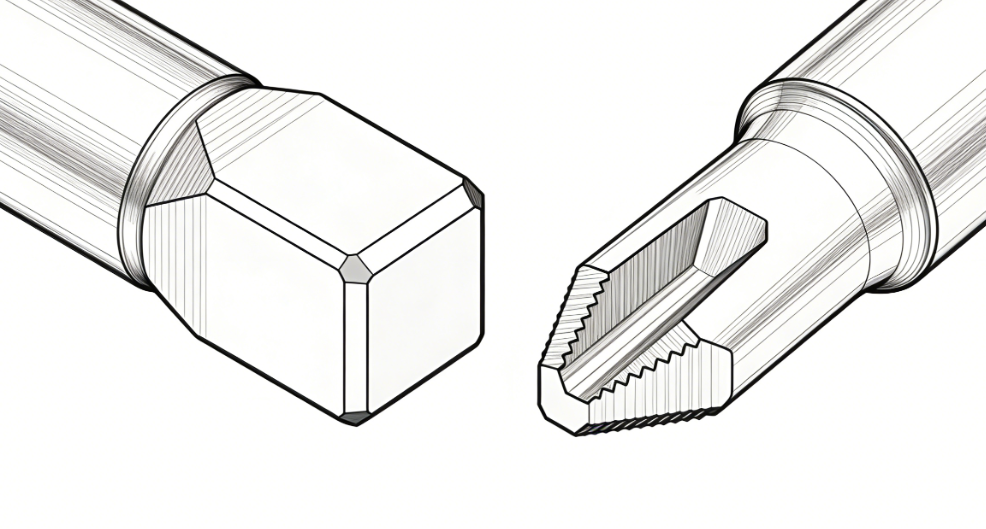
Metric version:
Feed
These formulas form the foundation for accurate parameter calculation.
Below are optimized starting points for carbide dovetail cutters.
| Material | SFM (Carbide) | Chip Load (in/tooth) | Notes |
|---|---|---|---|
| Aluminum 6061 | 400–800 | 0.0015–0.003 | Use air blast, avoid chip packing |
| Mild Steel (1018) | 200–350 | 0.0008–0.002 | Reduce depth of cut |
| Stainless Steel 304 | 120–220 | 0.0005–0.0015 | Avoid rubbing; maintain feed |
| Tool Steel (Pre-hard) | 100–180 | 0.0005–0.0012 | Climb cut only |
| Titanium Grade 5 | 60–120 | 0.0004–0.001 | High coolant pressure required |
These are conservative baseline parameters. Always adjust according to machine rigidity.
Chip load must consider:
Cutter diameter
Neck thickness
Overhang length
Workpiece material
Start at 60–70% of equivalent end mill chip load.
Because dovetail cutters experience lateral stress, aggressive chip loads often cause sudden fracture at the tapered section.
Scenario:
1/2" 60° carbide dovetail cutter
Machining 1018 steel
Target SFM = 250
4 flutes
Chip load = 0.0012 IPT
Recommended Starting Feed: 9 IPM
This method ensures calculated accuracy rather than guesswork.
Dovetail cutters are not designed for full-slot engagement.
Recommended:
Radial depth: 0.010" – 0.050" per pass (steel)
Axial depth: ≤ 0.5 × cutter height
Rough with end mill first, finish with dovetail cutter
This reduces tool stress and improves dimensional accuracy.
Always prefer climb milling when possible.
Benefits:
Reduced tool deflection
Improved surface finish
Lower heat buildup
Conventional milling increases rubbing and tool wear, especially in stainless and titanium.
Chip packing is the most common failure cause in dovetail cutting.
Best practices:
High-pressure coolant for steel and titanium
Air blast for aluminum
Pecking passes in deep features
Avoid flood coolant without chip evacuation control
Thermal control dramatically improves tool life.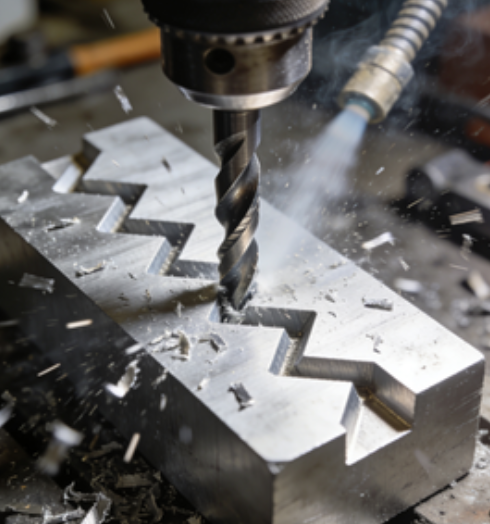
Cause:
Excessive overhang
Too high RPM
Insufficient rigidity
Fix:
Reduce spindle speed 10–20%
Shorten tool projection
Lower radial engagement
Cause:
Aggressive chip load
Deep radial engagement
Hard material shock
Fix:
Reduce chip load
Use roughing strategy first
Check spindle runout
Cause:
Rubbing (feed too low)
Tool wear
Improper climb direction
Fix:
Increase feed slightly
Replace tool
Switch to climb milling
For high-precision applications:
Adaptive strategies reduce load spikes.
Ideal operating window: 40–70% spindle load.
TiAlN for steel
ZrN for aluminum
AlTiN for high-heat alloys
Proper coating improves heat resistance and wear life.
Generally 50–70% of equivalent end mill chip load, depending on material.
No. Always rough the pocket or slot first with a standard end mill.
Because of their thin neck and side-cutting stress concentration.
Not recommended. Always reduce radial engagement.
Dovetail machining requires more conservative and calculated parameter selection compared to standard end milling. Correct dovetail cutter feeds and speeds depend on:
Material
Tool geometry
Machine rigidity
Engagement strategy
By applying proper formulas, selecting conservative chip loads, and optimizing coolant and engagement methods, you can significantly extend tool life while maintaining high dimensional precision.
If implemented correctly, dovetail cutting becomes predictable, efficient, and scalable for production environments.
person: Mr. Gong
Tel: +86 0769-82380083
Mobile phone:+86 15362883951
Email: info@jimmytool.com
Website: www.jimmytool.com


