

Why Used Roughing End Mill in CNC Machining?
Date:2026-01-21Number:2304In the relentless pursuit of manufacturing efficiency, roughing end mills stand as unsung heroes on the shop floor. While finishing tools capture attention with their pristine surface finishes, it's the roughing tools that determine 70% or more of your total machining time—and therefore, your profitability.
A common misconception persists: "An end mill is an end mill." This mindset costs shops thousands annually in extended cycle times, premature tool failure, and excessive machine wear. The reality? A properly selected and applied roughing end mill can increase metal removal rates (MRR) by 300% or more compared to using finishing tools for roughing operations.
This comprehensive guide will transform how you think about and utilize roughing end mills. We'll move beyond basic definitions into the engineering principles, practical applications, and advanced strategies that separate standard practice from world-class machining performance.
Chapter 1: The Engineering Behind Roughing End Mills - More Than Just "Wavy Teeth"
1.1 The Core Design Philosophy
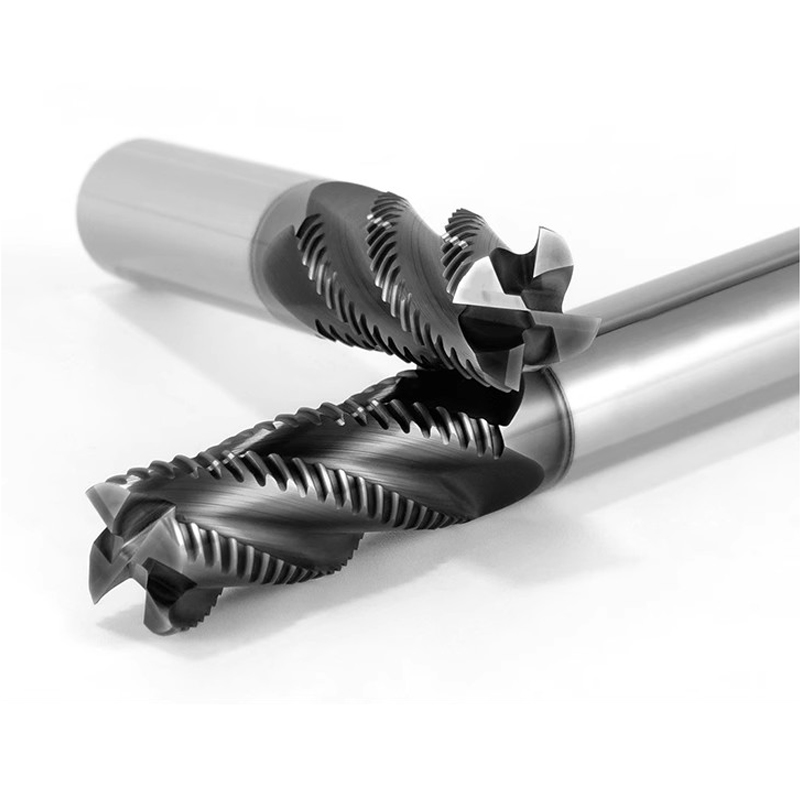
Roughing end mills, often called "ripper mills," "hog mills," or "corn cob mills" due to their distinctive serrated cutting edges, are engineered for one primary mission: efficient evacuation of maximum material volume in minimal time. Unlike their finishing counterparts, they prioritize chip formation and evacuation over surface finish.
Key Design Elements:
Serrated/Notched Cutting Edges: These irregular edges break chips into small, manageable segments rather than long, stringy ribbons
Reduced Contact Area: The notches create intermittent cutting action, reducing heat generation and cutting forces
Chip Thinner Geometry: Specialized edge preparation ensures chips are thinner than the theoretical chip load, reducing power consumption
Radial Relief Angles: Optimized to prevent rubbing and allow deeper radial engagement
1.2 Chip Formation Physics: Why Roughing Mills Work Better
When a standard end mill engages material, it produces continuous chips that:
Require significant energy to form
Tend to recut or clog flutes
Transfer heat back into both tool and workpiece
Roughing end mills create discontinuous chips through their serrated design. This delivers three critical advantages:
Thermal Management: Interrupted cutting allows coolant to reach the cutting edge between engagements
Reduced Vibration: The irregular cutting pattern disrupts harmonic vibrations that can cause chatter
Lower Power Consumption: Smaller chips require less energy per volume of material removed
Technical Insight: The ideal roughing chip resembles a small "6" or "9" shape—compact, easily evacuated, and carrying away maximum heat.
| Type | Primary Use | Key Feature | Best For |
|---|---|---|---|
| Coarse Pitch (2-3 teeth) | Aluminum, soft materials | Maximum chip clearance | High-speed machining, gummy materials |
| Medium Pitch (4-5 teeth) | General purpose steel | Balance of strength & finish | Most steel alloys (4140, 1018, A36) |
| Fine Pitch (6+ teeth) | Hard materials, finishing passes | Smoother cutting action | Hardened steels (>45 HRC), titanium |
| Variable Pitch | Chatter suppression | Uneven tooth spacing | Thin walls, extended reach, problematic setups |
| Variable Helix | Vibration reduction | Changing helix angles | Aerospace alloys, difficult geometries |
High-Feed Mills (HFM):
Ultra-low radial engagement (1-3% of diameter)
Very high axial engagement (up to 2× diameter)
Extreme feed rates possible (500-1000 IPM in aluminum)
Ideal for: Face milling, pocket roughing, shoulder milling
Multi-Flute Roughers:
Higher tooth counts (5-10 teeth)
Can run at higher RPM due to increased chip thinning
Ideal for: Hard materials, small diameters, finishing-ready roughing
Corner Radius Roughers:
Rounded cutting edges at tool corners
Dramatically increases edge strength and tool life
Ideal for: Die/mold machining, hard milling, interrupted cuts
Tool Selection Priority:
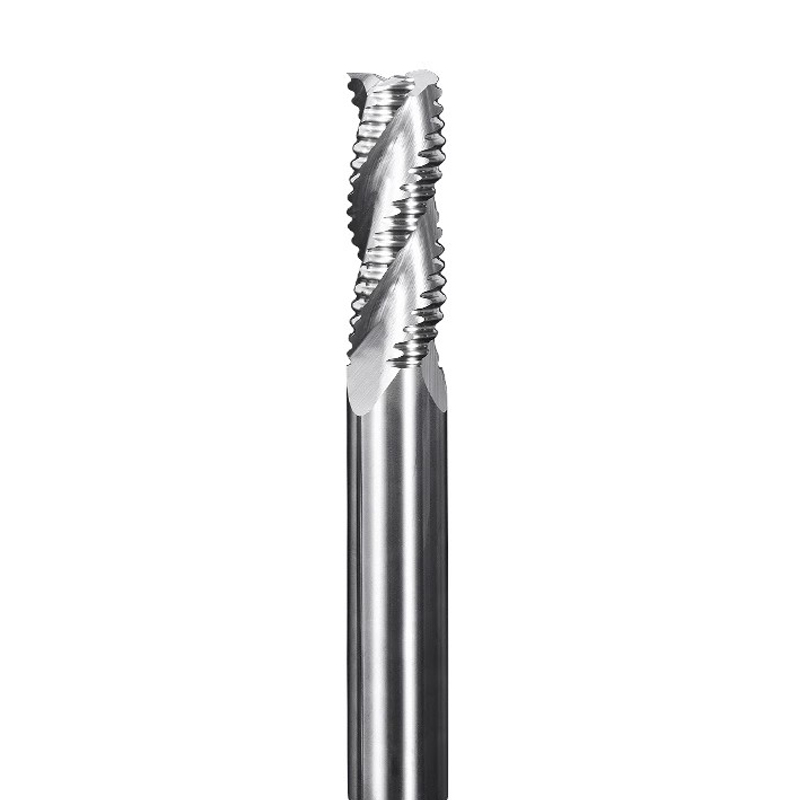
Coarse pitch (2-3 teeth for diameters >½")
Polished or ZrN-coated flutes to prevent material adhesion
High helix angle (40-45°) for efficient chip evacuation
Parameter Guidelines:
SFM: 800-1200 for carbide, 400-600 for HSS
Chip Load: 0.004-0.010" per tooth
Axial Depth of Cut (ADOC): 0.5-1.5× diameter
Radial Depth of Cut (RDOC): 30-50% of diameter
Pro Tip: In deep pocket aluminum roughing, use trochoidal toolpaths with 8-12% RDOC and maximize ADOC to full flute length. This prevents chip packing and reduces deflection.
Tool Selection Priority:
Medium pitch (4-5 teeth) for balance of strength and MRR
TiAlN or AlTiN coating for heat resistance
Corner radius design for edge strength
Parameter Guidelines:
SFM: 300-500 for mild steel, 200-350 for alloy steel
Chip Load: 0.002-0.006" per tooth
ADOC: 0.5-1× diameter
RDOC: 20-40% of diameter
Critical Consideration: For stainless steels, reduce SFM by 30% compared to mild steel and ensure flood coolant reaches the cut. Chip evacuation is crucial to prevent work hardening.
Tool Selection Priority:
Fine pitch or variable geometry for vibration damping
Micrograin carbide substrate with specialized coating
Reduced neck designs for clearance in deep cavities
Parameter Guidelines:
SFM: 80-150 for titanium, 50-100 for Inconel, 100-200 for hardened steel
Chip Load: 0.001-0.003" per tooth
ADOC: 0.3-0.5× diameter (conservative!)
RDOC: 5-15% of diameter
Safety Note: In titanium and nickel alloys, never stop the tool in the cut. Always use a retract move to prevent work hardening and tool seizure.
Dynamic Milling / Adaptive Clearing:
Maintains constant tool engagement
Allows higher feed rates with lower radial engagement
Reduces tool deflection and heat generation
Ideal RDOC: 5-15% of tool diameter
Trochoidal Milling:
Circular interpolation moves
Minimizes heat buildup in difficult materials
Excellent for slotting and pocketing
Key Parameter: Stepover should be 5-10% of diameter
High-Speed Roughing:
Utilizes chip thinning effect
Very high feed rates with light RDOC
Requires high-RPM spindle capabilities
Formula for Effective Chip Thickness: ECT = Feed per tooth × sin(engagement angle)
A balanced approach yields optimal results:
70% of material removal with roughing tools
30% left for finishing (0.010-0.030" typically)
Transition: Use a "semi-finishing" pass with a rougher to remove an additional 0.010-0.015" before switching to finisher
Why this works: Roughing mills leave consistent, predictable stock for finishing tools, preventing shock loading and extending finishing tool life.
Tool Cost Per Cubic Inch:
Cost/in³ = (Tool Price) / (Total in³ removed over tool life)Hidden Costs to Consider:
Machine Time: $50-150/hour for typical CNC mills
Downtime: Tool changes, setup adjustments
Secondary Operations: Additional finishing due to poor roughing
Scrap/Rework: Failed tools often damage parts
Consider upgrading when:
Material costs are high (exotics, forgings, castings)
Machine time exceeds $75/hour
Batch sizes are large enough to justify optimization
Part geometries are particularly challenging
Rule of Thumb: A 20% increase in MRR typically justifies a 100% increase in tool cost for production runs.
AI-Optimized Geometries: Tools designed by machine learning algorithms analyzing thousands of cutting tests
Sensor-Embedded Tools: Vibration and temperature sensors for real-time adaptive control
Nanostructured Coatings: Multi-layer coatings with graduated properties
Hybrid Rough/Finish Tools: Single tools capable of both operations with toolpath control
Modern CAM systems now integrate with:
Tooling databases with actual performance data
Machine dynamics models to predict vibrations
Material-specific libraries with proven parameters
This allows virtual tool testing before physical purchase or use.
Roughing is not merely a necessary evil—it's your greatest opportunity for machining efficiency gains. The difference between average and exceptional roughing performance often represents 20-40% reduction in total part cycle time.
Your 90-Day Implementation Plan:
Month 1: Assessment
Document current roughing parameters and MRR
Identify your 3 most common roughing applications
Calculate current tool cost per cubic inch
Month 2: Testing
Select one application for optimization
Test two alternative tool geometries/strategies
Measure MRR, tool life, and part quality
Month 3: Implementation & Scaling
Implement best practices across similar operations
Train operators on new parameters and techniques
Establish ongoing monitoring of key metrics
Remember: The most sophisticated roughing tool cannot compensate for improper application. Start with understanding your specific needs—material, machine capability, part geometry—then select tools and strategies accordingly.
The journey to roughing excellence begins not with purchasing the most expensive tool, but with asking better questions about your current process. What limiting factor prevents you from removing material faster? Is it machine power, tool rigidity, chip evacuation, or programming strategy? Answer this, and you'll know exactly where to focus your improvement efforts.
person: Mr. Gong
Tel: +86 0769-82380083
Mobile phone:+86 15362883951
Email: info@jimmytool.com
Website: www.jimmytool.com


