

How to Choose Face Milling Cutters?
Date:2026-01-23Number:1802Face milling is often the first and most critical operation in machining a part. It establishes the foundational flatness, parallelism, and surface quality that every subsequent feature depends upon. Unlike peripheral milling, where cutting occurs primarily on the tool's circumference, face milling engages both the face and periphery of the cutter to create wide, flat surfaces with exceptional efficiency.
The choice of face milling cutter directly impacts:
Surface finish quality (Ra, Rz values)
Flatness and parallelism tolerances
Material removal rates (MRR)
Production cycle times
Overall machining costs
This comprehensive guide will transform you from a casual user to a strategic expert in face milling cutter selection, application, and optimization.
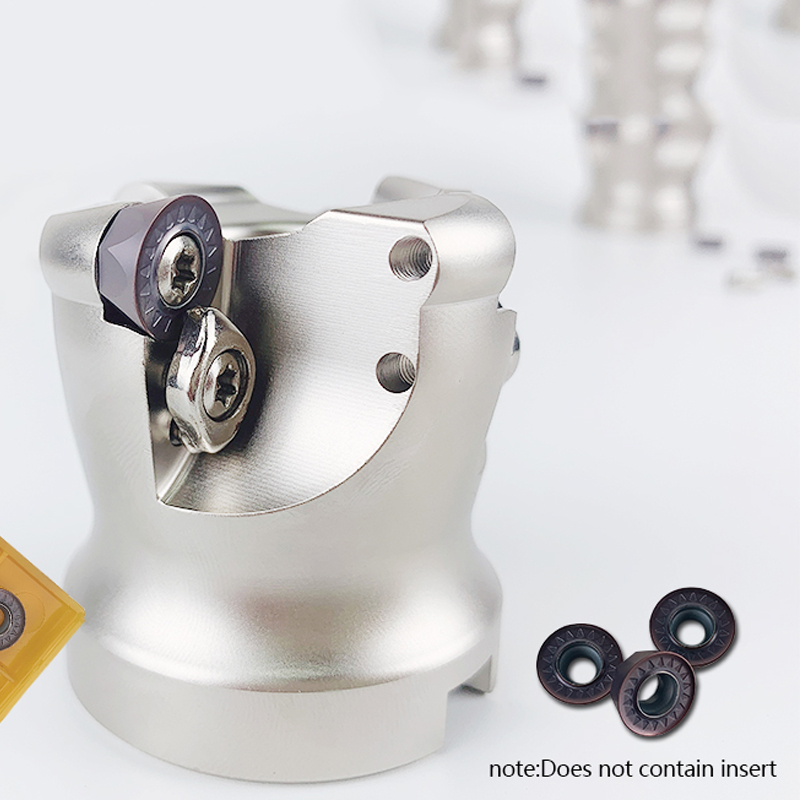
Cutter Body:
Material: Typically steel or heavy-duty steel alloys
Interface: CAT, BT, HSK, or CAPTO shanks
Key Feature: Precision-machined pocket locations that determine insert positioning accuracy
Cutting Inserts:
Geometry: Square, round, octagonal, or trigon shapes
Cutting Edges: 4-8 usable edges per insert
Mounting: Screw-clamp, wedge-lock, or pin-lock systems
Cutting Geometry Elements:
Lead Angle (κ): Most critical parameter (typically 45°, 75°, or 90°)
Axial Rake Angle (γₐ): Controls cutting forces and chip flow
Radial Rake Angle (γᵣ): Affects power consumption and surface finish
Face milling generates a unique chip formation pattern:
Entry → Full Engagement → Exit
Thin Chip → Maximum Thickness → Thin Chip
This varying chip thickness affects:
Cutting Forces: Peak during maximum engagement
Heat Generation: Concentrated at insert center
Tool Life: Entry and exit cause maximum edge stress
Pro Insight: The "lead angle" is your primary control lever. A 45° lead angle distributes forces axially and radially, while 90° creates purely axial forces—critical for thin-walled components.
| Cutter Type | Typical Diameter | Insert Size | Best Application |
|---|---|---|---|
| Small Diameter | 0.75"-2" (19-50mm) | IC 1/4" - 1/2" | Shoulder milling, small faces |
| Medium Diameter | 2"-6" (50-150mm) | IC 1/2" - 5/8" | General purpose face milling |
| Large Diameter | 6"-12" (150-300mm) | IC 5/8" - 1" | Large surface area, high MRR |
| Extra Large | 12"+ (300mm+) | IC 1" - 1.5" | Mill tables, large plates |
Square Inserts (90° corner):
Most common, economical
8 cutting edges typically
Medium to heavy cutting conditions
Limitation: Sharp corner susceptible to chipping
Round Inserts (Button Cutters):
Infinite cutting edges (rotateable)
Excellent for high-feed applications
Superior edge strength
Best for: Roughing, difficult materials, interrupted cuts
Octagonal Inserts:
8 usable cutting edges
Stronger corner than square inserts
Good balance of economy and performance
Ideal for: General steel milling
Trigonal Inserts:
6 cutting edges
Positive rake geometry
Free-cutting action
Perfect for: Aluminum, stainless steel
High-Feed Cutters:
Small lead angles (10°-15°)
Very high feed rates possible (0.040-0.080" per tooth)
Low radial, high axial engagement
Result: Reduced machine power requirements
High-Efficiency Cutters:
Variable pitch design (uneven tooth spacing)
Chatter-free operation
Superior surface finishes
Benefit: Can run at higher parameters without vibration
Fine-Pitch Cutters:
Many teeth (close spacing)
High surface quality (Ra < 32 μin)
Light cutting conditions
Application: Finishing, semi-finishing
Tool Selection Priority:
Cutter: Medium to coarse pitch, 45° lead angle
Insert: Square or octagonal, reinforced corner
Coating: TiCN or TiAlN for steel, uncoated for cast iron
Parameter Optimization:
Material: AISI 1045 Steel
Cutter: 4" diameter, 6 inserts
SFM: 450-550
Chip Load: 0.008-0.012" per tooth
Axial DOC: 0.100-0.250"
Radial DOC: 50-75% of cutter diameter
Critical Consideration: For ductile cast iron, use positive rake geometry to prevent edge build-up. For gray cast iron (with sand inclusions), choose tough substrate inserts.
Tool Selection Priority:
Cutter: High tooth count, polished flutes
Insert: Sharp, positive rake (often polished)
Coating: Uncoated or AlTiN for abrasion resistance
High-Speed Parameters:
Material: 6061 Aluminum
Cutter: 3" diameter, 8 inserts
SFM: 1200-1800
Chip Load: 0.006-0.010" per tooth
Axial DOC: 0.150-0.300"
Radial DOC: 75-100% (full immersion possible)
Pro Tip: For finishing aluminum faces, use wiper inserts (flat lands behind cutting edge) to double feed rates while maintaining surface finish.
Tool Selection Priority:
Cutter: Variable pitch, robust design
Insert: Round or large corner radius
Coating: Specialized (like AlTiN-TiSiN nanocomposite)
Conservative Approach Required:
Material: 304 Stainless Steel
Cutter: 3" diameter, 5 inserts (coarse pitch)
SFM: 250-350
Chip Load: 0.005-0.008" per tooth
Axial DOC: 0.080-0.150"
Radial DOC: 30-50% of cutter diameter
Safety Rule: In titanium and nickel alloys, never stop feed during cut. Always program continuous motion to prevent work hardening.
Three Methods to Improve Surface Finish:
Wiper Geometry:
Flat land behind cutting edge
Smears surface peaks
Allows 2x feed rate at same Ra value
Lead Angle Selection:
90° Lead: Best for flatness, thin walls
75° Lead: Good balance
45° Lead: Best surface finish, reduced power
Stepover Strategy:
50% stepover: Maximum productivity
33% stepover: Good finish balance
10-15% stepover: Finishing with small cutters
Four-Step Diagnostic and Solution:
Identify: Listen for characteristic "singing" sound
Analyze: Check for regular pattern on surface
Immediate Fix:
Reduce RDOC by 30%
Increase feed rate by 20%
Change cutter rotation direction
Permanent Solution:
Use variable pitch cutter
Increase cutter diameter
Reduce overhang (cutter + holder)
| Material | Coolant Approach | Pressure Requirement |
|---|---|---|
| Aluminum | Flood (5-10% concentration) | Standard (50-100 psi) |
| Steel | Through-tool preferred | Medium (200-500 psi) |
| Cast Iron | Dry or minimal MQL | Not critical |
| Exotics | High-pressure through-tool | High (500-1000+ psi) |
Critical Insight: For high-feed milling, coolant must reach the cutting zone despite high chip evacuation rates. Through-tool coolant is often essential.
TCO = (Cutter Cost + Insert Cost × Changes) +
       (Machine Rate × Total Time) +
       (Setup/Downtime Costs) +
       (Scrap/Rework Costs)
| Scenario | Current Tool | Premium Alternative | Payback Period |
|---|---|---|---|
| Production Batch | Standard grade | High-performance inserts | < 500 parts |
| Critical Flatness | General cutter | Precision ground body | Immediate |
| Difficult Material | Standard geometry | Material-specific design | < 50 parts |
| High-Machine Cost | Low-cost inserts | High-feed system | < 40 hours runtime |
Calculate potential savings:
Current: 4" face, 0.010" ipt, 500 SFM = 10 in³/min MRR
Upgrade: Same cutter, 0.018" ipt, 600 SFM = 18 in³/min MRR

Time Savings: 44% reduction
Annual Savings (1000 hours): $22,000 at $50/hour
Problem: Poor surface finish (visible feed marks)
Cause: Feed rate too high for cutter geometry
Solution: Reduce feed by 30% or use wiper inserts
Prevention: Calculate theoretical Ra = (Feed²)/(8×Nose Radius)
Problem: Visible step between passes
Cause: Tool deflection or machine backlash
Solution: Use climb milling, reduce axial DOC
Prevention: Program 0.001-0.002" overlap between passes
Problem: Insert chipping at corners
Cause: Entry/exit shock or interrupted cut
Solution: Use round inserts or larger corner radius
Prevention: Program arc entry/exit moves
Problem: Rapid flank wear
Cause: Speed too high or inadequate coolant
Solution: Reduce SFM by 20%, check coolant concentration
Diagnostic: Analyze wear pattern—thermal vs abrasive
Smart Cutters:
Embedded sensors for temperature and vibration
RFID chips for automatic tool identification
Wireless data transmission to CNC or monitoring systems
Additive Manufactured Bodies:
Lightweight optimized structures
Internal coolant channels impossible with machining
Custom geometries for specific applications
AI-Optimized Geometries:
Machine learning algorithms design insert shapes
Performance prediction before physical testing
Material-specific micro-geometries
Dry Machining Developments:
Specialized coatings for dry cutting
Geometry optimized for heat dissipation
Reduced environmental impact
Circular Economy Models:
Cutter body refurbishment programs
Insert recycling and reconditioning
Carbon footprint tracking
Week 1-2: Assessment Phase
Document current face milling operations
Measure actual surface finishes vs requirements
Calculate current MRR and cost per part
Week 3-4: Testing Phase
Select one problematic or high-volume operation
Test two alternative approaches (geometry or parameters)
Collect data: finish quality, tool life, cycle time
Month 2: Implementation
Scale successful changes to similar operations
Train operators on new procedures
Establish monitoring metrics
Start Here (Quick Wins):
Insert grade optimization for your primary material
Proper lead angle selection for your application
Coolant optimization (concentration, pressure, direction)
Then Progress To:
4. Cutter body upgrade for vibration reduction
5. Advanced geometries (wipers, variable pitch)
6. Process monitoring systems
The perfect face milling cutter doesn't exist in isolation. It's part of a system:
Machine Tool: Rigidity, power, spindle interface
Workholding: Stability, accessibility, dampening
Programming: Toolpaths, entry/exit strategies
Coolant: Delivery, filtration, chemistry
Measurement: Verification, feedback loops
Your competitive advantage won't come from any single component, but from how these elements work together. A moderately priced cutter in a well-optimized system will outperform the most expensive cutter in a poorly configured setup every time.
Final Thought: The most significant variable in face milling success isn't in your tool crib—it's in your approach. Are you treating face milling as a commodity operation or a strategic process? The difference between these mindsets is measured in surface quality, throughput, and ultimately, profitability.
Start with one improvement. Measure the results. Scale what works. The journey to face milling excellence is incremental, but each step delivers immediate, measurable returns.
person: Mr. Gong
Tel: +86 0769-82380083
Mobile phone:+86 15362883951
Email: info@jimmytool.com
Website: www.jimmytool.com


