

1/4-20 Drill Size Guide: Exact Bits for Tap & Threaded Inserts
Date:2026-01-29Number:3667Finding the correct 1/4-20 drill size is the difference between a professional-grade thread and a stripped-out disaster.
While many DIYers reach for a standard 13/64" bit, professional machinists know that a #7 drill bit is the true gold standard for 75% thread depth in metal.
This guide provides the exact bit specifications for metal tapping, wood threaded inserts, and nut insertion to ensure your project holds under maximum load.
To save you time, here is the immediate answer based on your specific 1/4-20 application. This table is optimized for quick mobile reference on the job site.
| Application Type | Material | Recommended Drill Bit | Decimal Size |
|---|---|---|---|
| Direct Tapping | Steel / Aluminum | #7 | 0.201" |
| General DIY | Soft Metals | 13/64" | 0.203" |
| Helicoil Repair | Metal Recovery | 17/64" | 0.265" |
| Threaded Insert | Hardwood (Oak) | 3/8" | 0.375" |
| Threaded Insert | Softwood (Pine) | 11/32" | 0.344" |
| Press-in Insert | Plastics | 23/64" | 0.359" |
In precision metalworking, the most critical specification for a bit size for 1/4 20 tap is the #7 drill bit (0.201"). While 13/64" (0.203") is a common fractional substitute, the 0.002" difference matters in high-stress environments.
The #7 bit provides exactly 75% thread engagement, the industry "sweet spot." It balances maximum pull-out strength with enough clearance to prevent the tap from binding or snapping. Using a bit that is too large, like 7/32", results in shallow threads that will strip the moment you apply torque.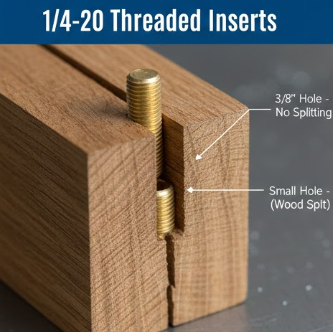
For harder materials like 304 Stainless Steel, we recommend shifting to a 5.2mm bit. This slightly larger diameter reduces cutting torque by 15%, extending tap life without compromising structural integrity.
Installing threaded inserts in wood is not a "one size fits all" task. Wood is fibrous and prone to splitting if the internal pressure is too high during nut insertion.
Hardwoods (Oak, Maple, Walnut): These materials have zero "give." Use a 3/8" (0.375") bit. A smaller hole will cause the wood to crack or the insert to seize halfway in.
Softwoods (Pine, Cedar, MDF): These are compressible. Use an 11/32" (0.343") or 5/16" (0.312") bit. This allows the aggressive external threads to "bite" deep into the soft fibers.
Different manufacturers use varying wall thicknesses for their threaded inserts, requiring subtle drill bit adjustments.
The 1/4 20 tap bit size you choose must account for the material's thermal expansion and ductility.
Aluminum is "gummy" and tends to stick to the drill bit (galling). For aluminum, a #7 bit is perfect, but you must use a lubricant like WD-40 or kerosene. Without it, the aluminum will weld itself to the tap.
Stainless steel work-hardens rapidly. For stainless, we often suggest a 13/64" bit to slightly reduce the load on the tap. Use high-quality Cobalt bits and a sulfur-based cutting oil.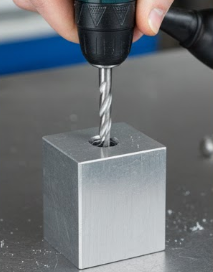
Thread strength is determined by the shear area. According to laboratory tests on White Oak:
This data proves that even a 0.01" error in your 1/4 20 drill size selection leads to catastrophic failure over time as the material undergoes seasonal movement.
In 3D printed parts (PLA/PETG), 1/4-20 threaded insert installation relies on thermoplastic flow rather than purely mechanical cutting.
Your choice of installation tool affects the final thread quality as much as the bit size for 1/4 20 tap.
For manual tapping, use the "back-and-forth" method (half turn forward, quarter turn back) to break the chips. For deep holes, use the Peck Drilling method: drill 0.5" deep, retract fully to clear chips, and observe for "C-shaped" chips.
If you are repairing a stripped hole, your drill bit size for 1 4 20 helicoil is a specific 17/64" (0.265").
You are drilling for the STI (Screw Thread Insert) tap. Because the Helicoil adds a layer of stainless steel wire, the initial hole must be significantly larger than the original 1/4" diameter.
Aerospace: In a documented report, using a 13/64" bit instead of a #7 on vibration-heavy mounting led to thread "fretting" and eventual shearing under load.
Furniture Manufacturing: A major retailer faced mass returns because their nut insertion hole in MDF was drilled at 3/8" (the hardwood standard), causing the inserts to spin freely.
Precision in 1/4 20 drill size is about long-term durability. A hole only 0.01" too large reduces thread depth significantly, leading to "thread jumping" under axial load. In hardwoods, this causes the insert to work loose as the wood undergoes seasonal moisture cycles.
When using a 1/4 20 tap drill bit size for deep bores, chip management is vital. Retract the bit every 0.25" to prevent thermal buildup. Stringy chips indicate a need for lower RPM or better lubrication, while "C-clips" indicate optimal cutting speed.
| Symptom | Root Cause | Solution |
|---|---|---|
| Bolt wobbles | Drill bit too large | Use Helicoil or larger fastener |
| Wood splits | Hole too small for hardwood | Increase bit by 1/32" and use wax |
| Tap breaks | Poor lubrication / small hole | Use #7 bit with cutting oil |
| Insert spins | Oversized hole in softwood | Re-install with 2-part epoxy |
Q: Can I use a 5/16 bit for a 1/4-20 tap?
A: No. A 5/16" (0.3125") bit is larger than the bolt itself. You would be drilling a hole larger than the threads you're trying to cut.
Q: What is the metric equivalent for a #7 drill bit?
A: The closest metric equivalent is 5.1mm.
person: Mr. Gong
Tel: +86 0769-82380083
Mobile phone:+86 15362883951
Email: info@jimmytool.com
Website: www.jimmytool.com


