

How to Choose Milling Cutter Types for Different Materials & Operations?
Date:2026-01-26Number:2157In the precision-driven world of manufacturing, milling cutter selection isn't just a technical decision—it's a strategic business choice that directly impacts productivity, quality, and profitability. With hundreds of milling cutter types available, many machinists default to familiar tools, unknowingly sacrificing 20-40% of potential efficiency. This guide demystifies the complete universe of milling cutters, providing you with systematic knowledge to select the perfect tool for every application.
Understanding milling cutter types matters because each tool is engineered with specific geometries, materials, and coatings optimized for:
Particular materials (aluminum, steel, titanium, composites)
Specific operations (roughing, finishing, slotting, contouring)
Machine capabilities (high-speed, high-torque, rigid or flexible setups)
Economic considerations (tool life, productivity, total cost per part)
This comprehensive guide will transform you from a reactive tool user to a strategic machining expert, capable of selecting milling cutters that deliver optimal results in every situation.
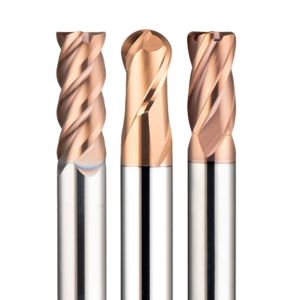
All milling cutters can be classified into five fundamental categories based on their primary cutting action and application:
1. Peripheral Milling Cutters
Cutting primarily occurs on the periphery (circumference) of the tool
Examples: Plain milling cutters, helical cutters, side milling cutters
2. Face Milling Cutters
Cutting occurs on both the face and periphery, designed for creating flat surfaces
Examples: Shell mills, face mills with indexable inserts
3. End Mills
Versatile tools that cut on both the periphery and end, for multiple operations
Examples: Square end mills, ball end mills, corner radius end mills
4. Form-Relieved Cutters
Specifically shaped to produce particular profiles or forms
Examples: Gear cutters, T-slot cutters, dovetail cutters
5. Special Purpose Cutters
Designed for unique, specific applications
Examples: Thread mills, keyseat cutters, woodruff cutters
Critical Geometry Elements Every Machinist Must Understand:
Primary Clearance Angle (α): Prevents rubbing on workpiece
Secondary Clearance Angle: Additional relief behind cutting edge
Rake Angles:
  - Axial Rake (γₐ): Controls chip flow direction
  - Radial Rake (γᵣ): Affects cutting forces
Helix Angle (β): Influences cutting smoothness and chip evacuation
The Cutting Edge Hierarchy:
Primary Cutting Edge: Main edge performing bulk material removal
Secondary Cutting Edge: Edge following primary, affecting surface finish
Corner/Nose Radius: Critical for edge strength and surface quality
Tool Material Evolution:
High-Speed Steel (HSS) → Cobalt HSS → Carbide → Cermet → PCD → Ceramic
↑ Durability ↑ Heat Resistance ↑ Hardness ↑
Material Selection Matrix:
| Tool Material | Max Hardness (HRC) | Max Temperature | Best For |
|---|---|---|---|
| HSS | 35 HRC | 600°F | Manual mills, low volume |
| Cobalt HSS | 42 HRC | 700°F | Interrupted cuts, tough materials |
| Solid Carbide | 65 HRC | 1000°F | CNC, high speeds, hard materials |
| Micrograin Carbide | 70 HRC | 1200°F | Precision finishing, hard milling |
| PCD (Diamond) | N/A | 1300°F | Non-ferrous, composites, graphite |
| Ceramic | 65+ HRC | 2000°F | High-temp alloys, hardened steels |
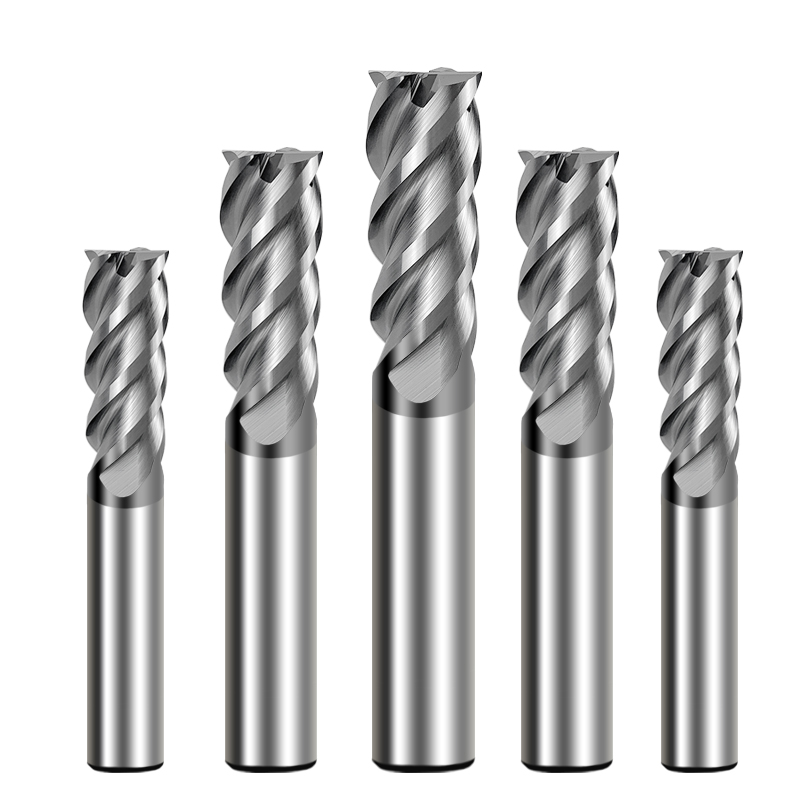
Square End Mills (Flat Bottom):
Design: 90° corners, flat bottom
Applications: Shoulder milling, pockets, slots, profiling
Variations: 2-flute (aluminum), 3-flute (general), 4-flute (steel), 5+ flute (finishing)
Pro Tip: For deep pockets, choose reduced neck or "long reach" versions
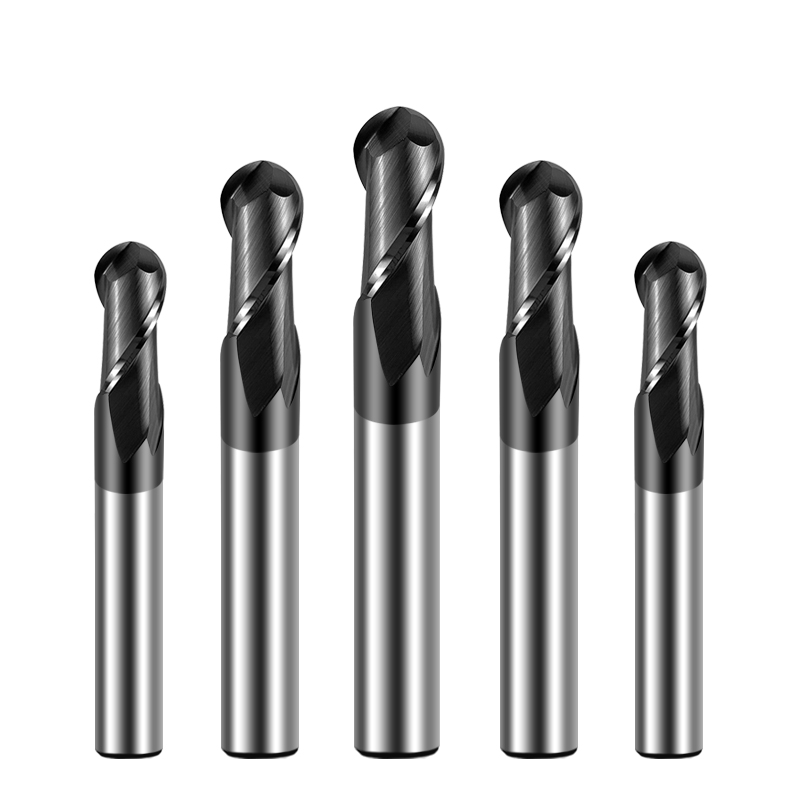
Ball Nose End Mills:
Design: Hemispherical end for 3D contouring
Applications: Mold/die making, complex surfaces, radius bottom slots
Critical Metric: Stepover determines surface finish (typically 5-10% of diameter)
Advanced Variant: Tapered ball nose for deep cavities
Corner Radius End Mills:
Design: Rounded corners for strength
Applications: Shoulder milling, pockets requiring fillets
Benefits: 3-5× longer tool life vs sharp corners, better surface finish
Specification: R0.5, R1.0, R2.0 etc. (radius in mm)
Chamfer Mills:
Design: Angled cutting edges
Applications: Deburring, edge breaking, chamfering holes
Common Angles: 45°, 60°, 82° (for countersinks)
Usage Tip: Program helical motion for consistent chamfers
Drill Mills:
Design: Combines drilling and milling capabilities
Applications: Spot drilling, shallow hole drilling, helical interpolation
Limitation: Not for deep holes (>3× diameter)
Roughing End Mills (Ripper/Pork Chop Cutters):
Design: Serrated cutting edges
Function: Break chips into small segments
Advantages:
  - 30-50% higher MRR possible
  - Reduced vibration and chatter
  - Better chip evacuation
Best For: Deep pockets, high-volume material removal
Finishing End Mills:
Design: Precise cutting edges, tight tolerances
Surface Finish Capability: Ra 16-32 µin achievable
Special Features: Wiper flats for improved finish at higher feeds
Application: Final passes before part completion
Variable Helix/Variable Pitch End Mills:
Innovation: Uneven tooth spacing
Benefit: Eliminates harmonic vibrations (chatter)
Applications: Thin walls, extended reach, difficult materials
Result: Can run at higher parameters without vibration issues
High-Feed End Mills:
Design: Small lead angle (10°-15°)
Strategy: Low radial, high axial engagement
Benefit: Reduced machine power requirements, high feed rates
Typical Feed: 0.020-0.080" per tooth possible
Coating Selection Guide:
| Coating | Color | Max Temp | Best For | Avoid |
|---|---|---|---|---|
| Uncoated | Silver | 600°F | Aluminum, non-ferrous | Hard materials |
| TiN | Gold | 750°F | General purpose, HSS tools | High-temp alloys |
| TiCN | Blue-Gray | 850°F | Stainless, alloy steels | Aluminum |
| TiAlN | Purple-Black | 1100°F | Hard materials, high speeds | Copper alloys |
| AlTiN | Black | 1500°F | Dry machining, hardened steels | - |
| Diamond | Silver | 1300°F | Graphite, composites, aluminum | Ferrous metals |
Basic Components:
Cutter Body: Steel or heavy-duty alloy with precision pockets
Inserts: Carbide inserts with multiple cutting edges
Locking Mechanism: Wedge, screw, or pin systems
Mounting System: CAT, BT, HSK, or CAPTO interface
Cutter Diameter Selection Rule:
Optimal Cutter Width = Workpiece Width + 20-30%
Minimum: 1.2× workpiece width
Maximum: 1.5× workpiece width (to avoid excessive overhang)
Square Inserts (90° Corner):
Edges: Typically 8 usable edges
Economy: Most cost-effective per edge
Application: General purpose facing
Limitation: Sharp corner susceptible to chipping
Round Inserts (Button Cutters):
Edges: Infinite (rotateable)
Strength: Maximum edge strength
Application: Roughing, interrupted cuts
Advantage: Can run at higher feed rates
Octagonal Inserts:
Edges: 8 usable edges
Balance: Between square and round
Application: General steel milling
Benefit: Stronger corner than square inserts
Trigonal Inserts:
Edges: 6 cutting edges
Geometry: Positive rake design
Application: Aluminum, stainless steel
Result: Free-cutting action, lower power consumption
High-Feed Milling Cutters:
Design Principle: Small lead angle (10°-15°)
Cutting Strategy: Low radial (1-5%), high axial engagement
Benefits:
  - 3-5× higher feed rates possible
  - Reduced machine power requirements
  - Excellent for shallow, wide areas
Typical Feed: 0.040-0.120" per tooth
Copy Mills (Shoulder Mills):
Design: Square shoulder capability
Application: Shoulder milling, square pockets
Insert Options: 90° square shoulder or 45° chamfer
Advantage: Single tool for facing and shoulder milling
Modular Milling Systems:
Concept: Interchangeable cutter heads on common arbors
Benefit: Reduced tooling inventory, quick changeover
Applications: Large shops with varied work
Systems: CoroMill, MillQuad, Novemill
Side Milling Cutters:
Design: Cutting teeth on periphery only
Types: Staggered tooth, plain, half side
Application: Slotting, side milling, straddle milling
Historical Note: Largely replaced by end mills in modern shops
Slot Drills:
Design: Two flutes, center-cutting
Function: Cutting slots to exact width
Key Feature: Can plunge cut like a drill
Modern Equivalent: 2-flute center-cutting end mill
T-Slot Cutters:
Design: Shank-mounted with perpendicular cutting head
Application: Cutting T-slots for machine tables
Operation Sequence:
End mill cuts straight slot for neck clearance
T-slot cutter widens bottom
Sizing: Must match T-bolt dimensions
Woodruff Keyseat Cutters:
Design: Disk-shaped with teeth on periphery
Application: Cutting semicircular keyseats
Sizing: Corresponds to key numbers (K-1, K-2, etc.)
Usage: Requires precise depth control
Gear Cutters:
Design: Form-relieved to specific gear profiles
Types: Involute gear cutters (1-8 for different tooth counts)
Application: Producing spur gears on milling machines
Modern Context: Largely replaced by gear hobbing/shaping
Dovetail Cutters:
Design: Angled cutting edges (45°, 60°, etc.)
Application: Machine tool slides, precision joining
Usage: Typically used in pairs (male and female)
Measurement: Across angled surfaces, not diameter
Convex & Concave Cutters:
Design: Form-relieved to specific radius
Application: Molding patterns, decorative edges
Specification: Radius size (R5, R10, etc.)
Modern Alternative: Ball nose end mills with toolpath programming
Thread Milling Cutters:
Design: Single or multi-point threading profiles
Advantages over Tapping:
No breakage risk
Single tool for multiple thread sizes
Better chip control
Higher accuracy
Programming: Requires helical interpolation
Single Angle Cutters:
Design: One angled cutting face
Angles: 45°, 60°, 70°, 80° common
Application: Cutting chamfers, notches, serrations
Usage: Can be used in pairs for V-grooves
Double Angle Cutters:
Design: Symmetrical angles on both sides
Application: Thread forms, fluting, V-grooves
Common Angles: 45°, 60°, 90° included angle
Precision: Centerline alignment critical
Conclusion: Mastering Milling Cutter Selection as a Competitive Advantage
The journey through milling cutter types reveals a fundamental truth: there is no "best" cutter, only the most appropriate cutter for your specific application. The distinction between adequate and excellent machining often comes down to cutter selection.
Your Action Plan for Continuous Improvement:
Start Systematic: Document your current cutter applications and performance
Test Strategically: Select one problematic operation for optimization
Measure Objectively: Use quantifiable metrics (MRR, tool life, surface finish)
Implement Gradually: Scale successful changes across similar operations
Train Continuously: Share knowledge with your team
Remember These Core Principles:
Simplicity First: Often a standard end mill with optimized parameters outperforms a specialized cutter with poor parameters
System Thinking: The cutter is just one component; machine rigidity, workholding, and programming matter equally
Economic Balance: The lowest tool cost rarely equals the lowest part cost
Continuous Learning: New cutter technologies emerge constantly; stay curious
In today's competitive manufacturing landscape, knowledge of milling cutter types is more than technical expertise—it's a strategic business advantage. Each proper cutter selection reduces cycle time, improves quality, and increases profitability. Your investment in understanding these tools pays dividends with every part produced.
Final Wisdom: The most valuable tool in your shop isn't in your cutter cabinet—it's the knowledge in your mind and the experience in your hands. Combine this guide's systematic approach with your practical experience, and you'll transform cutter selection from a guessing game into a precise science.
person: Mr. Gong
Tel: +86 0769-82380083
Mobile phone:+86 15362883951
Email: info@jimmytool.com
Website: www.jimmytool.com


