

How Ball Nose End Mills for Complex Surfaces
Date:2026-02-06Number:1019Ball nose end mills represent a specialized category of cutting tools designed specifically for three-dimensional machining applications where complex curved surfaces and smooth contour transitions are required. These tools feature a hemispherical cutting end that enables precise material removal across curved surfaces, making them indispensable in industries ranging from mold and die making to aerospace component manufacturing and medical device production. Unlike conventional flat-end mills that create sharp corners and planar surfaces, ball nose tools generate smooth radii and continuous curvatures that match the organic forms increasingly prevalent in modern engineering design and manufacturing requirements.
The unique spherical geometry of ball nose end mills presents both significant advantages and specific challenges in machining applications. The consistent contact geometry maintains uniform cutting action regardless of engagement angle, facilitating smooth transitions across complex three-dimensional toolpaths. However, this same geometry creates varying cutting speeds across the tool's radius, with the center point approaching zero surface speed during operation—a characteristic that demands specialized parameter strategies to optimize performance and prevent premature tool wear. This guide explores the essential considerations for selecting and applying ball nose end mills effectively in modern manufacturing environments.
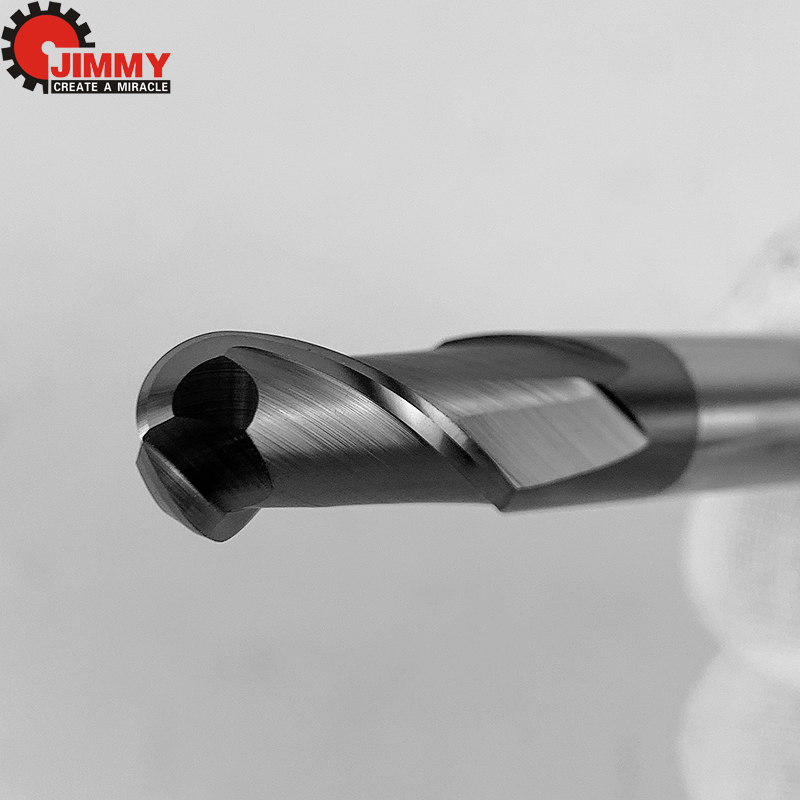
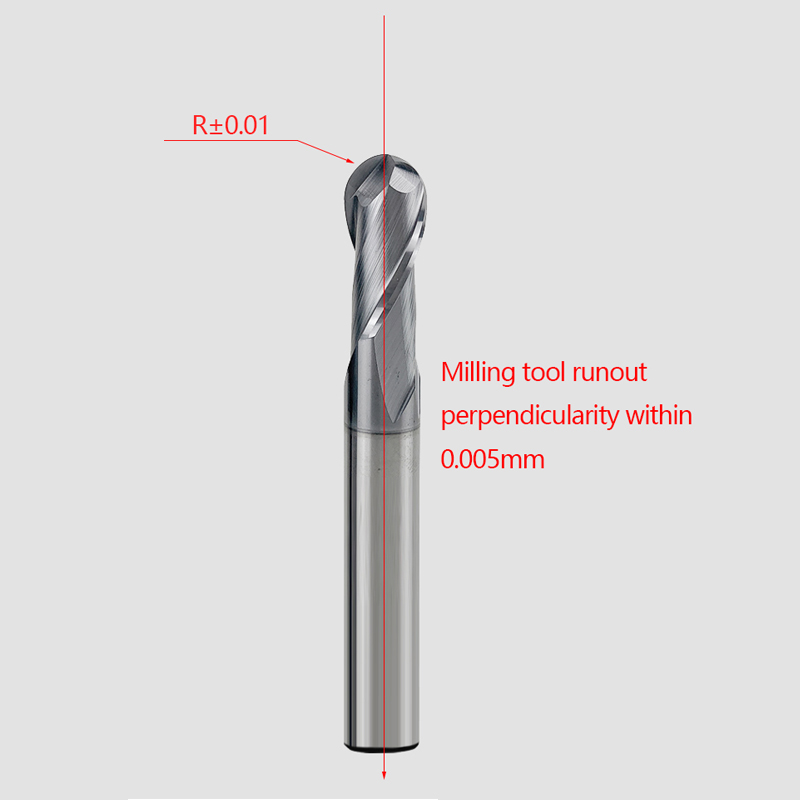
Ball nose end mill manufacturing utilizes advanced materials and precision grinding technologies to achieve the exacting specifications required for three-dimensional machining applications. Solid carbide has become the standard material choice for most precision applications, providing the necessary combination of hardness, wear resistance, and structural integrity to maintain spherical geometry through extended use under demanding conditions. The manufacturing process involves sophisticated grinding operations that generate precise spherical forms while maintaining dimensional accuracy across the entire cutting surface. Common tool diameters range from miniature sizes for detailed work to larger diameters for substantial surface area machining, with selection dependent on specific feature requirements and machine capabilities.
Geometric design considerations extend beyond the basic spherical form to include flute configurations, helix angles, and cutting edge preparations specifically optimized for ball nose applications. Two-flute designs offer maximum chip clearance for materials producing bulky chips or in deep cavity applications where efficient chip evacuation is critical. Three and four-flute designs provide increased edge density for improved surface finishes and higher feed rates in materials with manageable chip formation. Variable helix designs help disrupt harmonic vibrations that can compromise surface quality in extended reach applications or when machining thin-walled components. These geometric refinements work together to enhance tool performance across diverse three-dimensional machining scenarios.
Advanced coating technologies significantly improve ball nose end mill performance by addressing specific wear patterns and thermal conditions. Titanium aluminum nitride (TiAlN) coatings provide thermal protection for elevated temperature applications in difficult materials. Aluminum titanium nitride (AlTiN) coatings offer enhanced high-temperature performance for demanding applications in hardened steels or high-temperature alloys. Diamond-like carbon (DLC) coatings provide exceptional lubricity for non-ferrous materials where built-up edge formation could compromise surface finish. These specialized surface treatments work synergistically with substrate properties and geometric designs to create complete cutting systems optimized for the specific demands of three-dimensional contour machining.
Mold and die making represents the most significant application area for ball nose end mills, where these tools enable precise surface generation for injection molds, die casting dies, and stamping tools. The ability to follow complex curvatures with consistent cutting geometry allows manufacturers to produce cavity surfaces that accurately match design specifications while achieving the surface finishes necessary for proper material flow and part release. In these applications, ball nose end mills typically operate in sequential roughing, semi-finishing, and finishing operations, with tool size reductions at each stage to achieve increasingly precise surface definitions and meet stringent quality requirements.
Aerospace component manufacturing relies heavily on ball nose end mills for complex structural elements, turbine components, airfoil surfaces, and other curved features common in aircraft and propulsion system designs. The contoured surfaces characteristic of aerodynamic components demand the geometric capabilities that ball nose tools provide, particularly when machining from solid billet materials where traditional forming approaches prove impractical. Aerospace applications frequently involve difficult-to-machine materials including titanium alloys, nickel-based superalloys, and high-strength aluminum alloys, necessitating specialized tool geometries and coatings to achieve acceptable tool life and surface integrity.
Medical device manufacturing employs ball nose end mills for orthopedic implants, surgical instruments, and dental components featuring complex curved surfaces that interface with human anatomy. The biocompatible materials common in medical applications present specific machining challenges that ball nose tools address through specialized geometries and cutting strategies. Surface finish requirements in medical applications often exceed those in general manufacturing, as surface irregularities can harbor contaminants or create stress concentrations that compromise device performance. The small-scale features common in medical devices frequently necessitate micro-diameter ball nose tools with exceptional precision and rigidity to maintain dimensional accuracy while producing required surface qualities.
Effective ball nose end mill application requires specialized toolpath strategies designed to leverage the tool's geometric capabilities while managing its limitations. Constant Z-level machining employs sequential horizontal slices at gradually descending elevations, with the ball nose tool following contour lines within each slice. This approach provides predictable engagement conditions and consistent surface finish characteristics but can produce visible step marks between levels. Parallel plane machining utilizes uniformly spaced toolpaths across the surface at a constant angle, generating predictable patterns that facilitate surface quality control. Modern high-speed machining strategies employ constant scallop height toolpaths that adjust stepover distances based on surface curvature to maintain uniform surface finish characteristics across complex geometries.
Stepover distance selection represents one of the most critical parameters in ball nose end mill application, directly influencing both machining time and surface finish quality. Smaller stepovers produce finer surface finishes at the expense of increased machining time, while larger stepovers improve productivity but may compromise surface quality. Typical stepover distances range from 2% to 10% of tool diameter for finishing operations, with roughing applications utilizing larger stepovers to maximize material removal rates. Adaptive stepover strategies adjust distances based on surface curvature, employing larger stepovers on relatively flat areas and reducing distances in regions of high curvature to maintain consistent surface finish quality across complex geometries.
Cutting parameter optimization requires consideration of the variable surface speed inherent in spherical tool geometry. Effective speed selection often involves calculating based on the effective cutting diameter at a specific engagement depth rather than the nominal tool diameter, with adjustments based on material characteristics and specific machining conditions. Feed rate optimization balances material removal objectives with surface finish requirements and tool deflection limitations, while depth of cut strategy varies significantly between roughing and finishing operations. Modern CNC capabilities allow dynamic parameter adjustment during machining operations, optimizing performance based on real-time engagement conditions to maintain consistent results across varying geometric conditions.
Steel and alloy machining with ball nose end mills demands particular attention to tool geometry, coating selection, and parameter strategy. The higher cutting forces characteristic of steel alloys necessitate robust tool designs with adequate core strength to prevent deflection under load. Specialized coatings provide thermal protection for elevated temperatures generated during continuous engagement. For hardened tool steels and die materials, micrograin carbide substrates maintain cutting edge integrity under extreme pressures. Parameter selection typically employs more conservative speeds and feeds than comparable operations in non-ferrous materials, with particular attention to heat management and tool deflection prevention throughout the machining process.
Aluminum and non-ferrous material machining benefits from ball nose end mill geometries specifically optimized for these material families. High helix angles and polished flutes facilitate chip evacuation and prevent material adhesion in continuous cutting conditions. Sharp cutting edges produce clean shearing action that minimizes cutting forces and improves surface finish quality. The excellent thermal conductivity of aluminum allows more aggressive parameters than possible with steel alloys, but requires careful management to prevent thermal expansion issues that could compromise dimensional accuracy in precision components. Proper chip evacuation proves particularly important in deep cavity applications where recutting of chips can rapidly degrade surface finish and tool performance.
Implementation of ball nose end mills requires systematic planning and consideration of both technical capabilities and production workflow requirements. Tool selection should match specific application needs with consideration of material characteristics, geometric requirements, surface finish specifications, and available machine capabilities. Parameter development benefits from systematic testing under controlled conditions, with documentation of optimal settings for specific material and application combinations. Economic analysis should consider both direct tooling expenses and indirect factors including machining time, surface quality requirements, and secondary processing needs to determine the most cost-effective approach for each application scenario. Through proper selection, application, and optimization, ball nose end mills provide essential capabilities for three-dimensional machining applications across diverse manufacturing sectors and industries.
person: Mr. Gong
Tel: +86 0769-82380083
Mobile phone:+86 15362883951
Email: info@jimmytool.com
Website: www.jimmytool.com


