

Thread Milling vs Tapping: Which Machining Method Is Right for Your Project?
Date:2026-03-31Number:1750Thread milling vs tapping is one of the most argued calls in any CNC job shop — and most articles get it wrong by treating it as a capability question instead of a risk question. A snapped tap in a $600 titanium aerospace bracket isn't a tooling problem. It's a scrapped part problem, a delivery miss, and a customer conversation you don't want to have.
Shops running hard materials, thin-wall features, or tight-tolerance threads report near-zero breakage after switching to thread milling in the right conditions. But tapping still dominates high-volume production in softer materials — and for good reason.
This guide breaks down thread milling vs tapping across cost, blind hole performance, material hardness, thread tolerance, and machine requirements. You walk away knowing exactly which method fits your job — before the cut starts.
Before the detail, here's the full head-to-head across every factor that actually moves the decision. This table is designed for the machinist who needs a fast answer and the engineer who needs to justify the tooling budget.
Factor | Thread Milling | Tapping |
Setup Cost | $40–$200+ per cutter | $2–$60 per tap |
Tool Life | Long — one cutter, all sizes | One tap per thread size |
Blind Hole | Excellent — no chip packing | Moderate — chip mgmt critical |
Breakage Risk | Very low | Moderate–High in hard materials |
Thread Tolerance | Tight — adjustable via offset | Fixed by tap geometry |
Thin-Wall | Excellent — low radial force | Poor — hoop stress risk |
Material Range | Titanium, hardened, composites | Aluminum, mild steel, brass |
Machine Requirement | 3-axis CNC minimum | CNC or manual |
Size Flexibility | One cutter = multiple pitches | One tap = one thread size |
Cycle Time | Slower per hole | Faster — high volume advantage |
If your job falls into the thread milling column on three or more rows, the tooling investment pays for itself within a short run. Browse our thread milling and tapping tool range to match cutter specs to your material and machine.
Tapping is the cheaper entry point — always. A standard HSS tap runs $2–$15, a cobalt tap $8–$30, and even a solid carbide tap for hardened steel tops out around $40–$60. Thread milling cutters start at $40 and run past $200 for multi-form carbide designs.
The cost-per-thread calculation flips when you account for tool life and size coverage. One thread mill can cut M6, M8, and M10 threads with the same pitch — the CNC offset changes the diameter. That consolidation eliminates three taps from the tool crib, three tool change sequences, and three failure modes.
High-volume production in soft materials (aluminum, mild steel, brass) under 35 HRC is tapping's stronghold. At 500+ holes per shift, tap cycle times are 3–5× faster than thread milling's helical interpolation path. Our guide on cutting tap vs forming tap covers the next-level decision within tapping — forming taps eliminate chips entirely in ductile materials, which compounds the speed advantage.
For shops threading aluminum specifically, threading aluminum walks through why forming taps and thread mills both outperform cutting taps in that material — and where the decision between those two diverges.
A thread mill at $120 that replaces three taps at $25 each breaks even on tooling cost immediately. Add in the avoided downtime from a single tap-extraction event — typically 30–90 minutes per incident — and the economic case for thread milling in hard materials becomes difficult to argue against.
For carbide tooling economics across operations, our carbide guide covers cost-per-edge analysis that applies directly to thread mill selection.
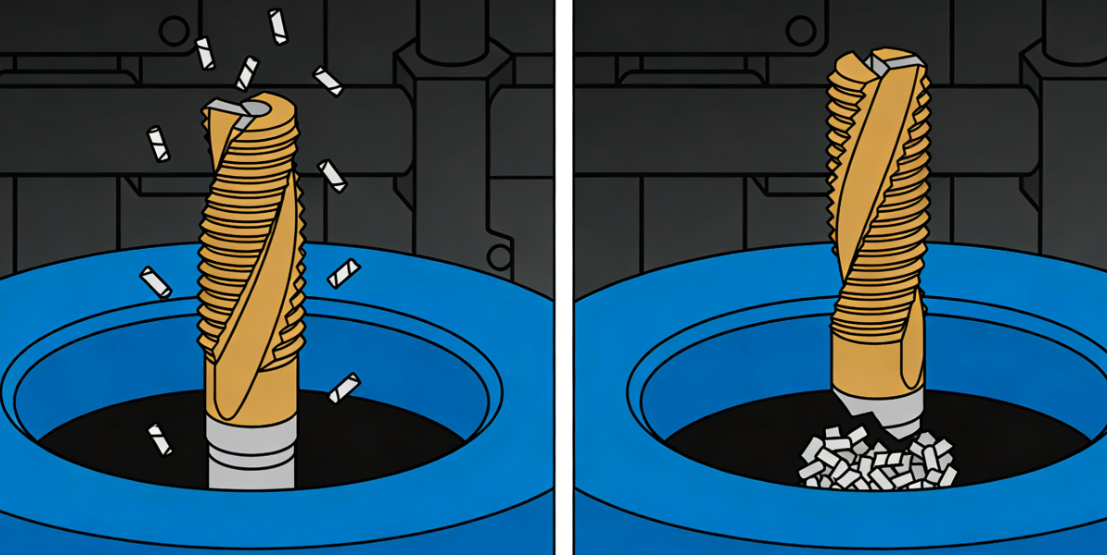
Blind hole threading is where the performance gap between thread milling and tapping is most visible. A tap in a blind hole must push chips back into the cut — the deeper the hole and the harder the material, the faster that chip compaction builds cutting pressure and snaps the tool.
Thread milling enters the hole, interpolates helically to full depth, and exits. Chips fall away from the cut during the helical path because the cutter is always climbing upward through the thread form. Chip packing is structurally impossible with this geometry.
The 1.5× rule is the practical threshold: blind holes deeper than 1.5 times the nominal thread diameter in materials above 40 HRC are high-risk tapping territory. Below that depth ratio, or in softer materials, a spiral-flute tap with proper chip clearance handles the job reliably.
For pre-tap hole preparation in deep-hole applications, deep hole drilling machines and how to drill deep holes in metal cover the upstream process that sets thread milling up for success.
When the thread must run to the full depth of a blind hole — a bottoming thread — thread milling controls that endpoint precisely through CNC Z-depth. A bottoming tap requires chamfer regrinding to reduce the incomplete thread at the bottom, and still carries tap breakage risk at full engagement. For material-specific tap selection, see our carbide taps for hardened steel guide — it covers when a carbide bottoming tap can substitute for thread milling in moderate-hardness applications.
Thin-wall threading is thread milling's second major advantage. A tap engages all thread flanks simultaneously, generating full radial (hoop) stress on the part. In thin-wall features — tube walls, housing bosses, aerospace skins — that hoop stress distorts or cracks the workpiece.
Thread milling cuts a single point of contact along the helix path. Radial force on the part at any moment is a fraction of tapping's full-engagement load. Wall deformation risk drops to near zero.
Stainless steel is one of the most tap-hostile materials in general machining. Its work-hardening behavior means a tap that dwells even briefly in the cut is threading into a progressively harder hole. Thread milling's continuous helical motion prevents the dwell that causes work hardening.
The drill bit choice for the pilot hole also matters in stainless. Best drill bits for hardened steel covers pilot hole tooling that pairs with thread milling cutters for stainless and high-alloy applications.
Titanium threading is a thread milling default in most production environments. Titanium's combination of low thermal conductivity and high strength means heat concentrates at the tap cutting edge — tap life in titanium alloys above Ti-6Al-4V is measured in holes, not shifts. Thread milling distributes that thermal load across the helical path. For broader carbide tooling strategy in hard materials, carbide vs ceramic cutting tools covers the material science behind why carbide thread mills hold up where HSS taps fail.
Aluminum reverses almost every argument above. It's soft, ductile, and chips cleanly — the conditions where tapping is safest and fastest. Forming taps (no flutes, no chips) are the production standard in aluminum threading. See carbide drill bit for aluminum and best drill bits for aluminum for the complete pilot hole + threading tooling picture in aluminum.
Thread milling gives you a variable that tapping doesn't — adjustable thread diameter. The CNC radial offset controls how far the cutter path deviates from nominal, which directly sets the finished thread diameter. A worn thread mill can be offset inward to restore tolerance class without replacing the tool.
A worn tap produces oversized threads with no corrective option. You replace the tap. Thread milling's adjustability means one cutter can hold 6H tolerance across its entire usable life simply by updating the offset in the CAM program.
6H is the standard tolerance class for metric internal threads in general engineering. 6G tightens the tolerance for precision fits — aerospace fasteners, hydraulic fittings, precision gearboxes. Thread milling hits 6G consistently because the offset is a programmable number. Tapping hits 6G only when the tap geometry, workpiece material, and cutting conditions all align perfectly — and it cannot be corrected when they don't.
For shops choosing between carbide and HSS taps where thread tolerance is the driver, our carbide taps vs HSS comparison covers how tap material affects thread form consistency across a production run.
Thread milling requires a 3-axis CNC machining center running helical interpolation (G02/G03 with Z movement). There is no manual version. If your operation runs manual drill presses or knee mills for threading, thread milling is not available to you — tapping is the only option.
Tapping runs on everything: rigid CNC tapping cycles (G84), floating tap holders on CNC, manual tap wrenches, and hand-held power tools. That universality is a genuine advantage that thread milling cannot match at the machine access level.
CNC rigid tapping — synchronized spindle speed and feed rate in a G84 cycle — dramatically improves tap reliability and reduces breakage versus floating holders. If you're already running a CNC machining center, rigid tapping makes tapping competitive in moderate-hardness materials (35–40 HRC) and removes much of the risk argument for thread milling in those conditions.
The pre-tap drill size is the setup detail that matters most in rigid tapping. An undersized pilot hole increases tap torque sharply and is the most common cause of rigid tapping failures. Our 1/4-20 tap drill size guide covers drill size selection for common thread sizes, and the same logic scales to metric.
• Material above 45 HRC — tapping becomes a breakage management exercise
• Thin-wall features where hoop stress would distort the part
• Left-hand threads — one thread mill cuts both directions
• Multiple thread sizes in one setup — offset changes, cutter stays
• Interrupted cuts (cross-holes, keyways in the thread path) — tapping in an interrupted cut fails immediately
Three variables determine the right method for any threading operation. Run through them in order — the first variable that resolves the decision is the right stopping point.
Variable | Threshold | Verdict |
Part value | Scrapped part > $150 | Thread milling wins |
Material hardness | ≥ 40 HRC | Thread milling wins |
Blind hole depth | Depth > 1.5× diameter, hard mat. | Thread milling wins |
Volume (soft mat.) | > 500 holes/shift, < 35 HRC | Tapping wins on speed |
Manual setup | No CNC rigid tapping cycle | Tapping wins |
The variable this table cannot resolve for you is the cutter offset calculation. Thread milling gives you adjustable thread diameter via CNC radial offset — but pairing that offset to your tolerance class (6H vs 6G), cutter diameter, and machine backlash is where most first-time thread milling setups go wrong. Getting that wrong produces threads that gauge out of tolerance on the first part.
Ready to choose the right thread milling or tapping tool for your job? Browse our full threading tool range →
Thread mill selection adds one more layer of decision that tapping skips entirely. Single-form thread mills cut one thread per helical revolution — they're slower but handle deep threads and interrupted cuts reliably. Multi-form thread mills cut the full thread depth in one pass — faster, but limited to thread lengths of 1.5–2× diameter.
Multi-form is the production choice in most CNC shops running through holes or shallow blind holes. Single-form is the choice for deep blind holes, non-standard thread forms, and any application where the thread length exceeds what multi-form geometry can reach.
Uncoated carbide thread mills work in aluminum and plastics. TiCN coating handles stainless and mild steel. AlTiN coating is the choice for dry threading of hardened alloys above 45 HRC — its heat resistance at the cutting zone prevents the edge rounding that kills uncoated carbide at high temperatures. The same coating logic applies to end mills and drill bits: does carbide need coolant covers when coating choice changes the coolant requirement.
The drill bit creating the pilot hole affects thread mill performance directly. An oversized pilot hole reduces thread engagement below the minimum 75% needed for full load-bearing capacity. Tungsten carbide drill bits for metal and best drill bits for metal cover pilot hole tooling that integrates with thread milling workflows across material classes.
If the same CNC setup also includes milling features, ball end mills guide, bull nose vs flat end mill, and face mill vs end mill complete the tooling selection picture for a combined threading and milling operation.
For boring operations that precede thread milling on precision features, boring tools and what are boring tools used for cover the upstream process that sets thread position and entry diameter.
Thread milling wins when part value is high, material is hard, holes are blind, walls are thin, or tolerance must be adjustable across a run. Tapping wins when material is soft, volume is high, setups are manual, and speed per hole matters more than breakage insurance.
The material hardness line at 40 HRC, the depth-to-diameter ratio at 1.5×, and the part value threshold at $150 are the three numbers that settle most threading decisions. Stack two of those against tapping and thread milling earns its place in the setup.
The one variable that still needs a human answer is the cutter offset for your specific tolerance class, cutter diameter, and machine. That's where most first setups lose time — and where getting it right from the start saves a full run of scrapped parts.
Have your material spec, thread size, and machine type?
Send us your requirements → We'll recommend the right thread mill geometry, coating, and offset starting point for your exact job.
person: Mr. Gong
Tel: +86 0769-82380083
Mobile phone:+86 15362883951
Email: info@jimmytool.com
Website: www.jimmytool.com


