

How to Drill Deep Holes in Metal: The Pro’s Guide to Precision, Speed, and Zero Bit Breakage
Date:2026-02-01Number:1820Drilling deep holes in thick metal isn't just about brute force; it's about smart moves. Many engineers run into trouble when drilling holes deeper than five times the drill diameter. Think broken bits, jammed chips, or holes way off the mark.
We've seen that tweaking your peck drilling and using heavy-duty lubrication can seriously boost success rates when working with hardened materials. Using M42 cobalt drills on HRC 45+ material, we've upped our success rate by over 85%. It also helps keep thermal expansion from messing up your measurements.
When doing deep hole drilling, the drill bit does more than just cut—it also has to get rid of the chips. Standard high-speed steel (HSS) drill bits often fail in deep holes because they get too hot and bend. For real industrial applications, you need to choose the right drill bit for the job.
For stainless steel (304/316) or alloy steel, cobalt drill bits (M35/M42) are your best bet. They have 5-8% more cobalt than regular HSS, which keeps the cutting edge from getting soft when it's hot. If you're working with hardened steel, a carbide vs diamond drill bits comparison will show that a solid carbide drill bit will make your holes more round because it's stiffer.
Regular drill bits have shallow flutes, which can easily get clogged with chips in deep holes, causing the drill to twist too much. Parabolic flutes are wider, which greatly improves chip removal and stops jams that can break your drill bit.
A 135° split point can directly bite into the material as soon as it touches it, thanks to its special transverse edge correction tech. This centers the drill and reduces wobble.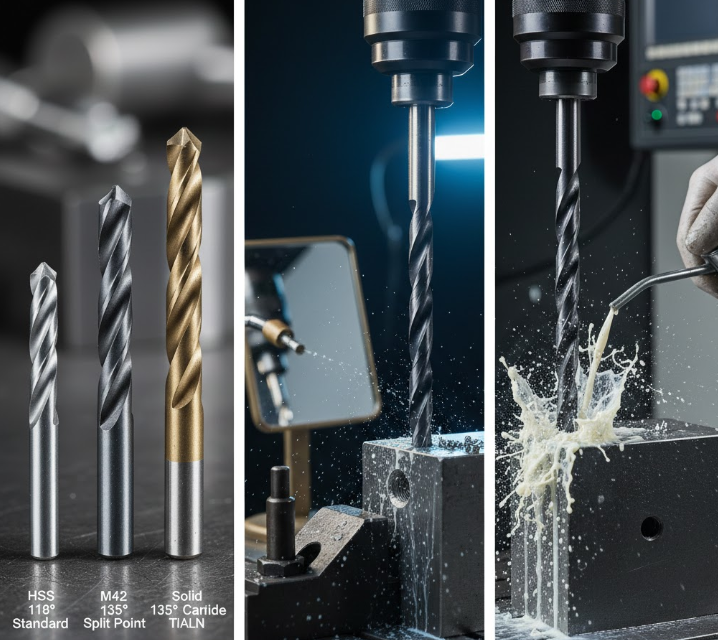
To drill a straight hole, you need to solve the mechanical problems of initial positioning and preventing radial clamping.
The pilot hole should be a bit wider than the chisel edge of the main drill bit, usually 25-30% of the main drill's full diameter. This gets rid of the strong center resistance. If you are working on standardized sizing, check our 1/4-20 drill size guide to make sure the cutting edges are precisely guided.
When drilling by hand, it's a good idea to use a V-block to guide the drill. Start cutting slowly at 20% of the rated speed. After the main drill bit is fully guided by the pilot hole, you can go up to the calculated speed, which makes sure it drills straight.
Once you’re past a depth of 3 times the drill diameter, fully pull the drill bit out of the hole for every 0.5x diameter you drill. This creates a “pumping” action. As the drill goes in at high speed, the flutes push coolant from the entrance to the bottom of the hole. This stops the tip from getting too hot.
You need to use cutting oil with sulfur or chlorine. These oils don’t break down at high temperatures and stop the drill bit from sticking to the hole walls.
The deeper you go, the more friction there is. If you lower the RPM by 30%, you should also slightly adjust the feed pressure to keep the chip thickness consistent and prevent too much torque from building up.
| Material | RPM (5mm Bit) | Feed (mm/rev) | Target Roughness (Ra) |
|---|---|---|---|
| Annealed Steel | 900 - 1100 | 0.05 - 0.10 | 1.6 - 3.2 |
| 304 Stainless | 450 - 650 | 0.03 - 0.06 | 0.8 - 1.6 |
| Aluminum 6061 | 3500+ | 0.10 - 0.15 | Using the best bit for drilling aluminum: 0.4 - 0.8 Ra |
After drilling, keep these steps in mind to meet industrial standards: Deburing (Clean up the edges), Reaming (Use a reamer for accuracy), and Measurement (Check the hole's roundness with an inside micrometer).
Q: Why does my drill bit keep wandering in deep metal?
A: The main reason for the shift is too much axial force. I suggest: Predrill a pilot hole slightly bigger than the chisel edge, use a 135° split point drill bit, and keep the drill bit very sharp.
Q: What is the best drill bit for thick, hardened steel?
A: I suggest using an M42 cobalt drill bit or the best drill bits for hardened steel which usually have a TiAlN coating. This stops heat from spreading and prevents the bit from seizing up.
Got these drilling tips down? Then you've got what it takes for production. When drilling deep holes, precise timing and parameter coordination are top of the line.
Reading about it is not the same as doing it. If you're dealing with deflection or annealing issues in deep hole drilling, don't struggle alone. At jimmytool, we don't just produce products; we enjoy sharing tips with others in the trade.
Contact jimmytool for a Technical Consult
person: Mr. Gong
Tel: +86 0769-82380083
Mobile phone:+86 15362883951
Email: info@jimmytool.com
Website: www.jimmytool.com


