

Titanium Ti-6Al-4V Machining: Stop Burning Up End Mills (Tool Life Fixes)
Date:2026-04-22Number:1543You start machining a Ti-6Al-4V part with a brand-new carbide end mill. Parameters look conservative. Coolant is on. Yet within 20 minutes, the tool tip glows red, the flutes pack with chips, and the cutting edge is completely burned.
If this sounds familiar, you're not alone. Ti-6Al-4V (Grade 5 titanium) is the most widely used titanium alloy in aerospace, medical, and automotive industries—but it's also one of the most destructive to carbide tooling when the process isn't optimized.
At JimmyTool, we've manufactured custom carbide tools for titanium applications for over 15 years. In this article, we'll explain exactly why Ti-6Al-4V burns up end mills, and what you can change—in tool design, coolant delivery, and cutting strategy—to stop it.
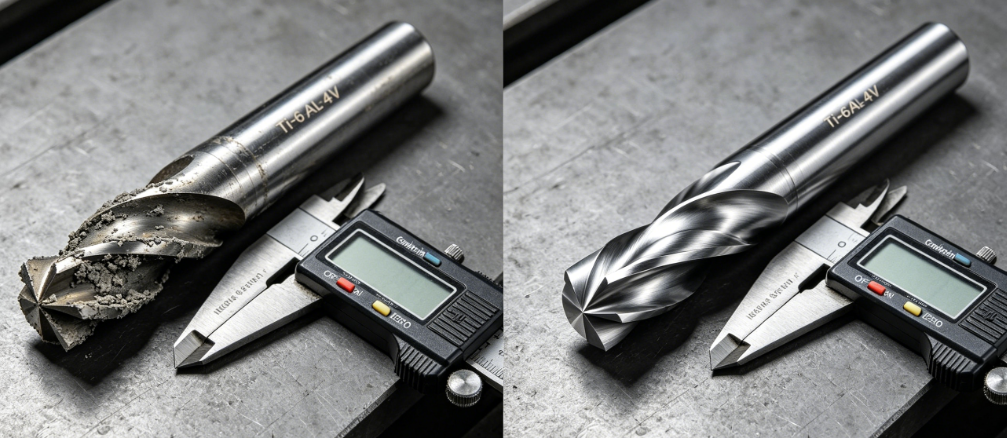
To fix the problem, we first need to understand the thermal physics of Ti-6Al-4V machining. Unlike steel or even Inconel, titanium attacks cutting edges through three specific mechanisms:
1. Extremely Low Thermal Conductivity
Titanium conducts heat about seven times slower than steel. In practical terms, heat generated during cutting cannot escape through the chip or the workpiece. Instead, over 80% of the heat stays right at the tool tip. This localized temperature spike—often exceeding 1000°C—rapidly softens the cobalt binder in carbide, leading to plastic deformation and catastrophic edge failure.
2. High Chemical Reactivity at Elevated Temperatures
At cutting temperatures above 500°C, titanium becomes highly reactive. It chemically bonds with many tool materials, including the tungsten carbide itself. This diffusion wear pulls cobalt out of the tool matrix, weakening the edge and accelerating crater wear on the rake face.
3. Low Elastic Modulus and Workpiece Deflection
Titanium is "springy." It deflects under cutting pressure and then springs back, rubbing against the flank face of the tool. This rubbing generates additional frictional heat and accelerates flank wear.
JimmyTool Shop Observation: When we analyze failed tools from titanium jobs, the dominant failure mode is rarely chipping—it's thermal softening combined with severe flank wear and built-up edge. Standard tools designed for steel simply cannot manage the heat load.
Upload Your Drawing for a Custom Titanium Tool Quote →
Here are four actionable adjustments that directly address titanium's thermal and chemical challenges.
Unlike Inconel, which benefits from a reinforced cutting edge, titanium demands sharp, high-positive rake angles (12° to 18°) and a minimal edge hone. A sharp edge shears the material cleanly with less cutting force and less frictional heat. Heavy edge hones or neutral/negative rake angles increase ploughing, which skyrockets temperatures.
JimmyTool Custom Approach: For titanium applications, we grind end mills with high helix angles (45°+) and polished flutes to reduce chip adhesion. This geometry significantly lowers cutting temperatures and improves chip evacuation.
Related Product: Explore our Custom Carbide End Mills for Aerospace Titanium designed with high-positive rake geometries and polished flutes specifically for Ti-6Al-4V.
AlTiN (purple/black) coatings work well for steel, but in titanium, they can react chemically at high temperatures. Instead, we recommend:
AlCrN (Aluminum Chromium Nitride): Offers excellent oxidation resistance and forms a protective aluminum oxide layer at high temperatures, acting as a thermal barrier.
TiB2 (Titanium Diboride): Specifically designed for titanium and aluminum alloys. It has extremely low chemical affinity for titanium, preventing built-up edge and crater wear.
Post-Coating Polishing: Regardless of coating type, a polished surface finish is critical. It reduces friction and prevents titanium chips from welding to the tool.
Flood coolant is nearly useless in titanium milling because the steam barrier at the cutting zone repels the fluid. High-pressure coolant (70+ bar / 1000+ psi) delivered through the tool is essential. It breaks the steam barrier and delivers coolant directly to the hottest point.
JimmyTool Design Integration: We can position coolant holes to exit on the flank face near the cutting edge, providing targeted cooling where heat generation is maximum.
The optimal cutting strategy for Ti-6Al-4V is trochoidal (dynamic) milling with a small radial engagement (5-10% Ae) and climb milling. This allows the cutting edge to spend most of each revolution in the air, cooling down between cuts. Never use conventional milling in titanium—it traps heat and rubs the flank face.
| Parameter | Recommended Starting Point (12mm 4-Flute Carbide End Mill) |
|---|---|
| Cutting Speed (Vc) | 50-70 m/min |
| Feed per Tooth (fz) | 0.08-0.12 mm/tooth |
| Radial Engagement (Ae) | 5-10% of tool diameter |
| Axial Depth (Ap) | Up to 1.5 x tool diameter |
| Coolant Pressure | 70+ bar (1000+ psi) through-tool |
Get a Custom Tool Quote: If you're machining complex titanium components and need a tool tailored to your exact part geometry, upload your drawing here for a same-day quote from our application team.
Standard catalog tools are designed for general-purpose use. For demanding Ti-6Al-4V applications—especially in aerospace structural parts or medical implants—a custom tool can be the difference between profitable production and constant downtime.
Consider custom tooling when:
Deep cavities require extended reach without sacrificing rigidity.
Thin floors and walls demand specialized geometries to reduce cutting pressure.
Multi-operation parts could benefit from a single custom form tool that combines roughing and finishing.
At JimmyTool, we engineer each custom titanium tool with the specific rake angles, helix angles, coating, and coolant hole placement required for your application. The result: predictable tool life, stable processes, and lower cost per part.
Burning up carbide end mills in Ti-6Al-4V is a direct consequence of heat mismanagement. By switching to sharp, positive rake geometries, selecting low-friction PVD coatings, using high-pressure through-tool coolant, and adopting trochoidal toolpaths, you can dramatically reduce tool failures and stabilize your titanium machining process.
Struggling with a specific titanium part right now?
Don't let tool failure dictate your production schedule. Share your part drawing and current challenges with us. Our application engineers will recommend a custom carbide solution designed specifically for Ti-6Al-4V.
Upload Your Drawing for a Custom Titanium Tool Quote →
Q1: Why does Ti-6Al-4V cause carbide end mills to burn up so quickly?
Ti-6Al-4V burns up carbide tools due to its extremely low thermal conductivity (heat concentrates at the tool tip), high chemical reactivity at elevated temperatures (diffusion wear), and low elastic modulus (workpiece spring-back causes rubbing friction). These factors combine to create localized temperatures exceeding 1000°C at the cutting edge, softening the carbide and accelerating wear.
Q2: What is the best coating for carbide end mills when machining Ti-6Al-4V?
AlCrN (Aluminum Chromium Nitride) and TiB2 (Titanium Diboride) are excellent choices. AlCrN forms a protective aluminum oxide layer at high temperatures, acting as a thermal barrier. TiB2 has very low chemical affinity for titanium, preventing built-up edge. Post-coating polishing is recommended for both to reduce friction.
Q3: Does high-pressure coolant really help when milling titanium?
Yes—significantly. High-pressure (70+ bar) through-tool coolant breaks the steam barrier that forms at the cutting zone, delivering coolant directly to the hottest point. Studies show it can improve tool life by 300-500% compared to flood coolant in titanium machining.
Q4: What are the recommended cutting parameters for Ti-6Al-4V with a 12mm carbide end mill?
Cutting Speed (Vc): 50-70 m/min
Feed per Tooth (fz): 0.08-0.12 mm
Radial Engagement (Ae): 5-10% of tool diameter
Axial Depth (Ap): Up to 1.5 x tool diameter
Always use climb milling and trochoidal toolpaths. These are starting points; optimize based on your specific machine rigidity and coolant pressure.
Q5: Why is a sharp cutting edge better than a honed edge for titanium?
Titanium requires a sharp, high-positive rake edge because it shears cleanly with less cutting force and less frictional heat. Heavy edge hones or neutral rake angles increase ploughing and rubbing, which dramatically raises cutting temperatures and accelerates wear.
Q6: Can I use the same tools and parameters for Ti-6Al-4V and commercially pure titanium (Grade 2)?
No. Commercially pure titanium is softer and more ductile, requiring different geometries and parameters. Grade 2 tends to produce long, stringy chips and may benefit from chip breaker geometries. Ti-6Al-4V is harder and more abrasive, demanding sharper edges and more heat-resistant coatings.
Q7: When should I consider a custom carbide tool for titanium instead of a standard catalog item?
Consider custom tooling when machining deep cavities (requiring extended reach), thin-walled features (needing low cutting pressure), or complex profiles that could combine multiple operations. A custom tool optimized for your specific part geometry often reduces cycle time and overall tool cost per part.
person: Mr. Gong
Tel: +86 0769-82380083
Mobile phone:+86 15362883951
Email: info@jimmytool.com
Website: www.jimmytool.com


