

Cobalt Drill Bits vs Carbide: How to Choose the Best Material for Metal Drilling
Date:2026-02-08Number:3412When drilling 304 stainless steel or high-hardness alloy steel, selecting the wrong drill bit material not only risks burning out the tool but also leads to the entire expensive workpiece being scrapped if the drill breaks off deep inside the hole.
Based on our industrial test data, when machining materials above HRC 35, M42 cobalt drill bits demonstrate four times the heat resistance of standard HSS, while carbide bits achieve over five times the output efficiency in CNC environments.
This article dissects the performance threshold of 8% cobalt content, reveals why high-priced carbide bits often break in handheld drills, and provides a cost-saving decision matrix for minimizing per-hole costs.
Before diving into technical specifications, you need this quick selection dashboard. Often, more expensive doesn't mean better—material choice depends entirely on your machining environment.
Radar Chart Highlights:
Hardness: Carbide nearly reaches the outer ring's top, while Cobalt sits in the middle range.
Toughness: Cobalt holds a clear advantage, withstanding vibrations; Carbide occupies a smaller area.
Heat Resistance: Both perform excellently, but Carbide has a higher critical threshold.
Price: Cobalt covers a larger area (indicating better value/lower cost), while Carbide sits in the central high-price zone.
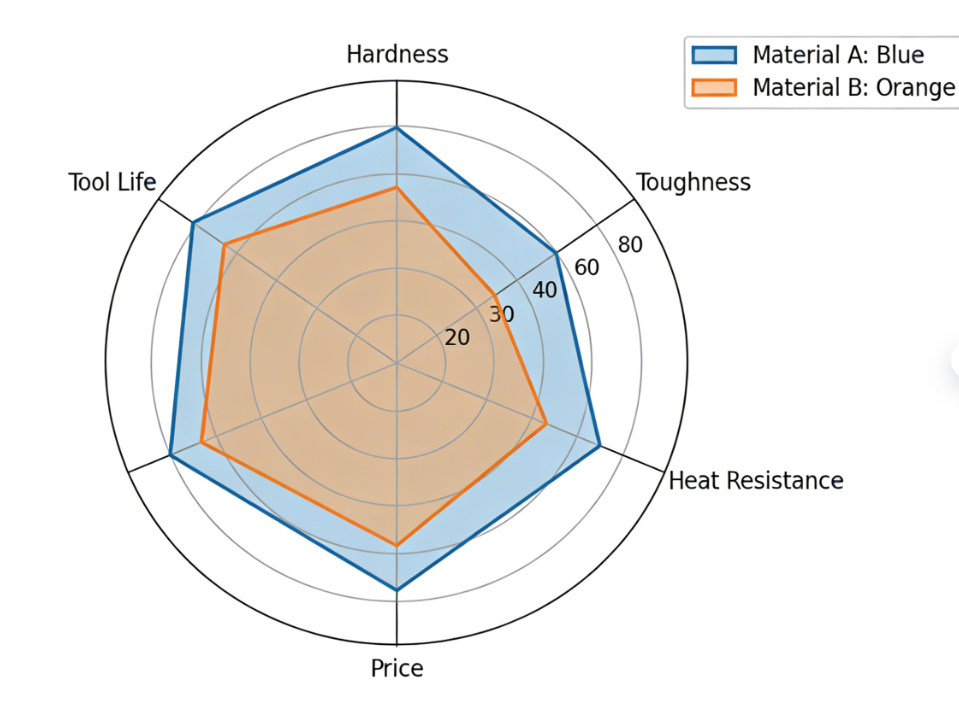
If your machining environment is unstable (e.g., handheld drills, magnetic drills), cobalt is your lifesaver. Its toughness absorbs impact without shattering. But if you're pursuing 100 holes per minute on an automated production line, carbide is the only productivity tool.For a deeper dive into extreme-hardness alternatives, check our comparison on
When you search for Metal Cobalt Drill Bits, you'll find two grades: M35 and M42. Their only difference lies in cobalt content: M35 contains 5%, while M42 contains 8%.
This 3% difference determines the drill bit's red hardness. During continuous cutting, the drill tip temperature rapidly soars. Standard high-speed steel softens at 400°C, whereas M42 cobalt drills maintain cutting edge hardness up to 650°C. This allows you to use higher spindle speeds without worrying about the drill bit instantly rounding off.
However, here's an industry pitfall guide: When machining aluminum alloys, avoid high-cobalt drill bits whenever possible. Cobalt exhibits strong chemical affinity with aluminum at high temperatures, causing aluminum to rapidly adhere to the cutting edge and form built-up edge (BUE). This can ultimately enlarge the hole diameter or cause the drill to seize.To see what actually works for these non-ferrous metals, refer to our guide on the
Many people encounter a frustrating experience when trying carbide drill bits: a brand-new, expensive bit snaps on the very first cut. This is usually not a quality issue, but rather an underestimation of carbide's “brittleness.”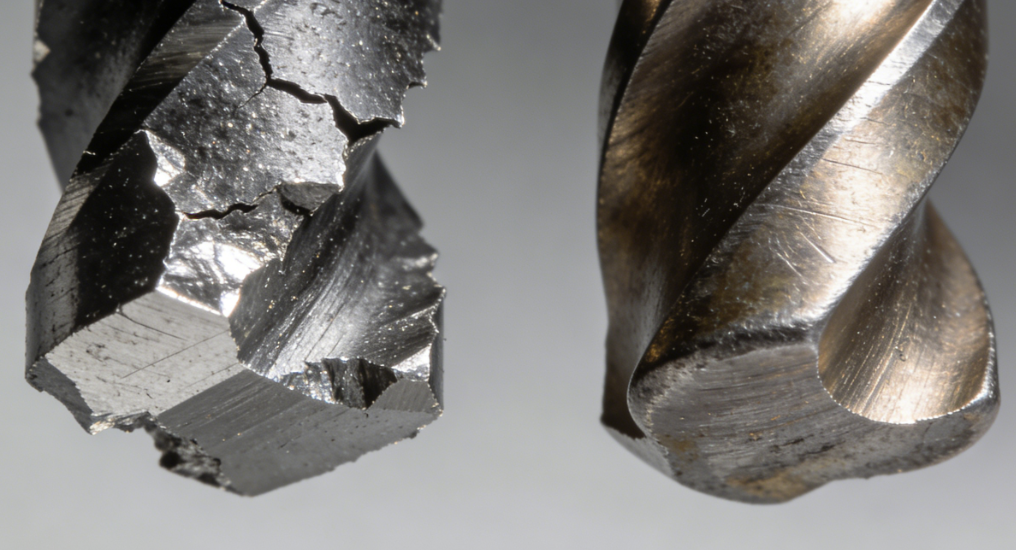
While carbide is three times harder than high-speed steel, its extremely high elastic modulus leaves virtually no room for deformation. In industrial testing, an 8mm carbide drill bit will experience brittle fracture at the cutting edge if your machine tool spindle has radial runout exceeding 0.02mm or if the workpiece clamping exhibits even slight vibration—such minute displacement is sufficient.
This is why we often say: Carbide is born for CNC machines, while cobalt drill bits reign supreme in job shops. If your equipment lacks rigidity, forcing carbide use will cost you $50 in under 10 seconds.
Regarding the classic question “What are the best drill bits for stainless steel?”, the answer lies not only in the material but also in the drill bit's “geometric characteristics.”
When machining 304 or 316 stainless steel, the greatest concern is “work hardening.” Once the drill bit skids and rubs against the material surface, that layer of metal rapidly hardens beyond the drill bit's own strength. To address this, ensure the drill bit features a 135° Split Point. This design allows the bit to immediately bite into the workpiece upon contact, preventing surface skidding.
Additionally, to counter the stickiness of 300 series stainless steel, we recommend using a 35° large helix angle. This design rapidly evacuates heat and long chips like an exhaust hood. Remember the principle for machining stainless steel: low RPM, high feed rate, and ample coolant. If coolant concentration falls below 10%, even the finest cobalt drill bits will inevitably burn out.
This is the most common pitfall factories fall into when upgrading tools: purchasing top-tier drill bits while still using ordinary flat-jaw vices and standard three-jaw drill chucks.
For carbide drill bits, the precision of the clamping system (T.I.R.) directly determines their lifespan. The runout of standard three-jaw chucks typically exceeds 0.05mm, which is essentially a death sentence for carbide drill bits. We strongly recommend using shrink-fit holders or hydraulic chucks for CNC machining. These fixtures control runout to within 0.003mm, ensuring even force distribution across every cutting edge of the drill bit at all times.
Additionally, the shank type must match your machining depth. For deep-hole drilling, cobalt drills with Morse taper shanks offer superior stability during high-torque cutting due to their self-locking properties. This prevents drill slippage within the chuck, effectively eliminating stripping damage.
When you see a drill bit with a golden or jet-black surface, it's not for aesthetics—it's a critical coating that determines your cutting speed (Vc).
In dry machining or minimal lubrication environments, AlTiN (aluminum titanium nitride) coating is the ideal partner for cobalt drills and carbide tools. Its most remarkable feature is that as cutting temperatures rise, the aluminum in the coating reacts with oxygen in the air to form an ultra-thin protective layer of aluminum oxide. This layer acts like a heat shield, instantly boosting the cutting speed of a Metal Cobalt Drill Bit by 30%-50%.
For machining ordinary low-carbon steel, a basic TiN (titanium nitride) coating suffices. However, when processing titanium alloys or Inconel high-temperature alloys, it is essential to select a composite coating containing silicon or higher aluminum content.
In B2B procurement, the initial cost of a single drill bit is often misleading. You must evaluate it from the perspective of total cost of ownership (TCO).
Although the purchase price of an 8mm Carbide Drill Bit may be three times that of a cobalt drill, its Cost Per Hole is usually much lower on high-volume production lines. The exceptional wear resistance of carbide means fewer tool changes and reduced downtime. However, you must factor in the hidden variable of “regrinding.”
Cobalt-tipped drills support manual regrinding; even a standard grinding wheel can restore them to working condition. Carbide drills, however, require professional technicians operating 5-axis CNC tool grinders and must undergo PVD coating reapplication. If your facility lacks this specialized equipment or reliable regrinding services, the flexibility advantage of cobalt-tipped drills becomes irreplaceable.
Absolutely. Due to its excellent toughness and lack of the extreme brittleness found in carbide, you can manually regrind them using an aluminum oxide grinding wheel or a CBN wheel. It is recommended to maintain the original 135° helix angle, which is crucial for center alignment.
This is a common misconception. The opposite is true: carbide is significantly harder than cobalt. Carbide typically has a Vickers hardness between 1400-1800 HV, while high-cobalt steel only reaches around 800-900 HV. The difference lies in their properties: carbide is “harder,” while cobalt drills are “tougher.”
If excessive run-out isn't the cause, it's usually due to an overly low feed rate. When machining hard materials, a too-light feed causes the drill to grind against the surface, generating intense heat that rapidly anneals or fractures the cutting edge. Remember: bite in, don't grind in.
Match your current situation:
Outdated equipment, manual operation, or unstable workpiece clamping? — Choose M35/M42 Cobalt. It forgives your mistakes.
High-rigidity CNC, high-volume production, or chasing the ultimate cycle time? — Invest in Solid Carbide. The efficiency gains will make it worth every penny.
Extra-large bore, heavy steel structures, limited budget? — Consider Carbide Tipped for a balance of rigidity and procurement costs.Explore our
If you're still struggling with a specific titanium alloy machining task, or unsure whether your spindle precision supports carbide tools, contact our engineers directly for a customized cutting parameter sheet.
person: Mr. Gong
Tel: +86 0769-82380083
Mobile phone:+86 15362883951
Email: info@jimmytool.com
Website: www.jimmytool.com


