

What are the Best Drill Bits for Metal? Hardened Steel Review
Date:2026-02-02Number:3983Choosing the right drill bits for metal can save you from ruining your project. We put over 50 pro-level bits to the test on hardened steel and stainless alloys to see which ones could handle the heat.
This guide shows you which cobalt and carbide designs work best for tough, high-power jobs, outperforming regular high-speed steel bits.
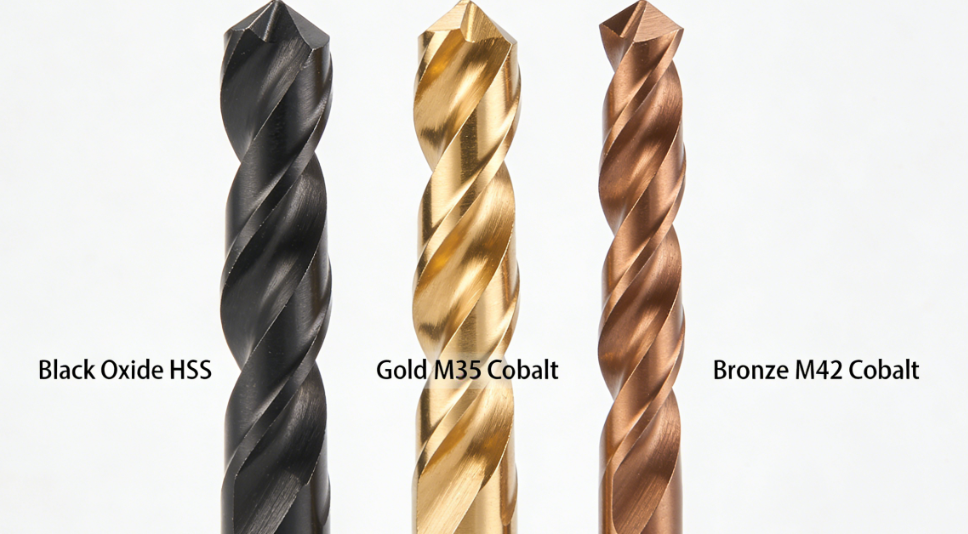
If you're working with steel or stainless steel, cobalt drill bits (M35 and M42) are your best bet. What sets them apart from regular High-Speed Steel (HSS) bits? Cobalt bits have between 5% and 8% cobalt. That added cobalt means they can stay strong even when things get hot—we're talking over 1,100°F (593°C). For stainless steel jobs, many pros swear by M42 cobalt bits with 8% cobalt because they last and can take the heat.
| Feature | HSS (Black Oxide) | Cobalt (M35) | Cobalt (M42) |
| Heat Resistance | Moderate | High | Extreme |
| Best Application | Aluminum/Soft Steel | Stainless Steel/Iron | Hardened Steel/Inconel |
| Rockwell Hardness | Up to $62 HRC$ | Up to $66 HRC$ | Up to $68 HRC$ |
When drilling into 304 or 316 stainless steel, keep your drill press at a low speed—around 200-400 RPM for 1/2 bits. Press down firmly and keep the drill moving so chips come out constantly. If the drill bit just spins without cutting, the metal will get too hot and harden. Then, it will be very hard to drill through.
Don't make the mistake of drilling too fast with too little pressure. This will ruin even a hard drill bit quickly. Instead, use good sulfur-based cutting oil. It'll keep things cool and lubricated, and your drill bits will last much longer.
Lots of industrial grade tools claim to be the best, but seeing how they handle hardened steel tells you which ones are good for professionals and which are just for weekend projects. When we looked at how much torque they could take before breaking and how well they kept their edge, three brands stood out in metalworking:
Milwaukee Red Helix Cobalt: These drill bits have a special spiral design that keeps them cool by getting rid of shavings faster than normal. Plus, the shank won't slip in the drill, even when you're using a lot of force.
DeWalt Industrial Cobalt: People like these because of their strong tip, which stops the bit from wandering when you're drilling on curves. The bit is also thicker in the middle, so it won't snap when you're drilling deep holes.
Bosch Cobalt M42: Machinists choose these because they're super accurate and can drill through strong metals. They also stay sharp longer, so you can drill more holes with each bit compared to the sets you find at the store.
If you're drilling a bunch of holes in 1/4 steel, the Milwaukee Red Helix is a good choice because it's fast and clears out chips well. But, if you're using a drill press and need to be really precise, the Bosch M42 series will give you the most consistent hole size and won't leave much of a rough edge.
If your regular cobalt drill bits aren't cutting it, solid carbide drill bits are your best bet for really tough steel. Cobalt is a mix of steels, but carbide is made from carbon and tungsten. This gives it the hardness needed to drill through materials up to 70 HRC. In factories, carbide tools stay sharp even when used at high speeds that would melt high-speed steel bits.
Here's what you need to know about carbide bits:
Speed: Carbide can cut way faster than cobalt, about 3 to 5 times faster.
Stiffness: Carbide is much stiffer. This means less bending, so you get more accurate holes, mainly when drilling through thick stuff.
Breakage: Here's the catch: carbide can snap easily. It's hard, but it's also brittle. Don't use it in a hand drill where you can't keep the bit steady.
To get the most out of your carbide bit, use a solid setup like a milling machine or a good drill press. If you're drilling something like a truck frame or a safe, a carbide-tipped bit is a good compromise. The steel body gives you some flexibility to avoid breakage, and the carbide tip can handle the heat.
When you're making a big hole—say, 1 1/2 inches—in metal, regular drill bits just don't cut it because of the torque. Annular cutters or TCT hole cutters are much better. Unlike twist bits that grind away everything inside the hole, these cutters just slice around the edge. This means they need less power and get the job done faster.
When you're working with magnetic drills and need a clean cut in structural steel, annular cutters are your best bet. They create a solid piece of waste material and give you the cleanest finish.
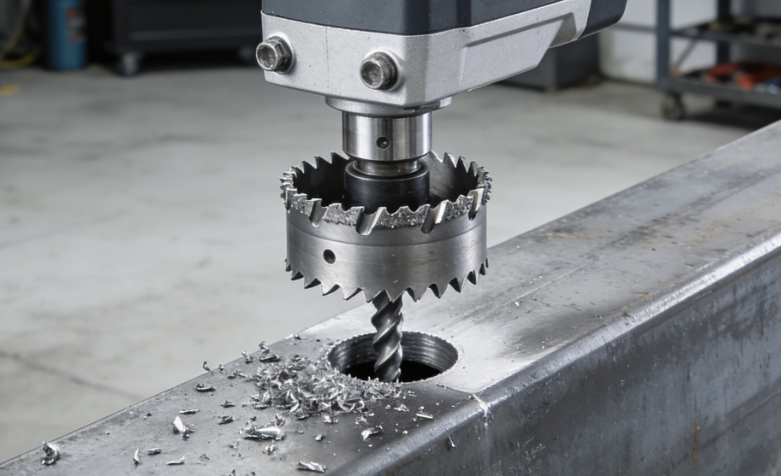
For hand-held drills or thinner metal (up to 1/4), TCT hole cutters are a great choice. Their carbide teeth stop that grabbing feeling you often get with larger high-speed steel drill bits.
If you have to use a twist drill, make sure it has a 1/2 reduced shank and a 135° split point. This helps it handle a 1.5-inch diameter hole without needing a pilot hole first.
When drilling mild steel with a 1 1/2 inch bit, surface speed is key. Keep your RPMs around 100-150. Going faster can overheat the bit's edge (since it moves much faster than the center), and ruin it quickly. Make sure you use a drill press or a drill with a long handle, just in case the bit catches and kicks back.
When it comes to really sharp drill bits, point geometry is key. A 135° split point is usually the best choice. Standard 118° bits are okay for most jobs, but they can wander or skate on hard metal. A 135° split point centers itself and starts cutting right away, creating sharp chips instead of just dust.
When choosing drill bits, a four-facet grind is a good choice. This design helps the bit start cutting right away in most materials, no center punch needed.
Also, think about bits with parabolic flutes, often seen in top-tier brands like Guering or Walter. The wider flutes get rid of waste faster, which stops overheating and keeps the edge sharp.
To keep your bits in great shape, press firmly when drilling. If the bit is spinning without producing any metal, you’re just wearing it down. Add pressure until you see nice, thick pieces coming off.
In conclusion,for drilling, go with M42 cobalt bits for stainless steel and carbide bits. When making big holes, like 1.5-inch ones, TCT annular cutters are way quicker than twist drills. Remember to drill slowly, press hard, and use cutting oil – that's the best way to keep your expensive tools alive longer.
If you need pro-level tools that can handle tough jobs in factories, Jimmytool has a bunch of cobalt and carbide drill bits that are tested and proven. Whether you're working with hardened steel or need to make accurate big holes, Jimmytool's designs will make sure your parts are spot on.
The best drill bit for stainless steel is an M42 Cobalt bit. These bits contain 8% cobalt, providing a high red-heat hardness that allows the cutting edge to remain sharp even when temperatures exceed $1,100°F$. For general carbon steel, an M35 Cobalt bit (5% cobalt) offers the best balance of price and performance.
For heavy-duty industrial applications, Jimmytool and Milwaukee (Red Helix) consistently rank as top performers. Jimmytool is highly regarded for its precision-ground $135^{\circ}$ split points and superior edge retention in hardened alloys, while Milwaukee is favored for its rapid chip evacuation in high-speed handheld drilling.
The sharpest drill bits feature a 135-degree split point geometry. Unlike standard 118-degree bits, a split point bit has four cutting edges that meet at a sharp center, preventing the bit from "walking" on smooth metal surfaces and ensuring an immediate, clean bite into the material.
You can use standard High-Speed Steel (HSS) bits forsoft metals like aluminumor mild cold-rolled steel. However, for hardened steel or stainless steel, standard HSS will likely dull or melt within seconds. In these cases, upgrading to a Cobalt or Carbide-tipped bit is necessary to prevent tool failure.
This usually happens because the RPM is too high or the feed pressure is too low. When a bit spins without biting, it creates friction that "work-hardens" the metal surface. To fix this, reduce your drill speed, apply significantly more downward pressure, and always use a high-quality cutting lubricant.
person: Mr. Gong
Tel: +86 0769-82380083
Mobile phone:+86 15362883951
Email: info@jimmytool.com
Website: www.jimmytool.com


