

Hard Milling Mold Steels (HRC 50-62): Carbide vs. CBN Cost Comparison & ROI Analysis
Date:2026-04-23Number:1671When your mold steel comes back from heat treatment at HRC 50–62, the machining equation changes completely. The same carbide end mill that performed beautifully in the annealed state now wears out in minutes—or worse, chips on the first pass. The immediate thought is often: "Should I switch to CBN?"
The answer isn't a simple yes or no. While PCBN (Polycrystalline Cubic Boron Nitride) tools are legendary for their hot hardness and wear resistance, their upfront cost—typically 8–10 times that of carbide per cutting edge—gives every shop manager pause. Conversely, advanced coated carbide tools have narrowed the performance gap significantly in recent years.
At JimmyTool, we manufacture both premium carbide and CBN tooling for mold and die applications. In this article, we'll move beyond marketing claims and break down the real cost per part of carbide versus CBN in HRC 50–62 hard milling, using shop-floor data and a clear ROI framework.
Before calculating costs, we need to understand what happens at the cutting edge when hardness exceeds HRC 50.
Why Carbide Struggles Above HRC 50
Standard carbide inserts and end mills, even with advanced PVD coatings, face a fundamental limitation at this hardness range. The cutting edge must be harder than the workpiece to shear effectively. When machining H13 or D2 tool steel at HRC 55–62, the heat generated at the cutting zone rapidly softens the cobalt binder in carbide, leading to accelerated flank wear and edge chipping. In practical terms, a carbide tool's life drops sharply—often to less than one hour—when machining H13 mold steel with tool edge hardness insufficient to overcome the workpiece hardness. The hard carbide particles within the tool steel matrix (such as chromium carbides in D2) act as micro-abrasives, eroding the cutting edge even under optimal conditions.
Why CBN Excels in Hard Milling
CBN is the second-hardest material after diamond, with a hardness of 8,000–9,000 HV and thermal stability up to 1,400°C—far exceeding carbide's limits. This means CBN tools maintain their cutting edge integrity at temperatures and pressures that would rapidly degrade carbide. Research has consistently shown that in high-speed milling applications at 20,000 rpm or higher, CBN end mills are vastly superior to carbide in both tool life and surface finish quality. The trade-off? CBN tools are brittle and have poor impact resistance, making them unsuitable for interrupted cuts or unstable setups.
The Critical Nuance: Not All Carbide Is Equal
Advanced coated carbide—specifically ultra-fine grain substrates (0.5–1 μm grain size) with AlCrN or TiAlN coatings—has significantly narrowed the performance gap in recent years. These tools can now reliably machine HRC 50–55 materials with predictable tool life, especially in trochoidal or dynamic milling strategies. The coating acts as a thermal barrier, while the fine grain structure improves wear resistance by 20% or more compared to conventional carbide.
Upload Your Drawing for a Custom Hard Milling Solution →
Tooling cost per part is rarely about the purchase price of a single tool. The true cost equation must account for: tool purchase cost ÷ parts per tool + (cycle time × machine hourly rate) + downtime cost.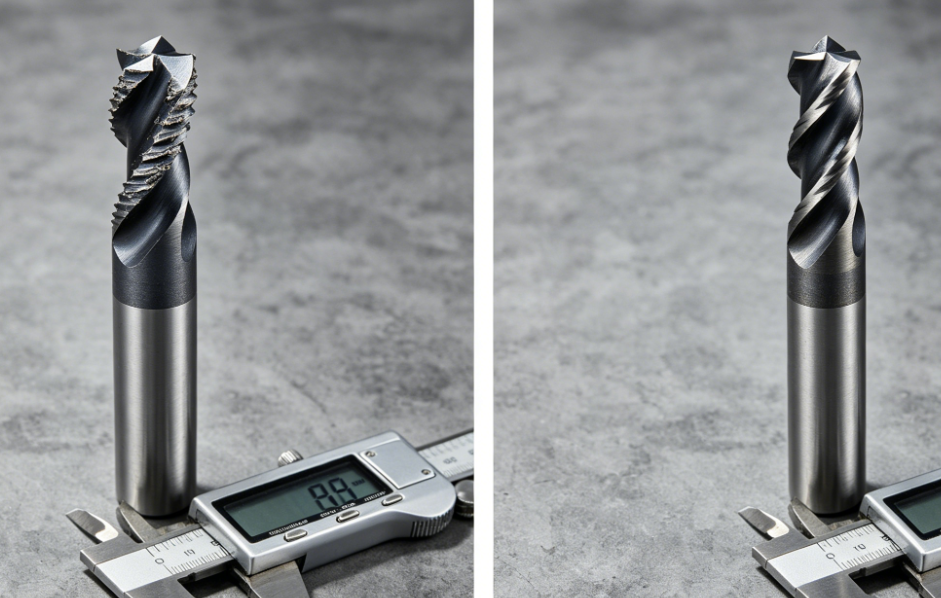
The Numbers at a Glance
| Cost Factor | Premium Coated Carbide | Solid CBN |
|---|---|---|
| Upfront Tool Cost (Ø12mm End Mill) | $50–$200 per tool | $300–$600+ per tool |
| Cost per Cutting Edge | ~$4–$10 | ~$40–$160 |
| Typical Tool Life at HRC 55–62 | 15–45 minutes | 2–5 hours |
| Parts per Tool (Typical Cavity) | 0.5–2 parts | 5–15 parts |
| Cutting Speed (Vc) | 90–180 m/min | 200–400+ m/min |
Related Product: Explore our Custom Carbide End Mills for Hard Milling Mold Steels designed with ultra-fine grain substrates and AlCrN coatings optimized for HRC 50–62 applications.
Cost Model Analysis
The economic crossover point depends heavily on batch size and part complexity. For a single complex mold cavity requiring 3 hours of hard milling, the math shifts decisively:
Coated Carbide: At $80 per tool, replacing every 30 minutes = 6 tools × $80 = $480 in tooling cost, plus 6 tool changes (~30 minutes of downtime).
Solid CBN: At $450 per tool, lasting the entire 3-hour job = $450 in tooling cost, with zero tool-change downtime.
In this scenario, CBN delivers lower direct tooling cost and higher machine utilization, despite the 5.6× higher upfront price. Industry data consistently shows that while solid CBN inserts have a higher upfront cost, their extended tool life—often 5–10× longer—can reduce overall machining costs by up to 40% in high-volume production environments. A detailed case study found that CBN's tooling cost per part can be as low as $0.15 compared to $0.40 for carbide, with the longer life dramatically reducing per-part expense.
The Carbide Advantage Scenarios
However, carbide remains more cost-effective when:
Batch size is small (1–3 cavities), making the CBN upfront cost harder to amortize.
Setup rigidity is suboptimal, increasing the risk of chipping brittle CBN tools.
The part contains interrupted cuts (e.g., holes, slots) that would cause impact failure in CBN.
Material hardness is below HRC 52, where advanced carbide often matches CBN performance at a lower price point.
Get a Custom Tool Quote: Not sure which tool material is right for your mold steel application? Upload your drawing here and our application team will recommend the optimal solution based on your hardness, batch size, and part geometry.
Despite CBN's impressive performance metrics, there are several scenarios where carbide remains the smarter economic choice:
1. Lower Hardness Range (HRC 50–54)
Advanced coated carbide tools with ultra-fine grain substrates can machine HRC 50–54 mold steels with predictable tool life and excellent surface finish. In this range, the performance gap narrows, and carbide's lower upfront cost becomes compelling.
2. Interrupted Cuts and Unstable Setups
CBN is brittle. Any impact from interrupted cuts, cross-holes, or machine vibration can cause catastrophic edge failure. In these conditions, carbide's superior toughness makes it the safer choice.
3. Small Batch Sizes and One-Off Jobs
For a single cavity or prototype, the upfront cost of a CBN tool may not amortize. Carbide allows you to get the job done without a large initial tooling investment.
4. Roughing Operations with Variable Stock
When stock allowance is inconsistent, CBN's brittle edge is at risk. Carbide handles variable engagement more forgivingly, especially in roughing passes.
Upload Your Drawing for a Custom Hard Milling Solution →
CBN becomes the clear economic winner when:
1. Hardness Exceeds HRC 55
Above HRC 55, carbide tool life drops exponentially. At HRC 60+, carbide may last only 5–10 minutes, while CBN can run for hours. Research indicates that when hardness exceeds 60 HRC, CBN inserts become the best choice because they can be run at the machine's highest spindle speeds.
2. High-Volume Production
If you're machining 10, 50, or 500 identical mold cavities, the reduced cycle time and longer tool life of CBN compound into massive savings. Extended tool life and higher cutting speeds reduce per-part costs while ensuring consistent quality and lower scrap rates.
3. Finishing Operations Requiring Superior Surface Finish
CBN's hot hardness and chemical stability produce finer surface finishes—often eliminating the need for secondary polishing. This is particularly valuable in mold making, where hand polishing adds significant cost and lead time.
4. Lights-Out or Unattended Machining
CBN's predictable wear and long tool life make it ideal for unattended operation. You can start a job at the end of the day and return to a finished cavity, with no tool-change interruptions.
| Parameter | Premium Coated Carbide | Solid CBN |
|---|---|---|
| Cutting Speed (Vc) | 90–180 m/min | 200–400+ m/min |
| Feed per Tooth (fz) | 0.05–0.12 mm/tooth | 0.03–0.08 mm/tooth |
| Radial Engagement (Ae) | 5–10% (trochoidal) | 3–8% (light passes) |
| Axial Depth (Ap) | Up to 1.0 × D | Up to 0.5 × D |
| Coolant | Air blast or MQL (dry) | Dry or air blast |
| Typical Application | Roughing to semi-finish | Finishing and semi-finish |
Important: For high-speed milling of hardened steels (HRC 50+), cutting speed is the most influential parameter on tool life. Higher speeds generate more heat, which accelerates carbide wear but helps CBN maintain its cutting edge. Optimize based on your specific machine rigidity and workpiece hardness.
At JimmyTool, we don't push one material over the other. We help you select the right tool for your specific application. For many mold shops machining a mix of hardness levels and batch sizes, the optimal strategy is a hybrid approach:
Use premium coated carbide for roughing, lower hardness ranges, and smaller batches.
Deploy CBN for finishing passes, high-hardness materials, and high-volume production.
For shops seeking maximum flexibility, we offer custom carbide tools with geometry and coating optimized specifically for hard milling applications—delivering CBN-like performance at a carbide price point for many HRC 50–55 applications.
Struggling with hard milling tool life or cost-per-part targets?
Upload your part drawing and current machining parameters. Our application team will analyze your process and recommend the most cost-effective tooling solution within 12 hours.
Upload Your Drawing for a Custom Hard Milling Solution →
The carbide versus CBN debate isn't about which tool material is "better"—it's about which is more cost-effective for your specific combination of hardness, batch size, and part geometry. At HRC 50–54 with smaller batches, advanced coated carbide often wins on total cost. At HRC 55+ with high volume or lights-out operation, CBN's higher upfront cost is more than offset by longer life, faster cycle times, and superior surface finish.
The key is to run the numbers based on your actual production data, not industry averages. And when standard catalog tools don't deliver the ROI you need, a custom-engineered carbide or CBN solution—optimized specifically for your part—can transform your hard milling economics.
Custom Hard Milling Solution
person: Mr. Gong
Tel: +86 0769-82380083
Mobile phone:+86 15362883951
Email: info@jimmytool.com
Website: www.jimmytool.com


