

Cutting Tap vs Forming Tap: The Complete Guide to Choosing the Right Thread Tap
Date:2026-03-12Number:3192If you've spent any time in a machine shop, you've faced the question: cutting tap or forming tap? It sounds simple until a tap breaks in a blind hole at the worst possible moment. The right answer depends on your material, your hole geometry, your production volume, and how much thread strength actually matters for your application. This guide breaks it all down — no fluff, just the practical differences that affect your work.
Whether you're threading aluminum housings in a high-volume CNC run or tapping one-off holes in hardened steel, understanding the core difference between cut thread taps and form taps will save you tools, time, and headaches.
Forming taps displace material to create stronger threads and last longer — ideal for ductile metals. Cutting taps remove material to cut threads — more versatile and work in virtually any material including hard or brittle ones.
A thread tap is a hardened, fluted tool used to create internal threads inside a pre-drilled hole. It's one of the most common operations in machining — and also one of the most failure-prone if the wrong tool is chosen. There are two fundamentally different approaches to how a tap creates a thread:
Cutting taps (cut thread taps): Remove material by slicing it away, producing chips
Forming taps (roll taps / thread-forming taps): Displace and compress material to shape the thread, producing no chips
Everything else — thread strength, tool life, required torque, material compatibility, and pre-drill size — flows from that single difference in mechanism.
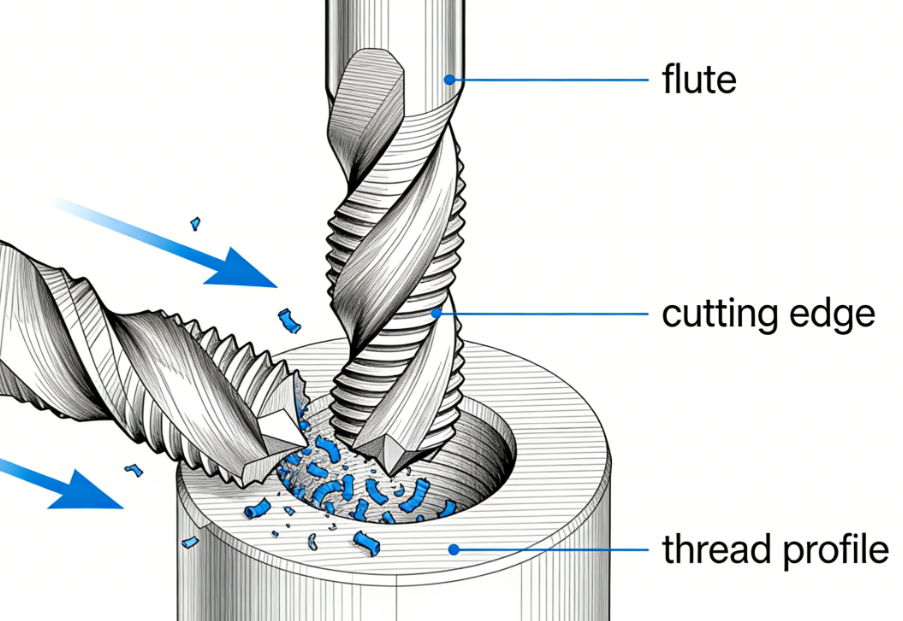
Cutting taps work exactly like any other cutting tool: sharp edges slice into the workpiece material to remove it. The tap has flutes — longitudinal grooves running along its length — that serve two jobs: they form the actual cutting teeth, and they provide an escape path for the chips that are produced during the cut.
When you drive a cutting tap into a pre-drilled hole, each cutting edge takes a thin slice of material with every rotation. The chips travel up through the flutes and out of the hole. This chip evacuation is critical — pack a hole with chips and you'll break the tap, strip the threads, or both.
Cutting taps come in three main chamfer styles, each suited to different hole types:
Taper tap: 7–10 thread chamfer. Easiest to start, distributes cutting load over many threads. Good for starting threads or hand tapping.
Plug tap: 3–5 thread chamfer. The most commonly used style; works for both through holes and most blind holes.
Bottoming tap: 1–2 thread chamfer. Used to cut threads to the very bottom of a blind hole; always use after a taper or plug tap.
Spiral point (gun) taps push chips forward through the hole — best for through holes. Spiral flute taps pull chips back up and out — better for blind holes where chips can't exit forward.
Forming taps — also called roll taps, thread-forming taps, or fluteless taps — take a completely different approach. They have no cutting edges and no flutes. Instead, they have a lobed or polygonal cross-section that presses against the hole wall as the tap rotates, pushing the metal sideways and downward into the thread form.
Because no material is removed, there are no chips. The metal is cold-formed around the tap's profile. This cold-working process compresses and work-hardens the material along the thread flanks, which is why formed threads are measurably stronger than cut threads in the same material.
Forming taps do have lubricant grooves — shallow channels that allow cutting fluid to travel along the tap axis. Without these, pressure would build up in a blind hole and potentially deform the part.
Key Insight: Because forming taps have no cutting edges to dull or chip, they typically last 3–10x longer than equivalent cutting taps in the same ductile material. For high-volume production in aluminum or mild steel, this difference in tool life is significant.
Here is how the two tap types compare across every major factor that affects your real-world tapping decisions:
Factor | Cutting Tap (Cut Thread Tap) | Forming Tap (Roll Tap) |
Mechanism | Removes material — produces chips | Displaces material — no chips |
Thread Strength | Baseline — grain structure interrupted | 15–25% stronger — compressed grain, work hardened |
Tool Life | Shorter — cutting edges wear and dull | 3–10x longer — no cutting edges to wear |
Torque Required | Lower (baseline) | Higher — 2–3x more than cutting taps |
Chip Production | Yes — chips must be evacuated | None |
Blind Hole Use | Possible — requires chip management | Excellent — no chip buildup risk |
Pre-Drill Size | Smaller (standard drill chart) | Larger (5–8% larger than cutting tap hole) |
Surface Finish | Good (Ra 63–125 microinches) | Superior (Ra 32–63 microinches, burnished) |
Material Range | Wide — ductile and brittle, hard and soft | Ductile materials only (under ~36 HRC) |
Operating Speed | Baseline | 30–50% faster in most materials |
Broken Tap Removal | Easier — flutes allow extractor tools to grip | Harder — smooth body offers less grip |
Initial Tool Cost | Lower | 15–30% higher upfront |
Best For | Versatility, hard/brittle materials, field repair | High-volume production, ductile metals, max thread strength |
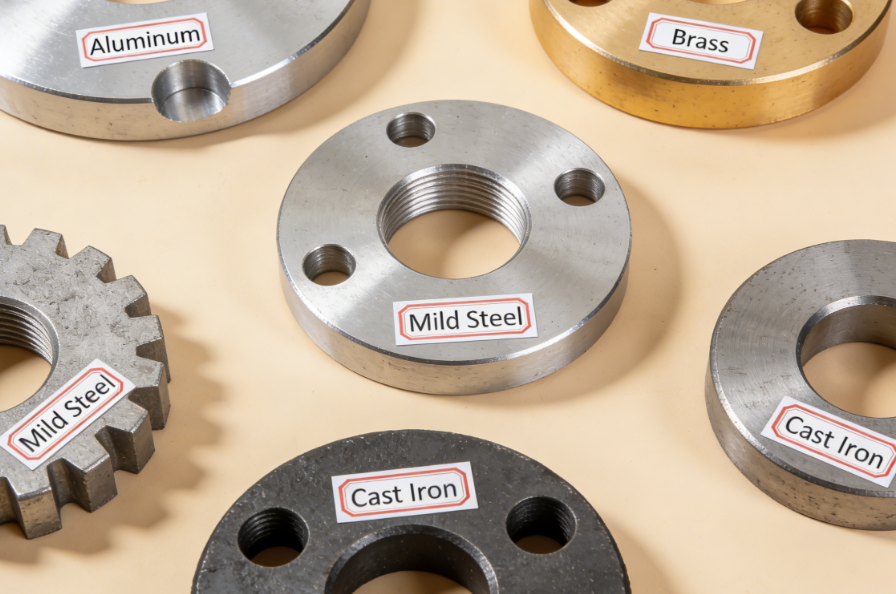
Material is the single most important factor in choosing between a cut tap and a form tap. Forming taps require ductility — the material must be able to flow under pressure without cracking. Cutting taps are far more forgiving across material types.
Material | Hardness | Recommended Tap | Notes |
Aluminum / Alloys | 15–30 HRC | Forming Tap | Ideal — excellent flow, superior finish, much longer tool life |
Brass / Bronze | 40–120 HB | Forming Tap | Excellent thread finish; low torque required |
Copper | ~40 HB | Forming Tap | Highly ductile — forming produces very clean threads |
Mild Steel (<28 HRC) | Under 28 HRC | Either (Forming preferred) | Forming gives stronger threads; cutting fine for low-volume |
Medium Steel (28–36 HRC) | 28–36 HRC | Either (Cutting preferred) | Borderline range — evaluate torque capacity before forming |
Hardened Steel (>36 HRC) | Over 36 HRC | Cutting Tap Only | Too hard to form — cutting tap or thread mill required |
Cast Iron | 150–300 HB | Cutting Tap Only | Brittle — will crack under forming pressure |
Stainless Steel (304/316) | 70–90 HRB | Forming Tap (with care) | Austenitic grades form well with proper lubricant and rigid setup |
Titanium | 30–36 HRC | Cutting Tap (specialized) | High spring-back makes forming difficult; use spiral flute cut tap |
Plastics (most) | N/A | Cutting Tap | Most plastics lack the ductility required for forming |
Zinc Die Cast | 60–110 HB | Forming Tap | Responds very well to forming; common in automotive |
Threads are 15–25% stronger due to work hardening and continuous grain flow
No chips means no chip packing in blind holes — a major reliability advantage
Tool life is dramatically longer — 3 to 10x more holes per tap in common materials
Smoother thread surface finish (burnished appearance, lower Ra values)
Faster operating speeds are possible — 30–50% higher SFM vs cutting taps
Lower total cost of ownership despite higher purchase price
Requires higher torque — demands a rigid machine setup; not ideal for hand tapping
Material is limited to ductile types below approximately 36 HRC
Requires a larger pre-drill hole than cutting taps (different drill chart)
Harder to remove if the tap breaks — no flutes for extractor tools to grip
Thin-walled parts may bulge or distort under forming pressure
Works in virtually any material — ductile, brittle, hard, soft, and most plastics
Lower torque requirement — suitable for hand tapping and less rigid setups
Flutes allow broken tap extractors to grip — easier removal if failure occurs
Lower upfront cost — more accessible for low-volume or one-off work
More forgiving with inconsistent materials or unknown alloys
Produces chips that must be managed — critical in blind holes
Shorter tool life — cutting edges wear and dull over time
Threads are inherently weaker than formed threads in the same material
Slightly rougher thread surface finish than forming taps
Use this quick checklist to make the call:
If this is true... | Then choose... |
Material is aluminum, brass, copper, or zinc | Forming Tap |
Material hardness is above 36 HRC | Cutting Tap |
Material is brittle (cast iron, some plastics) | Cutting Tap |
You are tapping a blind hole in a ductile material | Forming Tap (no chip risk) |
Maximum thread strength is required (structural) | Forming Tap |
You are doing field repair or hand tapping | Cutting Tap (lower torque, more versatile) |
High-volume CNC production in ductile metals | Forming Tap (longer life, faster speeds) |
Material is unknown or inconsistent | Cutting Tap (safer default) |
Pre-Drill Hole Size: A Critical Difference
One of the most common mistakes when switching between cut and form taps is using the wrong pre-drill size. The two tap types require meaningfully different hole diameters, and getting it wrong results in either broken taps (too small) or loose, undersized threads (too large).
Forming taps need a larger starting hole because the displaced material has to go somewhere — it flows radially into the thread form. The pre-drill for a forming tap is typically 5–8% larger in diameter than for the equivalent cutting tap.
Thread Size | Cutting Tap Drill | Forming Tap Drill | Difference |
1/4-20 UNC | #7 (0.201") | #3 (0.213") | +0.012" |
5/16-18 UNC | Letter F (0.257") | Letter I (0.272") | +0.015" |
M6 x 1.0 | 5.0 mm | 5.3 mm | +0.3 mm |
M8 x 1.25 | 6.8 mm | 7.2 mm | +0.4 mm |
M10 x 1.5 | 8.5 mm | 9.0 mm | +0.5 mm |
Lubrication is non-negotiable for both tap types, but the requirements differ:
Cut thread taps: Use sulfurized cutting oil for ferrous metals. Water-soluble coolant (8–10%) works well for aluminum. The goal is chip flushing as much as friction reduction.
Forming taps: Require lubricants with Extreme Pressure (EP) additives — the forming pressure is intense. Paste-type lubricants are excellent for manual operations. Consistent flood coolant is preferred for CNC.
Material | Cutting Tap SFM | Forming Tap SFM | Speed Gain |
Aluminum | 50–70 | 100–150 | +70–100% |
Brass | 35–50 | 70–100 | +80–100% |
Mild Steel | 25–35 | 50–70 | +80–100% |
Stainless Steel | 15–25 | 30–50 | +60–80% |
Forming taps demand a rigid setup. The higher torque load will expose any slop in your spindle, holder, or workholding — and that slop becomes broken taps. For forming, use rigid tapping cycles on CNC machines, synchronize spindle and feed precisely, and avoid tension-compression holders unless you have no alternative.
Problem | Tap Type | Likely Cause | Solution |
Tap breakage in blind hole | Cutting Tap | Chip packing | Switch to spiral flute tap, add peck cycles, or use forming tap |
Excessive torque / tap seizing | Forming Tap | Pre-drill too small | Check forming tap drill chart — hole may need to be 0.3–0.5mm larger |
Rough or torn thread finish | Cutting Tap | Dull tap or wrong speed | Replace tap; verify correct SFM for material; improve lubrication |
Material bulging around hole | Forming Tap | Thin wall / excess material | Switch to cutting tap; ensure sufficient wall thickness for forming |
Threads under gauge | Either | Wrong pre-drill size | Verify drill size with manufacturer chart for specific tap type |
Poor tool life in aluminum | Cutting Tap | Wrong tap type for material | Switch to forming tap — tool life improvement is dramatic in aluminum |
What is the main difference between a cutting tap and a forming tap?
A cutting tap removes material with sharp fluted edges to create threads, producing chips in the process. A forming tap has no cutting edges — it displaces and cold-forms the material around its lobed profile to shape the thread. The result is that formed threads are stronger, and the forming tap lasts significantly longer, but only works in ductile materials.
Are formed threads actually stronger than cut threads?
Yes — measurably so. Because forming compresses the grain structure of the metal rather than cutting through it, the thread flanks are work-hardened. In aluminum, brass, and mild steel, formed threads typically withstand 15–25% higher torque loads before failure and show better fatigue resistance under vibration compared to equivalent cut threads.
Can I use a forming tap on steel?
Yes, for mild and medium carbon steels below approximately 36 HRC. Austenitic stainless steels like 304 and 316 can also be form-tapped with proper lubrication and a rigid setup. Above 36 HRC, the material is too hard for forming and you should use a cutting tap.
Why does a forming tap need a larger pre-drill hole?
Because the material must have somewhere to go. When a forming tap displaces metal to shape the threads, that material flows radially outward and downward into the thread profile. If the hole is the same size as for a cutting tap, the forming tap will be choked, torque will spike, and breakage is likely. The forming tap pre-drill is typically 5–8% larger in diameter.
Which is better for blind holes — cut taps or form taps?
Forming taps are generally preferred for blind holes in ductile materials because they produce no chips. Chip management in blind holes is one of the main causes of tap breakage and thread damage when using cut taps. If you must use a cutting tap in a blind hole, use a spiral flute tap and add peck cycles to clear chips.
What are cut thread taps best used for?
Cut thread taps are the right choice when working with hard or brittle materials (hardened steel, cast iron, titanium), when the material is unknown, for field or maintenance work where versatility matters, and for hand tapping where lower torque is important. They are also the safer default when machine rigidity is in question.
Now that you know exactly when to reach for a cut thread tap and when a forming tap is the better call, the next step is having the right tool in hand. JimmyTool stocks a full range of professional cutting taps and forming taps in inch and metric sizes — HSS, HSS-E, and carbide — from leading manufacturers.
Not sure which tap is right for your specific job? Contact the JimmyTool team — we're machinists ourselves and happy to help you match the right tap to your material, machine, and production requirements.
person: Mr. Gong
Tel: +86 0769-82380083
Mobile phone:+86 15362883951
Email: info@jimmytool.com
Website: www.jimmytool.com


