

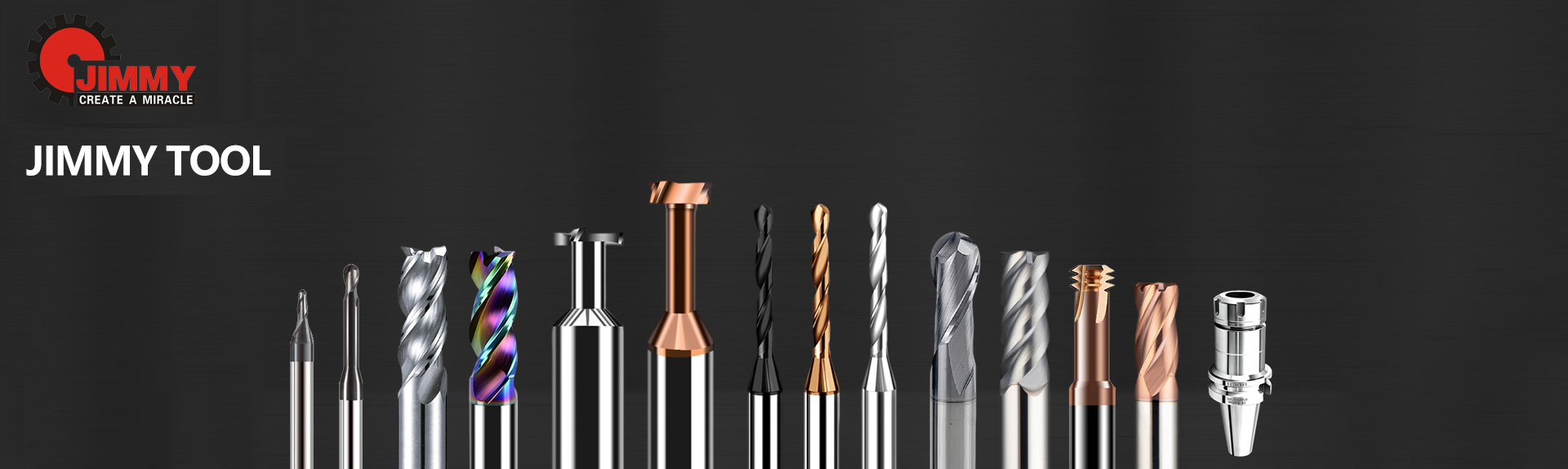
PVD Coatings for Carbide Tools: AlTiN, AlCrN, TiSiN — Which One Is Right for Your Job?
Date:2026-05-14Number:2081You‘ve specified the right carbide grade, optimized the cutting parameters, and dialed in the coolant pressure. But the tool still wears faster than expected. The missing variable is often the thinnest layer in the entire system: the PVD coating—a film just 2–4 microns thick that separates a sharp carbide edge from catastrophic failure in difficult materials.
For many shops, coating selection has been reduced to shorthand: “Purple for stainless, black for steel.” But beneath those visible colors are fundamentally different materials—AlTiN, AlCrN, TiSiN—each with distinct hardness, oxidation resistance, friction behavior, and chemical interaction with specific workpiece alloys. Choose wrong, and the coating delaminates, reacts with the chip, or simply wears through in minutes. Choose right, and tool life can double, triple, or more—with zero other process changes.
PVD (Physical Vapor Deposition) is now the dominant coating technology for solid carbide cutting tools. The process vaporizes a solid metal source in a vacuum chamber and deposits it atom by atom onto the tool surface, building a thin film with properties that the carbide substrate alone cannot provide.
At JimmyTool, we’ve developed PVD coating expertise over 15 years of manufacturing custom carbide tooling for aerospace, medical, automotive, and mold and die applications. In this article, we‘ll break down the three most widely used PVD coating families—AlTiN, AlCrN, and TiSiN—with real performance data, and provide a systematic framework to match coating to your workpiece material. If the choice still isn’t clear, we‘ll make it simple: send us your drawing, and we’ll engineer the right coating for your specific application.
(Image: A collection of carbide end mills with three different PVD coatings—AlTiN (anthracite/black), AlCrN (silver-gray), and TiSiN (bronze-copper)—arranged side by side on a clean industrial surface, with coating labels.)
A carbide cutting tool is a composite: hard tungsten carbide particles held together by a softer cobalt binder. At the cutting edge, where temperatures can exceed 900°C during machining, that cobalt binder softens, and the carbide particles lose their support. Simultaneously, the workpiece material—if chemically reactive—can diffusion-bond to the tool surface, pulling out carbide grains and accelerating crater wear.
A PVD coating addresses these failure mechanisms through four distinct functions:
Thermal barrier: The coating insulates the carbide substrate from cutting heat. Coatings like AlTiN form a protective aluminum oxide layer at high temperatures—a self-renewing barrier that slows heat transfer into the tool body. This is known as oxidation resistance.
Hardness and wear resistance: The coating is significantly harder than the carbide substrate (typically 3,000–4,000 HV vs. ~1,800 HV for tungsten carbide). All cutting is ultimately abrasive wear at the microscopic scale; harder surfaces resist abrasion longer. Through multi-gradient nano-coating technology, PVD coatings can achieve hardness values in the range of 3,000–4,000 HV.
Chemical barrier and friction reduction: At cutting temperatures, many workpiece materials become chemically reactive with carbide. The coating acts as an inert barrier that prevents diffusion wear between the chip and the tool, while simultaneously reducing friction to lower cutting forces and prevent built-up edge. Coatings with lower friction coefficients resist material adhesion more effectively.
Edge integrity preservation: A uniform coating preserves the precision-ground cutting edge geometry. Coating thicknesses of 1–4 microns are sufficient to provide these benefits without significantly altering the tool‘s sharpness or dimensional accuracy. Typical PVD coating thickness ranges from 1–4 µm.
The key distinction between coating types lies in the specific metals added to the titanium nitride base and the resulting property trade-offs:
Aluminum (Al) → improves hot hardness and oxidation resistance
Chromium (Cr) → improves oxidation resistance and reduces friction
Silicon (Si) → improves hardness and thermal stability
These elements form the three coating families we’ll now compare.
The following tables consolidate key property data and application performance from peer-reviewed research and industry testing.
Table 1: Physical and Mechanical Properties
Table 2: Application Performance Data from Peer-Reviewed Studies
AlTiN is the most widely used PVD coating for carbide tools, and for good reason: it offers a balanced combination of high hardness, excellent oxidation resistance, and broad applicability across ferrous materials. It‘s the “purple/black” coating that most machinists recognize immediately.
What makes AlTiN work
The key to AlTiN’s performance is the aluminum content. At elevated cutting temperatures (above 800°C), the aluminum in the coating reacts with oxygen in the air to form a thin, stable aluminum oxide (Al₂O₃) layer on the coating surface. This oxide layer is self-renewing: as it wears away during cutting, more aluminum migrates to the surface and forms fresh oxide. This mechanism provides the exceptional oxidation resistance that allows AlTiN to function at cutting temperatures up to 800–1,000°C.
AlTiN is characterized by very high hardness (3,300 ± 300 HV for premium grades), high oxidation stability, and a low heat conduction coefficient. The low thermal conductivity is beneficial—it directs heat into the chip rather than into the tool body, protecting the carbide substrate from thermal softening.
The annealing behavior of AlTiN during high-temperature exposure can actually improve coating hardness. During annealing, a beneficial nano-composite structure forms that includes nano-scale domains of c-AlN in a c-(Ti,Al)N matrix, increasing hardness.
Where AlTiN performs best
AlTiN coatings are extensively used in machining stainless steels, alloy steels, and high-temperature alloys that maintain high mechanical properties at elevated temperatures. It is the preferred coating for:
General steel machining (carbon steels, alloy steels) at moderate to high speeds
Hardened steels up to ~50 HRC — AlTiN nano-grade is suitable for ferrous materials up to this hardness range
Stainless steels — where oxidation resistance at the cutting edge is critical
Dry machining and high-speed cutting — where the self-renewing oxide layer provides continuous protection without coolant
High-performance cutting of hardened steel with or without coolant
Limitations of AlTiN
At very high temperatures (>1,000°C), the oxide layer may not reform quickly enough for sustained cutting.
In highly abrasive materials with hard carbide particles (e.g., high-silicon aluminum, compacted graphite iron), AlTiN may wear faster than harder coating alternatives.
In titanium and nickel alloys where chemical reactivity dominates wear, AlTiN‘s moderate chemical inertness may be insufficient. Research shows that AlTiN/TiAlN double-layer coating had the lowest hardness and wear resistance factor in superalloy milling tests, and the tool failed after only 12 m of milling.
Real-world AlTiN application example
A GWS Tool Group reconditioning case study documented that deep cryogenic treatment of AlTiN-coated end mills used in steel machining improved tool life by 20–30%, demonstrating that post-coating treatments can further enhance AlTiN tool performance for shops seeking maximum tool life in steel applications.
AlCrN is the coating of choice when both high temperature and chemical inertness are required simultaneously—particularly in titanium alloys, nickel-based superalloys, and abrasive workpiece materials that demand low friction to prevent material adhesion.
What makes AlCrN different
Chromium, not titanium, forms the base metal in this coating. This substitution produces two critical property advantages: higher thermal stability (up to 1,100°C maximum application temperature) and significantly lower friction—the lowest among the three coatings compared in nanolaminated structure.
AlCrN-based coatings are more oxidation resistant and have a markedly greater hot hardness than conventional coatings, meaning they are stable even under extremely high thermal load and generally perform better in demanding applications.
The structural analysis shows that heat treatment of AlCrN coating allows recrystallization and crystal growth, enhancing its wear behavior. Heat-treated monolayer AlCrN coating presented better performance than a conventional monolayer in titanium alloy machining tests.
Where AlCrN excels
The research evidence for AlCrN in challenging applications is particularly strong:
Titanium alloys (Ti6Al4V): A dedicated study found that AlCrN-coated carbide tools demonstrated more efficient machinability in Ti6Al4V alloys, with lower friction coefficients than previously researched coatings. This matters because titanium‘s low thermal conductivity and high chemical reactivity at cutting temperatures make friction reduction and chemical inertness essential.
Nickel-based superalloys (e.g., GH4169/Inconel 718): AlCrN/TiAlN double-layer coating showed intermediate hardness and wear resistance in superalloy milling tests, with less bonding tendency than TiSiN-based coatings. The anti-bonding characteristic is critical for superalloys, which tend to adhere to the tool surface at high temperatures.
Carbon fiber-reinforced plastic (CFRP) and titanium stacks: AlCrN has been investigated for drilling CFRP–Ti stack workpieces popular in the aerospace industry, where the coating must handle the abrasive wear of carbon fiber and the chemical reactivity of titanium simultaneously.
Compacted graphite iron (CGI): Among all tested coatings in one study, AlCrN (AC) presented the best surface integrity and mechanical properties, achieving the best comprehensive performance.
High-speed and dry finishing up to 55 HRC: For example, when finishing Ck45 steel at cutting speeds of both 200 m/min and 400 m/min, AlCrN outperforms conventional coatings.
Near-dry (MQL) or dry cutting conditions where lubricity is limited—AlCrN’s low coefficient of friction partially compensates for reduced lubrication.
Limitations of AlCrN
In superalloy milling, hardness and wear resistance factor are smaller than TiSiN, and the tool can approach failure after extended milling of difficult materials.
The cost per coating can be higher than AlTiN for some suppliers, though this differential narrows in applications where the tool life increase justifies it.
At very high hardness applications (above 55 HRC), TiSiN or specialized AlTiN grades may offer better pure wear resistance.
AlCrN is not the default choice for general steel machining—AlTiN is more cost-effective for those applications. AlCrN earns its cost when the combination of thermal stability, chemical inertness, and low friction is required simultaneously.
Related Product: Explore our Custom Carbide Tools with Application-Specific PVD Coatings for titanium, nickel alloy, and composite machining.
TiSiN is the high-hardness specialist: a coating engineered for applications where abrasive wear is the dominant failure mode and extreme hot hardness is required.
What makes TiSiN unique
The addition of silicon (Si) into the titanium nitride structure changes the coating‘s microstructure. A superficial TiSiN layer on TiAlN-coated carbide tools leads to improved compound mechanical properties, and these properties depend on the TiSiN-film Si content and coating structure.
According to mechanical property studies, TiSiN films possess enhanced mechanical properties in comparison to TiAlN and TiN coatings. In perpendicular impact experiments at various temperatures, TiSiN films exhibited the best resistance and fatigue behaviour.
In milling tests of superalloy GH4169, TiSiN/TiAlN double-layer coating demonstrated the highest hardness and wear resistance factor, with the smallest flank wear after 24 m of milling.
The adhesion trade-off
The performance advantage of TiSiN comes with a structural compromise: the same silicon that boosts hardness and fatigue resistance can weaken the coating‘s bond to the carbide substrate. Rockwell C indentations and inclined impact tests revealed a deteriorated adhesion of the TiSiN coating compared to TiAlN and TiN films.
This adhesion deterioration on the substrate led to a cutting performance reduction in milling compared to TiAlN coated inserts. In other words, TiSiN’s hardness advantage can be nullified if the coating delaminates before wearing through—a risk factor that must be accounted for in the application.
The superalloy bonding problem
A separate but related issue emerged in superalloy milling: TiSiN/TiAlN coating is easy to bond with the superalloy. This bonding tendency is a chemical interaction between the silicon-containing coating and the nickel-based workpiece material at high temperatures. For superalloy applications where material adhesion to the tool is a known problem, this bonding tendency may offset TiSiN‘s hardness advantage.
Where TiSiN excels
Highly abrasive materials where pure mechanical wear dominates failure
Hard milling applications where tool hardness must exceed workpiece hardness by a substantial margin
High-temperature cutting where fatigue resistance matters—TiSiN showed best resistance and fatigue behaviour at elevated temperatures in controlled testing
Applications with stable, rigid setups where the risk of coating delamination from impact or vibration is minimal
Where TiSiN requires caution
Interrupted cuts and unstable setups where impact loading can trigger delamination at the coating-substrate interface
Nickel-based superalloys where the bonding tendency can cause material adhesion and built-up edge
Applications requiring maximum adhesion—AlCrN has demonstrated the highest critical load in comparative nanolaminated coating studies
TiSiN and the Multi-Layer Approach
Many modern coating architectures address TiSiN‘s adhesion limitation through multi-layer design. A TiAlN base layer provides strong adhesion to the carbide substrate, while a TiSiN top layer delivers maximum hardness at the cutting edge. This is the coating architecture used in the GH4169 superalloy milling tests where TiSiN/TiAlN demonstrated the highest wear resistance. Shops evaluating TiSiN should confirm whether the coating is applied as a monolayer or a multi-layer system.
The following framework synthesizes the research data and properties discussed above into a systematic decision guide.
Key note on double-layer vs. single-layer coatings: The majority of studies compare double-layer architectures (e.g., AlTiN/TiAlN, TiSiN/TiAlN) rather than pure single-layer films. The base TiAlN layer provides superior adhesion to the carbide substrate, while the top functional layer determines the tribological and oxidation properties at the cutting edge. This is relevant for shops comparing coating specifications: a “TiSiN” coating may be a TiSiN/TiAlN multi-layer system in practice.
The coating selection question that reveals which variable matters most
When choosing a coating, ask: What is the primary failure mode of this tool in this material—abrasive wear, thermal softening, chemical adhesion, or coating delamination? The coating that best addresses that dominant failure mode will typically deliver the greatest tool life improvement, even if it is not the highest overall performer on paper.
Example: If a TiSiN-coated tool fails by coating delamination rather than wear, the higher hardness of TiSiN is irrelevant—the failure mode is adhesion, and AlCrN with its higher critical load and lower friction would likely outperform TiSiN in that application despite having lower hardness on paper.
Can’t decide which coating fits your workpiece?
Submit your part drawing and material specifications. Our application engineering team will recommend the right PVD coating for your specific application—including the coating family, thickness, and post-coating treatment—within 12 hours.
Submit Your Drawing for Coating Selection →
Multi-Layer and Nano-Layer Coatings
Modern PVD coatings for high-performance carbide tools are rarely single monolithic layers. Multi-layer architectures—alternating nanolayers of different compositions, each 5–20 nanometers thick—can achieve property combinations impossible with any single material. The nanolaminated AlCrN coating structure demonstrated the highest adhesion ability and the lowest coefficient of friction in comparative studies, outperforming both TiAlSiN and TiN coatings.
The AlTiSiN + TiSiN coating system with a TiN interlayer has been shown to produce much more enhanced tribological performance at both unlubricated and boundary lubricated conditions, even at elevated contact pressures.
For high-performance applications, these advanced architectures deliver measurable tool life improvements over single-layer coatings—often 30–50% or more in difficult materials—by combining the hardness of one material with the adhesion and low friction of another.
Post-Coating Treatment: The Performance Multiplier
The coating process itself isn‘t the final word. Post-coating polishing reduces surface roughness and friction, which is particularly beneficial in aluminum and titanium machining where built-up edge is a primary failure mode. For AlTiN coatings used in hardened steel machining, annealing post-treatment can increase hardness through the formation of a beneficial nano-composite structure within the coating.
Studies show that deep cryogenic treatment of AlTiN-coated tools used in steel applications can further improve performance by altering the residual stress state of the coating-substrate system. This is distinct from the coating process itself—it’s a tool treatment that happens before or after coating—but it directly impacts how long the coating survives in the cut.
At JimmyTool, we offer post-coating treatment options including polishing and cryogenic treatment for qualifying applications where maximum tool life is required.
Related Product: Explore our Custom Carbide Tools with Application-Specific PVD Coatings and Post-Treatment for demanding aerospace, medical, and mold and die applications.
JimmyTool‘s approach to coating selection is application-driven, not catalog-driven. We don’t stock pre-coated tools and hope they match your workpiece. We coat tools to match your material.
Our PVD Coating Capabilities:
Through multi-gradient nano-coating technology, our PVD physical coating process achieves a 4µm coating layer attached to the cutting tool surface, with product hardness (abrasion resistance) reaching 3,000–4,000 HV.
Standard coating offerings include:
AlTiN — for general steel, stainless steel, and high-speed machining
AlCrN — for titanium alloys, nickel alloys, CFRP stacks, and high-temperature applications requiring maximum oxidation resistance and low friction
TiSiN — for highly abrasive materials and extreme hardness applications
ZrN — for aluminum and non-ferrous machining where built-up edge prevention is critical
Custom multi-layer nano-coatings — for applications where standard single-layer coatings are insufficient
Our coating selection process:
Application review: You submit your workpiece material grade, hardness, and the specific machining operation (milling, drilling, threading, contouring).
Failure mode analysis: If you‘re replacing an existing coated tool, we ask what failed—edge wear, chipping, built-up edge, or delamination. This tells us which coating property to prioritize.
Coating recommendation: We specify the coating family (AlTiN, AlCrN, TiSiN, or multi-layer combination), thickness (1–4 µm), and post-coating treatment (polishing, cryogenic) based on your specific application parameters.
Performance verification: Each coated tool ships with documented coating specification data. For qualifying applications, we can provide comparative testing against your existing tooling to quantify the performance improvement.
Need help selecting the right coating for your tooling application?
Upload your part drawing, workpiece material, and current tool life data. Our engineering team will recommend the optimal PVD coating for your specific application—including coating type, thickness, and post-coating treatment—within 12 hours.
Submit Your Drawing for Coating Recommendation →
A PVD coating costs a fraction of the carbide tool it protects, yet it‘s the difference between a tool that cuts 200 parts and one that cuts 50. The data in this article demonstrates that choosing the wrong coating—or worse, no coating at all—is the most expensive decision in carbide tool procurement.
The framework is clear:
AlTiN is the general-purpose workhorse for steels, stainless steels, and high-speed machining up to 50 HRC, with self-renewing oxide protection at high temperatures.
AlCrN is the specialist for titanium, nickel alloys, composites, and cast iron—where chemical inertness, low friction, and extreme thermal stability (up to 1,100°C) are the dominant performance requirements.
TiSiN is the hardness champion for extreme abrasive wear, but its adhesion sensitivity and bonding tendency in superalloys make it an application-specific choice rather than a general upgrade over AlTiN.
The most important coating decision isn‘t “which one is hardest?” It’s “which one fails last in my specific workpiece material under my specific cutting conditions?” That‘s the question this selection framework helps answer.
If the answer still isn’t clear from the data above, we‘ll help you find it. Submit your part drawing and material specs—we’ll recommend the right coating, engineer it onto your custom carbide tool, and ship the tool with its coating specification documented. Within 12 hours, you‘ll know which coating is right for your job.
Submit Your Drawing for Custom Coating Selection →
Q1: What exactly is a PVD coating, and how is it applied to carbide tools?
PVD (Physical Vapor Deposition) is a vacuum-based coating process that vaporizes a solid metal source—such as titanium, aluminum, chromium, or silicon—and deposits it atom by atom onto the tool surface. The process occurs at relatively low temperatures (typically 400–500°C), which preserves the carbide substrate‘s metallurgical properties while applying a thin film coating just 1–4 microns thick. The resulting coating is significantly harder than the carbide substrate (typically 3,000–4,000 HV vs. ~1,800 HV for tungsten carbide), provides oxidation resistance at high cutting temperatures, and acts as a chemical barrier between the tool and workpiece.
Q2: What’s the real difference between AlTiN, AlCrN, and TiSiN coatings for carbide tools?
All three are PVD coatings based on titanium nitride with different alloying elements that change the coating‘s properties at high temperatures. AlTiN contains aluminum, which forms a self-renewing protective oxide layer at temperatures above 800°C—making it the workhorse for general steel and stainless steel machining. AlCrN replaces titanium with chromium, producing the lowest friction coefficient and highest thermal stability (up to 1,100°C), making it the preferred choice for titanium alloys, nickel superalloys, and abrasive materials where chemical adhesion is the primary failure mode. TiSiN adds silicon, producing the highest hardness and best fatigue resistance of the three, but with an important trade-off: poorer adhesion to the carbide substrate and a documented tendency to bond with nickel-based superalloys at high cutting temperatures. In comparative milling tests of GH4169 superalloy, TiSiN/TiAlN showed the highest wear resistance but was most prone to bonding, while AlCrN/TiAlN showed intermediate wear resistance with significantly less bonding tendency.
Q3: Which PVD coating is the hardest?
TiSiN (Titanium Silicon Nitride) is the hardest among the three main PVD coatings for carbide tools. In comparative studies of coated tools milling nickel-based superalloy, TiSiN/TiAlN had the highest hardness and wear resistance factor, with the smallest flank wear after 24 meters of milling. However, TiSiN films also showed the worst adhesion to the substrate compared to TiN and TiAlN coatings in controlled testing, and in superalloy milling tests, TiSiN was the most prone to bonding with the workpiece material. This means TiSiN‘s hardness advantage can be nullified if the coating delaminates or if material adhesion is the dominant failure mode rather than abrasive wear.
Q4: Why does AlCrN outperform AlTiN in titanium machining?
Titanium is chemically reactive at the high temperatures generated during cutting. It readily diffusion-bonds with many coating materials, pulling coating particles away with the chip and accelerating crater wear. AlCrN outperforms AlTiN in titanium for two reasons: its lower coefficient of friction (the lowest among the three coatings in comparative studies, compared to TiN and TiAlSiN) and its superior chemical stability. Studies specifically investigating AlCrN for reducing carbide cutting tool deterioration in titanium alloys demonstrated more efficient machinability in Ti6Al4V alloys. The heat-treated monolayer AlCrN coating presented better performance than conventional monolayer coatings in these tests.
Q5: How thick is a typical PVD coating, and does thicker mean better?
Standard PVD coating thickness for carbide cutting tools ranges from 1–4 microns (µm). A thicker coating is not necessarily better for cutting performance. The optimal coating thickness depends on the cutting edge radius of the tool—a very sharp edge ground for soft or gummy materials may be dulled by a 4µm coating, reducing performance. Conversely, a reinforced edge for hard milling can benefit from the full 4µm thickness. The coating thickness is application-specific and must be matched to the edge preparation and workpiece material.
Q6: Can I use the same coating for all materials, or do I really need to switch?
You can use AlTiN for a wide range of materials—that‘s why it’s the most common coating in the industry. However, switching to the application-specific coating for demanding materials produces measurable tool life improvements. For example, switching from AlTiN to AlCrN for titanium machining can extend tool life by 30–50% or more in documented cases due to the lower friction and better chemical stability. In one study of coated tools in compacted graphite iron machining, AlCrN achieved the best surface integrity and overall mechanical properties among all tested coatings. The cost of a different coating is negligible compared to the tooling and downtime cost saved across a production run.
Q7: What’s a nano-coating, and how does it differ from standard PVD?
A nano-coating is a PVD coating with grain sizes in the nanometer range (typically 5–50 nm). The ultra-fine grain structure provides higher hardness and wear resistance than conventional micron-grain coatings. Multi-gradient nano-coatings, such as those developed by JimmyTool, build the coating layer in progressively changing compositions—starting with a composition that bonds strongly to the carbide substrate and transitioning to a composition that provides optimal surface properties at the cutting edge. This achieves product hardness in the range of 3,000–4,000 HV while maintaining strong adhesion to the tool surface at 4µm coating thickness. The nano-composite structure also improves oxidation resistance and reduces friction compared to single-layer coatings of the same nominal composition.
Q8: How do I know which coating is right for my specific job if I machine a mix of materials?
Start with the material that consumes the most tooling cost or produces the most scrap. If you machine 70% 4140 steel and 30% Ti6Al4V, AlTiN is the logical baseline coating because it covers the majority material well. For the titanium portion, evaluate whether the tool life improvement from switching to AlCrN justifies the cost of a second coated tool inventory. If you machine a wide range of materials with no single dominant alloy, AlTiN is the best general-purpose starting point. If your workpiece material is a high-temperature alloy and you need a coating recommendation specific to your application, send us your part drawing and material specifications—we‘ll recommend the right coating within 12 hours.
Q9: Does post-coating treatment really make a difference?
Yes. Post-coating polishing reduces surface roughness and friction coefficient, which is beneficial for materials prone to built-up edge (aluminum, titanium, stainless steel). For AlTiN coatings, annealing at controlled temperatures can form a beneficial nano-composite structure within the coating that increases hardness at elevated temperatures. Deep cryogenic treatment of AlTiN-coated tools used in steel applications has been shown to improve tool life by 20–30% in documented cases. These post-coating treatments add modest cost but can extend tool life enough to justify the investment for high-volume production or expensive workpiece materials.
Q10: Can I send my drawing to JimmyTool for a coating recommendation?
Yes. Submit your part drawing, workpiece material grade and hardness, and the specific machining operation (milling, drilling, threading, contouring). Our application engineering team will recommend the right PVD coating for your application—including coating type, thickness, and post-coating treatment—within 12 hours. This is not an automated recommendation; it‘s reviewed by an engineer who understands the specific demands of your workpiece material and cutting conditions.
person: Mr. Gong
Tel: +86 0769-82380083
Mobile phone:+86 15362883951
Email: info@jimmytool.com
Website: www.jimmytool.com


