

What Is a U Drill? The Complete Expert Guide
Date:2026-03-03Number:707A U drill (also called a shallow hole drill or indexable drill) is a specialized CNC cutting tool featuring a U-shaped flute cross-section and two replaceable carbide inserts — one at the center and one at the periphery. Developed by Sandvik in the 1970s, it drills precise holes at depth-to-diameter ratios of 1.5×D to 3.0×D, running 2–5× faster than HSS twist drills while delivering tighter tolerances and lower per-hole costs through its indexable insert system.
The U drill — formally known as an indexable shallow hole drill or spade drill with carbide inserts — represents one of the most significant advances in hole-making technology of the last half-century. Its defining characteristic is a U-shaped flute profile that enables fundamentally different chip evacuation behavior compared to the helical flutes of a conventional twist drill.
Sandvik Coromant engineers in Sweden introduced the concept in the early 1970s, solving a persistent problem in high-volume production: solid drills wore unevenly and required complete replacement, causing expensive downtime. The U drill's modular insert system allowed manufacturers to replace only the cutting edges — a philosophy that has since become standard across most precision tooling families.
Today, U drills are produced by virtually every major tooling manufacturer — Kennametal, Iscar, Mitsubishi Materials, Kyocera, and many OEM brands — in diameters ranging from 12mm to 80mm+, covering the vast majority of production hole-making applications.
Pro Tip
The name "U drill" is informal and industry-wide. In manufacturer catalogs, look for terms like indexable drill, insert drill, shallow hole drill, or S-MAX drill (Iscar brand). They all refer to the same category of tool.
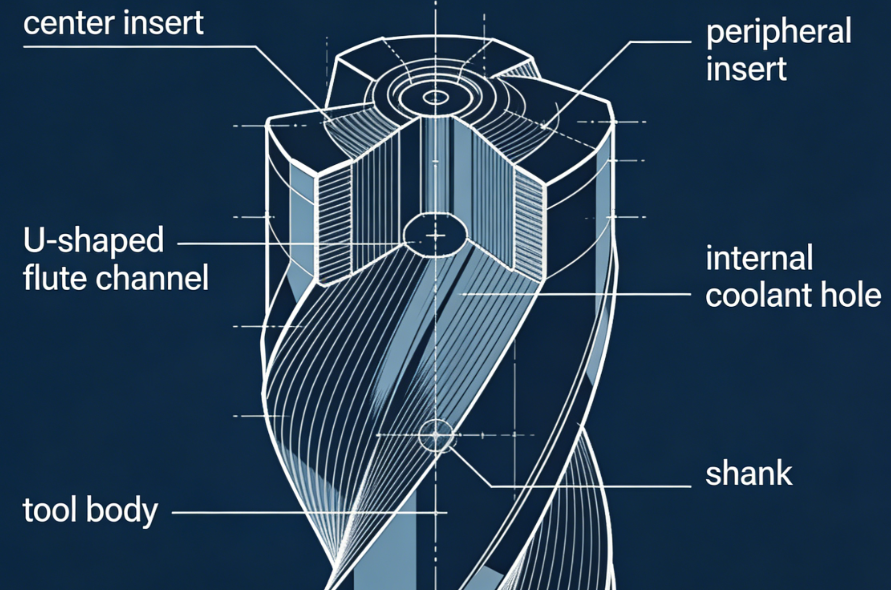
A U drill accomplishes hole-making through the simultaneous action of two geometrically distinct inserts, working in carefully coordinated zones. Understanding this dual-zone cutting action is the key to optimizing performance.
Positioned at the drill's axis, the center insert operates at very low surface speed (approaching zero at the tool center). Its primary role is to establish the initial hole geometry and provide centering. This insert experiences high compressive forces and lower surface speed, which is why manufacturers design it with a stronger, more robust geometry than the peripheral insert.
Located near the outer diameter, the peripheral insert operates at the highest surface speed. It expands the hole to final diameter and generates the finished wall surface. Because it cuts at high velocity, this insert experiences more thermal stress and typically shows earlier wear — expect 15–25% shorter life versus the center insert in most materials.
The flute cross-section is not merely a shape — it is a functional chip transport highway. Unlike helical flutes that wrap around the tool body and create friction, the U-profile creates a straight, open channel. When high-pressure coolant enters through the internal channels and exits at the cutting zone, it:
Selecting the right drill type begins with understanding how each handles the fundamental challenges of hole-making: chip evacuation, heat, accuracy, and speed.
| Property | U Drill | Twist Drill (HSS) | Gun Drill |
|---|---|---|---|
| Max Depth (L/D) | 3×D (5×D advanced) | 10×D+ | 100×D+ |
| Cutting Speed (Steel) | 80–180 m/min | 20–60 m/min | 80–120 m/min |
| Diameter Range | 12–80mm+ | 0.1–80mm+ | 1–50mm |
| Insert Replaceability | Yes (indexable) | No (resharpen/replace) | No (brazed tip) |
| Coolant Required | Through-tool ≥20 bar | Optional | High pressure required |
| Surface Finish (Ra) | 1.6–3.2 µm | 3.2–6.3 µm | 0.4–1.6 µm |
| Tolerance (Diameter) | ±0.05mm typical | ±0.1–0.15mm | ±0.01–0.025mm |
| Best Application | Shallow, high-volume | General purpose | Deep precision holes |
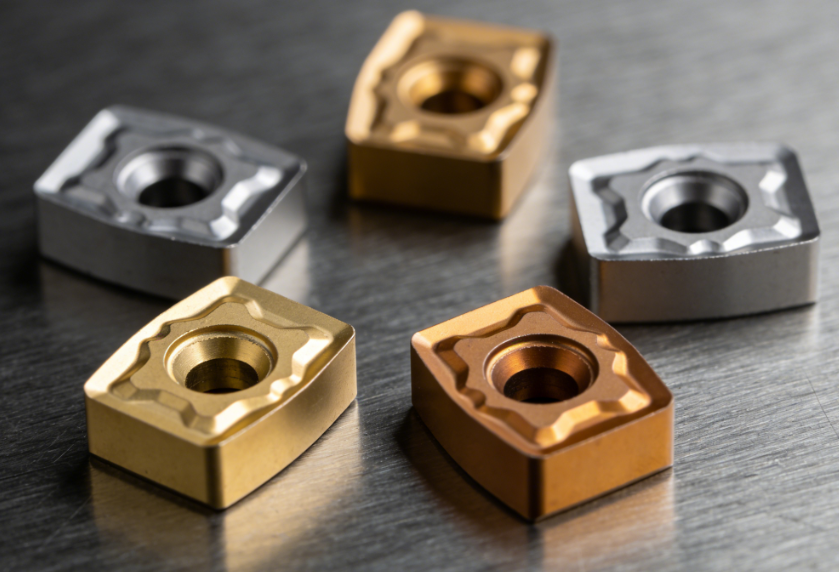
Insert selection is the single most impactful variable in U drill performance. The wrong insert grade in the right application will under-perform; the right grade in the wrong application will fail. Here is a complete framework:
Center inserts feature a stronger, more negative cutting geometry to handle the thrust forces at low surface speeds near the drill axis. Peripheral inserts use a sharper, more positive rake angle to minimize heat generation at high surface speeds. Never interchange them — they are not interchangeable even when the physical shape looks similar.
| Workpiece Material | Recommended Grade | Recommended Coating | Key Concern |
|---|---|---|---|
| Low Carbon Steel | P25–P35 | TiAlN or TiCN | Built-up edge |
| Alloy/Tool Steel | P15–P25 | TiAlN (multilayer) | Abrasive wear |
| Stainless Steel (304/316) | M20–M30 | AlTiN or TiAlSiN | Work hardening |
| Cast Iron (Gray) | K10–K20 | TiN or uncoated CBN | Abrasive chipping |
| Aluminum Alloys | N10–N20 | DLC or polished | Adhesion / BUE |
| Titanium (Ti-6Al-4V) | S15–S25 | AlTiN or nACo | Heat, work hardening |
| Inconel / Superalloys | S20–S35 | PVD AlTiN (thin) | Extreme heat & wear |
Warning
Never use a steel-grade (P-series) insert on aluminum. The geometry and coating create built-up edge that destroys surface finish within seconds. Always match the ISO material group letter (P, M, K, N, S, H) to your workpiece.
Getting cutting parameters right is where most U drill failures begin. The tables below represent practical starting points — always consult your insert manufacturer's specific recommendations and adjust based on machine rigidity, coolant type, and workpiece clamping quality.
| Material | Hardness | Vc min (m/min) | Vc rec. (m/min) | Vc max (m/min) |
|---|---|---|---|---|
| Mild Steel (1020) | <200 HB | 80 | 120 | 180 |
| Alloy Steel (4140) | 200–300 HB | 60 | 90 | 130 |
| Stainless (316L) | 180–220 HB | 40 | 65 | 90 |
| Gray Cast Iron | 180–240 HB | 80 | 120 | 160 |
| Ductile Iron | 150–300 HB | 60 | 90 | 130 |
| Aluminum (6061-T6) | 95 HB | 200 | 350 | 600 |
| Ti-6Al-4V | 30–36 HRC | 20 | 40 | 60 |
| Diameter Range | Steel fn (mm/rev) | Cast Iron fn (mm/rev) | Aluminum fn (mm/rev) |
|---|---|---|---|
| 12–20mm | 0.05–0.12 | 0.06–0.14 | 0.10–0.20 |
| 20–32mm | 0.10–0.18 | 0.12–0.20 | 0.18–0.32 |
| 32–50mm | 0.16–0.25 | 0.18–0.28 | 0.28–0.48 |
| 50mm+ | 0.22–0.35 | 0.24–0.38 | 0.40–0.65 |
Parameter Tip
When entering an interrupted cut (hole through multiple materials, crossholes, or casting cavities), reduce feed by 30–40% at the entry and exit points. The sudden change in cutting force is the most common cause of insert chipping in U drill applications.
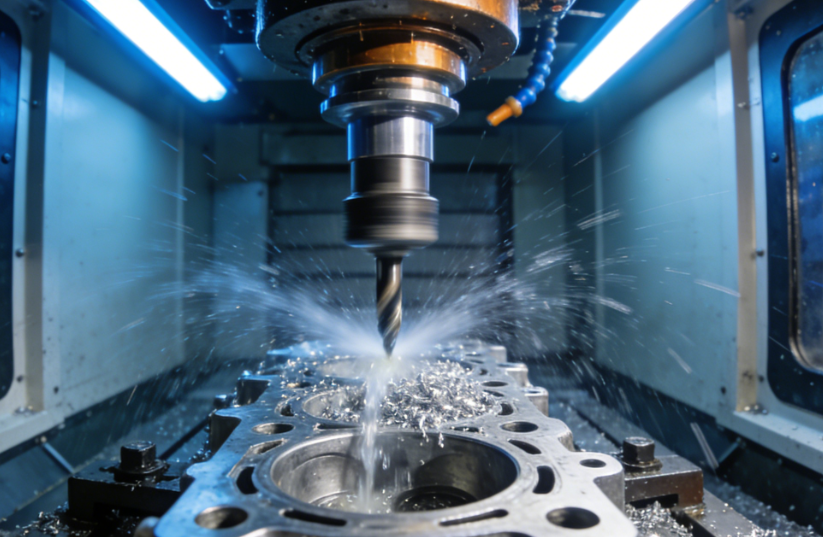
U drills have earned a dominant position across several industries specifically because of their ability to deliver consistent, high-volume hole quality in production environments where seconds-per-part translate directly to profitability.
Airframe and engine component manufacturing demands the tightest tolerances and strictest material traceability. U drills are widely used for structural frame holes in aluminum 7075 and 2024, titanium bulkhead holes (with specialized inserts), and composite-to-metal stack drilling with hybrid insert geometries. The replaceable insert system also satisfies aerospace quality requirements: worn inserts are serialized, replaced, and logged without disturbing calibrated toolholders.
The automotive sector is arguably the U drill's most demanding home. Engine blocks, cylinder heads, transmission casings, and brake components all require high-precision bolt-pattern holes produced at rates of hundreds per hour. A major engine plant might run 50+ U drills simultaneously across a single transfer line. The insert-swap-without-setup-change feature directly reduces machine downtime that would otherwise cost thousands of dollars per hour.
Valve bodies, pump casings, and manifold blocks in the oil and gas industry are typically made from 316 stainless, duplex stainless, or Inconel alloys — all notoriously difficult to machine. U drills with premium S-grade inserts and high-pressure coolant (50+ bar) have become the standard approach for these materials, offering significantly better tool life than solid carbide alternatives in production quantities.
Hydraulic valve bodies, pneumatic manifolds, die and mold plates — anywhere precise bolt holes are needed in production volumes. U drills are often the default choice when hole diameter exceeds 16mm in steel, replacing solid carbide drills purely on cost-efficiency grounds.
Even perfect insert selection and cutting parameters will fail if setup fundamentals are ignored. These are the factors that separate consistent, long-life U drill operation from chronic problems.
U drills are exceptionally sensitive to radial runout. The center and peripheral inserts are designed to work at precisely calculated height and radial offsets. Any runout beyond 0.02mm (20 microns) TIR will cause unequal load distribution between inserts, dramatically accelerating wear on one insert while underloading the other. This manifests as oversized holes, poor surface finish, and premature insert breakage.
Always measure runout at the insert seats when setting up a new U drill, and re-check after any toolholder change or spindle service.
| Holder Type | Typical Runout | Best For | Notes |
|---|---|---|---|
| Hydraulic Chuck | <0.003mm | High-precision, long runs | Best choice for U drills |
| Shrink Fit | <0.003mm | High-speed, high-precision | Excellent, requires equipment |
| ER Collet Chuck | 0.005–0.015mm | General use | Acceptable with quality collets |
| Side-Lock / Weldon | 0.010–0.030mm | Roughing only | Not recommended for U drills |
| Problem | Most Likely Cause | Solution |
|---|---|---|
| Oversized hole diameter | Excessive runout; worn peripheral insert | Check and correct runout (<0.02mm); replace peripheral insert |
| Poor surface finish | Dull insert; incorrect grade; chip re-cutting | Replace insert; verify insert grade; increase coolant pressure |
| Insert chipping at entry | Too high feed rate; surface scale; interrupted cut | Reduce feed 30–40% at entry; de-scale pre-drilling; use stronger insert edge |
| Drill wandering off-axis | Uneven insert wear; no spot drill; part movement | Use spot drill if surface is angled; replace worn center insert; verify fixture clamping |
| Rapid center insert wear | Too high feed; insufficient coolant at center | Reduce feed 10–15%; increase coolant pressure; check center coolant hole for blockage |
| Chip packing / clogging | Insufficient coolant pressure; stringy chips | Increase coolant to ≥20 bar; implement peck cycle; verify chip breaker geometry matches material |
| Excessive vibration / chatter | Tool overhang too long; workpiece not rigid | Minimize overhang to 3×D max; improve fixture; reduce speed 20–30% |
| Thermal insert cracking | Interrupted coolant supply; thermal shock | Ensure uninterrupted coolant; never stop coolant mid-cut; check pump and filter |
Purchase price is a poor proxy for drilling cost. The metric that matters is cost per hole, which accounts for insert life, cycle time, machine downtime, and quality rejects.
| Cost Factor | U Drill | Solid Carbide Drill | HSS Drill |
|---|---|---|---|
| Initial tool cost | $200–500 (holder) | $80–250 | $15–60 |
| Insert/regrind cost | $15–30 per change | $80–250 (replace) | $5–15 (regrind) |
| Insert life (holes in steel) | 50–100 holes/edge | 200–500 holes | 20–40 holes (regrind) |
| Insert change time | 1–3 min | 10–20 min | 10–20 min |
| Cutting speed advantage | Baseline | 1.2–2× of U drill | 0.2–0.5× of U drill |
| Typical ROI vs HSS | 2–4 months in production volumes >500 holes/month |
Cost Insight
For shops running fewer than 200 holes per month in a given size, solid carbide drills often win on pure cost. The U drill's economic advantage becomes compelling at 500+ holes/month where reduced cycle time and machine availability compound into significant savings.
A U drill is used for creating precise, shallow-to-medium depth holes (up to 3×D) in metal workpieces during CNC machining. It is especially well-suited to high-volume production drilling in steel, cast iron, aluminum, and stainless steel across automotive, aerospace, oil & gas, and general engineering applications. Its indexable insert system makes it the most cost-effective drilling solution for holes above 16mm diameter when volumes are sufficient.
What is the difference between a U drill and a twist drill?Twist drills use a helical flute and a solid, non-replaceable cutting tip. U drills feature a U-shaped flute profile and two separate, replaceable carbide inserts. As a result, U drills run 2–5× faster, produce better chip evacuation and tighter tolerances, but are limited to shallower holes (typically ≤3×D) and require through-tool coolant. Twist drills are more versatile across depth and diameter ranges, but are far less economical at high production volumes above 16mm diameter.
How deep can a U drill go?Standard U drills are optimized for a depth-to-diameter ratio of 1.5×D to 3.0×D. Extended-reach designs can achieve 5×D. Beyond that depth, gun drills, BTA drills, or ejector drills are the appropriate technology. Attempting to use a U drill beyond its rated L/D ratio causes rapid insert wear, poor chip evacuation, and risk of tool failure.
Why is it called a U drill?The "U" refers to the characteristic U-shaped cross-section of the flute — the groove that runs along the tool body. When you look at the drill from the end, the chip-carrying channel has a rounded U profile rather than the deep V or helical spiral of a conventional drill. This shape enables more efficient chip flow and better coolant delivery than helical alternatives.
What coolant pressure do U drills require?A minimum of 20 bar (290 PSI) of through-tool coolant pressure is recommended for general applications. For harder materials (stainless steel, titanium, superalloys) or deeper holes, 40–70 bar is preferred. Insufficient coolant pressure is the most common field cause of premature insert failure — chips cannot be evacuated reliably and thermal damage follows rapidly.
Can U drills be used without coolant?Dry drilling is not recommended for U drills. Minimum Quantity Lubrication (MQL) at high flow rates can work in aluminum applications, but virtually all other materials require liquid coolant through the tool. The insert design and chip evacuation mechanism both depend on coolant to function correctly. Running dry will cause rapid thermal failure of both inserts within a short number of holes.
How often should U drill inserts be replaced?In standard steel applications, peripheral inserts typically last 30–50 holes before needing replacement; center inserts last 15–25% longer. In aluminum, insert life can extend to 200+ holes. The best practice is to track hole counts and inspect inserts for flank wear beyond 0.3mm — don't wait for visible breakage, as worn inserts cause hole quality degradation before catastrophic failure occurs.
U drills represent one of the clearest ROI upgrades available in precision machining. If you're still using HSS twist drills above 16mm diameter in production volumes, the math almost always favors switching. Start with your highest-volume, most time-critical hole — the results will make the case for the rest of your operation.
person: Mr. Gong
Tel: +86 0769-82380083
Mobile phone:+86 15362883951
Email: info@jimmytool.com
Website: www.jimmytool.com


