

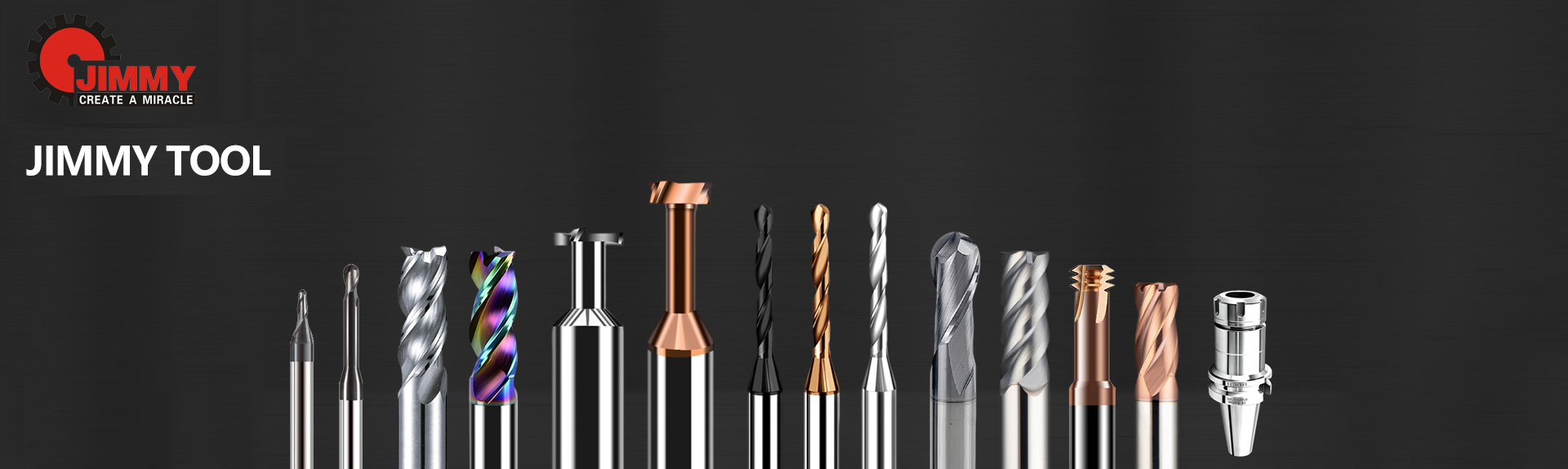
Mold Machining Carbide End Mills — Injection Mold & Die Casting | Jimmy Tool
Date:2023-06-09Number:1873Mold manufacturing is where carbide end mills are pushed to their absolute limits. A P20 pre-hardened mold base at HRC 33 feels easy — until it's back from heat treatment at HRC 52 and you're trying to hold Ra 0.4 μm across a complex cavity surface without a grinding or EDM pass. That's where the mold machining carbide end mill you specified either delivers or costs you a cavity re-cut. Jimmy Tool has supplied precision ball nose, flat end, and arc angle milling cutters to mold shops and die manufacturers since 2010, with tool runout verified to ±0.002mm per unit — the critical threshold below which surface finish results become predictable in hard milling operations.
This page organizes tooling recommendations around the four stages of mold machining — roughing, semi-finishing, finishing, and hard milling. Each stage has different tool geometry, coating, and parameter requirements. You'll also find a Quick Comparison table for mold steel grades, a cost-logic section on hard milling vs EDM, and specific guidance for graphite electrode milling that most cutting tool pages skip entirely.
Before selecting a tool, confirm two things: the steel grade and the machining stage. P20 and H13 machine very differently from each other, and the same H13 block machines differently at HRC 44 coming off the rough mill versus at HRC 52 returning from heat treatment. This table maps the most common mold steel grades to their recommended tool type and target surface finish at each stage.
| Mold Steel | Hardness (HRC) | Stage | Recommended Tool | Coating | Target Ra | Key Challenge |
|---|---|---|---|---|---|---|
| P20 | 30–36 | Roughing + Semi-finish | 4-flute flat end mill / arc angle | TiAlN | — | Chip packing in deep pockets |
| H13 | 44–50 (pre-HT) | Semi-finish | Arc angle end mill R0.5–R2 | AlCrN | Ra 1.6 μm | Work hardening on interrupted cuts |
| H13 / SKD61 | 50–58 (post-HT) | Finish | Ball nose R0.5–R10 | AlCrN multi-layer | Ra 0.4–0.8 μm | Chatter at long overhangs, heat at edge |
| DC53 / SKD11 | 60–65 | Hard milling | Ultrafine grain ball nose R0.5–R3 | AlCrN / DLC | Ra 0.1–0.2 μm | Thermal softening at high Vc, edge chipping |
| NAK80 | 38–42 | Finish | Ball nose + tapered ball nose | TiAlN | Ra 0.4 μm | Adhesion — requires sharp edge prep |
| S136 (mirror polish) | 50–54 | Super-finish | Micro ball nose R0.2–R1 | DLC | Ra ≤ 0.1 μm | Sub-micron finish before manual polishing |
| Graphite (EDM electrode) | — | Electrode milling | Diamond-coated / 2-flute carbide | CVD diamond | Ra 0.4 μm | Graphite dust abrasion, no coolant |
The roughing stage is a volume removal problem. In a P20 mold base at HRC 30–36, the goal is maximum material removal rate with minimum cycle time — while leaving a controlled stock allowance of 0.3–0.5mm for semi-finishing. Getting this wrong costs downstream time: too much stock and semi-finishing becomes another roughing pass; too little and your finish ball nose has no room to correct form errors.
Use a 4-flute solid carbide flat end mill with TiAlN coating for P20 roughing. Trochoidal (dynamic) milling paths — circular motion with linear traverse — limit radial engagement to ≤15% of tool diameter, which dramatically reduces the peak cutting force that causes chipping at full width of cut. This allows you to run Ap at 1–1.5×D rather than the shallow passes required by conventional slot milling.
Set cutting speed at Vc 80–120 m/min for P20, feed per tooth fz = 0.04–0.08mm depending on tool diameter. At these parameters, a Ø12mm 4-flute carbide end mill removes P20 at 30–50 cm³/min without thermal damage to the workpiece or tool. Use through-coolant or high-pressure flood coolant directed at the flute root — chip re-cutting in deep mold pockets is the primary cause of premature edge failure in roughing operations.
For core and cavity blocks with pockets deeper than 3×D, switch to a long-neck (reduced shank) end mill to provide clearance without sacrificing shank rigidity. Jimmy's flat bottom milling cutter series covers Ø1–Ø25mm with length-to-diameter ratios up to 6×D in the extended series — sufficient for most injection mold pocket depths.
Semi-finishing is the least glamorous stage of mold machining, but it's where the quality of your finish result is actually determined. If your semi-finish leaves variable stock — 0.1mm in some areas, 0.4mm in others — your finishing ball nose end mill cuts different depths across the surface. The result is inconsistent Ra values and pressure on the polishing team to fix what the machining couldn't deliver.
The arc angle (corner radius) end mill is the workhorse of mold semi-finishing. The corner radius — typically R0.5 to R3 — creates a gradual entry into the workpiece that distributes cutting forces over a larger edge area, preventing the micro-chipping that sharp-corner end mills develop after a few passes in H13.
Use Z-level (constant Z) contour paths for steep walls: 0.1–0.3mm step-down, feed per tooth 0.03–0.06mm at Vc 60–100 m/min in H13 at HRC 44–50. For shallow areas and blend zones between steep and flat regions, switch to 3D surface paths (scallop height control). Target scallop height ≤0.01mm to ensure the finish ball nose only needs a light final pass.
AlCrN coating is the correct choice for H13 semi-finishing at HRC 44–50. AlCrN maintains coating hardness above 3,000 HV at the 700–800°C temperatures typical of sustained mold steel cutting, and its oxidation resistance prevents flaking on the interrupted cuts around ribs and bosses.
The finishing stage on hardened mold steel — H13 at HRC 50–58, SKD61 at HRC 52–55 — is where ball nose end mills separate high-performance tooling from generic carbide. At these hardness levels, every micron of runout shows up in surface finish variation, and any tool deflection at the long overhangs typical of deep mold cavities directly causes Ra degradation.
For mold steel finishing at HRC 50–58, specify ultra-fine grain carbide substrate (grain size ≤0.5μm, 9–10% cobalt binder) with AlCrN PVD coating. Ultra-fine grain carbide provides the edge sharpness retention needed to maintain Ra 0.4–0.8 μm over a full mold cavity finishing run without premature edge micro-chipping that degrades surface finish mid-cavity.
Run ball nose finishing at high spindle speed, low feed: Vc = 80–150 m/min (depending on HRC), fz = 0.005–0.02mm per tooth, step-over 0.05–0.15mm. Increase spindle speed rather than feed rate to improve surface finish — higher Vc reduces the feed mark scallop height at a given step-over. Use lace path or scallop path strategies from your CAM system; avoid radial-to-centerline paths that leave a feed mark at the ball tip.
Toolholder runout is the hidden variable at this stage. Verify runout at the tool tip (at the actual cutting depth) with a dial gauge — not at the shank seat. A shrink-fit or precision collet HSK toolholder with G2.5 balance grade at 20,000 RPM reduces runout-induced finish variation. Jimmy's HSK toolholders are specified to ±0.002mm runout at the gage plane, and paired finishing toolholders are matched-verified.
Request a Free Tool Recommendation
Hard milling at HRC 60–65 in DC53, SKD11, or S7 tool steel is the application that eliminates EDM from the workflow. Features that once required graphite electrode machining, EDM burning, and electrode disposal — a process taking 1.5–3 hours per feature — can be machined directly in the CNC in 5–15 minutes with the right ultra-fine grain ball nose end mill at HSM parameters.
Hard milling at HRC 60–65 demands the smallest possible grain size in the carbide substrate — 0.3–0.4μm is the target specification — and a multi-layer AlCrN coating with hardness above 3,200 HV. The key operating parameter is chip thickness: keep maximum chip thickness per tooth below 0.005mm for HRC 60+ materials. This means high spindle speed (15,000–30,000 RPM), very low feed per tooth (fz = 0.002–0.005mm), and very shallow axial depth (Ap = 0.02–0.08mm).
Use dry machining or minimal air blast for chip evacuation — coolant thermal shock on the cutting edge at HRC 62+ accelerates micro-chipping. The workpiece fixture must eliminate any vibration path: clamp the mold block directly to the machine table with the shortest possible setup stack. Any compliance in the workholding translates directly to chatter marks at Ra scale.
The practical result at correct parameters: Ra 0.1–0.2 μm from the machine, requiring only final hand polishing to remove scallop marks. This compares favorably to EDM finishes (Ra 0.4–1.6 μm depending on electrode current setting) — and achieves it in a fraction of the cycle time.
Not every feature can be hard milled, and not every shop has moved entirely away from EDM. When you're machining graphite or copper electrodes, the tooling requirements flip entirely: graphite is extremely abrasive despite being soft, and it cuts as dry as a chalk board. Standard carbide end mills wear at the cutting edge within minutes of graphite contact.
For graphite electrode milling, use either CVD diamond-coated end mills or uncoated 2-flute carbide end mills with polished flutes. CVD diamond coating (thickness 10–20μm) provides abrasion resistance that extends tool life 10–30× versus standard TiAlN carbide in graphite. The 2-flute geometry maximizes chip clearance — graphite produces fine particulate rather than chips, and packed graphite dust in a 4-flute tool accelerates edge breakdown.
Run graphite dry, always — coolant mixed with graphite dust creates a conductive slurry that shorts machine components. Use strong vacuum extraction at the spindle to capture graphite particulate before it enters the enclosure. Set Vc at 150–300 m/min, fz = 0.02–0.06mm per tooth. Higher Vc reduces the abrasive contact time per unit length of cut, extending diamond coating life.
For copper electrodes, switch to a standard 4-flute DLC-coated carbide end mill. Copper galls onto uncoated carbide edges, producing BUE that ruins electrode geometry. DLC's near-zero friction coefficient with copper prevents adhesion and delivers consistent electrode dimensional accuracy to ±0.01mm across a full machining run.
The question mold shops face when setting up a new cavity feature: machine it directly in hardened steel, or rough in steel, burn with EDM, and polish? The answer depends on geometry complexity, required surface finish, and available machine capability — but the cost math is clearer than most shops realize.
| Factor | EDM Process | Hard Milling (Jimmy Grade) | Verdict |
|---|---|---|---|
| Feature cycle time | 1.5–3 hrs (electrode + burn) | 5–30 min (direct CNC) | Hard mill wins ✓ |
| Electrode cost | $15–80 per electrode (graphite + machining) | $0 (no electrode) | Hard mill wins ✓ |
| Surface finish Ra | Ra 0.4–1.6 μm (current-dependent) | Ra 0.1–0.4 μm (direct) | Hard mill can win ✓ |
| Geometry limit | Can reach ≤R0.1 internal radius | Limited by tool radius (≥R0.2) | EDM wins for ultra-sharp corners |
| Re-entrant features | Can undercut with shaped electrode | Cannot undercut | EDM required for undercuts |
| Setup complexity | High — electrode design, fixturing, dielectric | Low — single setup, CAM path | Hard mill wins ✓ |
| Hardness limit | No hardness limit | Practical limit ~HRC 65 | Equal at most mold grades |
The practical decision rule: if the internal corner radius requirement is ≥R0.3mm and the feature has no undercuts, hard milling with a ball nose end mill is faster and cheaper than EDM at any reasonable production volume. Reserve EDM for features that physically cannot be reached by a rotating tool — true undercuts, ≤R0.2mm internal radii, and complex cross-sections that require shaped electrodes.
The tooling cost comparison tilts heavily toward hard milling once you factor in electrode machining time. A carbide ball nose end mill at $30–80 that finishes 10–20 mold features before re-tipping costs $1.50–8 per feature. An EDM electrode at $25–80 (graphite + machining time) is consumed per feature. At any production volume above prototype, hard milling compresses the total tooling-per-feature cost by 60–80%.
Jimmy Tool has supplied carbide milling tools to mold manufacturers — injection molding shops, die casting toolrooms, stamping die makers — since 2010. Mold manufacturing is the foundational application for which Jimmy's carbide product line was originally engineered: ball nose end mills, arc angle end mills, flat bottom end mills, small-diameter boring cutters, and precision BT/HSK toolholders.
Ball nose end mills are manufactured on 5-axis CNC grinding platforms from ultra-fine grain carbide substrate (0.3–0.5μm grain size). Runout is verified to ±0.002–0.005mm on every unit using Zoller presetter systems. Radius tolerance on ball nose tools is held to ±0.003–0.005mm — the specification threshold that determines whether 3D cavity finishing achieves Ra 0.4 μm from the machine or requires hand correction. Batch-to-batch substrate hardness is verified per production lot, ensuring that the "H13 finishing grade" arriving on month 6 of a long-run mold project matches the performance data from the validation run on month 1.
For deep cavity applications, Jimmy's small-diameter boring milling cutter and long-neck ball nose series cover Ø0.5mm to Ø25mm with neck relief ratios to 8×D — sufficient for the 50–80mm deep pockets typical of automotive A-surface injection molds and consumer electronics mold inserts.
For H13 at HRC 52–58 cavity finishing, specify ultra-fine grain carbide (grain size ≤0.5μm) with multi-layer AlCrN PVD coating. Ball radius selection depends on minimum internal radius required in the cavity — match ball radius to the smallest internal corner, then run the entire finish path with that one tool to avoid step marks from tool changes. Target Vc = 100–150 m/min, fz = 0.005–0.015mm, step-over = 0.05–0.12mm. Verify toolholder runout ≤0.003mm at the tool tip before the finish pass — this is the single biggest variable in achieving Ra ≤ 0.8 μm from the machine.
Hard milling replaces EDM for approximately 60–80% of cavity features on typical injection molds — any feature where the internal corner radius is ≥R0.3mm and no undercuts are required. Features that still require EDM: true undercuts that a rotating tool cannot access, internal radii ≤R0.2mm, and complex electrode-defined geometries in parting line areas. For a modern automotive injection mold, the practical result is 1–3 EDM setups per mold (for unavoidable features) versus 8–15 EDM setups on the same design processed entirely by conventional methods.
The minimum requirement for graphite electrode milling is a 2-flute carbide end mill specifically — 4-flute tools pack graphite dust between flutes and fail within minutes. For production electrode volumes, CVD diamond-coated end mills extend tool life 10–30× over standard TiAlN carbide. Run dry, always — never use coolant on graphite. Install a high-vacuum chip extraction unit directly at the spindle to prevent graphite dust from contaminating the enclosure. Set Vc at 200–300 m/min with fz = 0.02–0.05mm per tooth.
To achieve Ra 0.4 μm from a ball nose end mill in hardened mold steel (HRC 50+), total tool system runout measured at the tool tip must be ≤0.003mm. At 0.005mm runout, the achievable Ra floor is approximately 0.8 μm — still acceptable for many mold grades, but requiring hand polishing to reach 0.4 μm. At 0.010mm runout, Ra 0.4 μm is not achievable by milling alone regardless of Vc or feed. Use a shrink-fit or precision collet HSK toolholder, and verify runout with a dial gauge at the actual cutting depth before beginning the finish pass.
Tell us your mold steel grade, hardness, cavity depth, and required surface finish. We'll recommend the right end mill, coating, and toolholder combination — with runout specs verified.
person: Mr. Gong
Tel: +86 0769-82380083
Mobile phone:+86 15362883951
Email: info@jimmytool.com
Website: www.jimmytool.com


